Alexandrite: The Color-Change Gem That Serious Collectors Are Buying
Published: June 23, 2026
The short answer: Fine alexandrite runs $5,000 to $15,000 per carat for sub-carat stones with visible color change, $20,000 to $50,000 per carat for 1–3 carat Brazilian or Sri Lankan material, and $70,000 to $150,000+ per carat for clean Russian stones over one carat. The truly exceptional Russian pieces — the ones with a 90%+ green-to-red shift — trade privately and almost never hit open market.
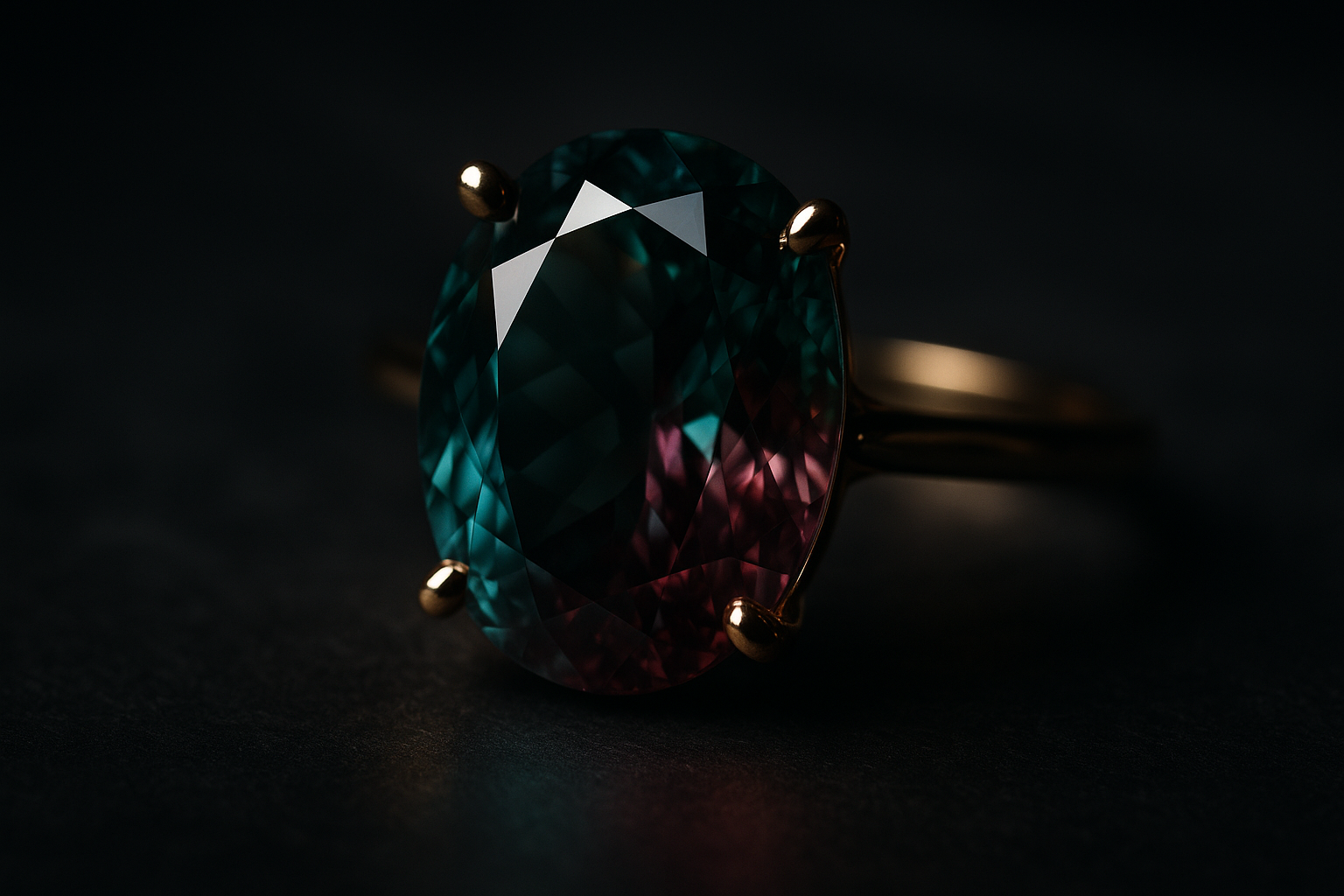
I watched a 2.17-carat Russian alexandrite sell at Christie's Geneva in 2014 for CHF 185,000 per carat. The buyer was a Russian collector I know by reputation — he'd been waiting three years for that specific stone. He didn't blink. He didn't negotiate. He just nodded once and the auctioneer's hammer dropped.
That's how alexandrite trades. Not like diamonds, where you can pull a Rapaport sheet and price to the dollar. It trades like rare art — when the right piece surfaces, you pay what it takes or you miss it.
I've handled maybe forty fine alexandrites in 17 years. That's not forty thousand. Forty total. The supply is that thin. And in the last five years, the buyers have gotten smarter and the prices have gotten very, very serious.
What Makes Alexandrite Worth More Than Most Diamonds?
Simple math. Alexandrite forms only where beryllium and chromium meet — a geological accident that requires two incompatible elements to crystallize together. Beryllium comes from granitic pegmatites. Chromium comes from ultramafic host rock. They almost never cooperate.
Add to that the color-change mechanism — chromium ions absorbing light differently under daylight versus incandescent sources — and you're asking nature to thread a needle that's already microscopic.
The Ural Mountains in Russia produced the only truly fine material from the 1830s until deposits opened in Brazil in the 1980s. Russian alexandrite shows the purest green-to-red shift. Brazilian material tends toward blue-green to purplish-red. Sri Lankan stones often lean yellowish-green to brownish-red. Indian alexandrite exists but rarely hits the color-change threshold that defines the species.
Here's what moves the price needle, in order:
-
Quality of color change. The percentage shift matters more than saturation. A 95% green-to-95% red stone — what dealers call a "traffic light" shift — commands triple what an 80% shift stone brings. I've seen stones graded at 70% change that barely feel like alexandrite at all.
-
Origin. Russian material carries a 2–3x premium over equivalent Brazilian. A one-carat Russian alexandrite with strong change will run $70,000–$100,000. The same carat weight from Brazil with strong change? $25,000–$40,000. The origin premium isn't sentiment — Russian stones consistently deliver the purest green and red hues. Buyers pay for that color fidelity.
-
Clarity. Most alexandrite is included. An eye-clean stone over one carat is rare. Loupe-clean over one carat is a unicorn. I reject 90% of what sellers offer me because the inclusions kill the color transmission. A cloudy alexandrite is just an expensive gray-brown pebble.
-
Carat weight. Every half-carat beyond one carat roughly doubles the per-carat price, not the total price. A 1.50-carat Russian stone doesn't cost 50% more than a one-carat — it costs 2–3x more per carat. The curve is exponential.
What Should You Actually Look for When Buying Alexandrite?
I'll tell you what I tell every client who walks into my office on 47th Street asking about alexandrite.
First, the lab report. For colored stones including alexandrite, the labs that matter are SSEF and Gübelin in Switzerland, and AGL in New York. GIA is the reference for diamonds — not for colored stone origin or treatment determination. If someone shows you a GIA report on an alexandrite and leans on it for origin verification, walk. SSEF and Gübelin are the gold standard; AGL is excellent domestically.
Second, demand to see the color change yourself. Not in a video. Not in a photo. In your hand, under two light sources. A proper color-change alexandrite looks distinctly green in daylight or fluorescent and distinctly red, purplish-red, or raspberry under incandescent or candlelight. If you have to squint to see it, it's not worth buying.
Third, check for windowing. Alexandrite is often cut to maximize weight rather than optical performance. Tilt the stone — if the center goes clear or pale while the edges hold color, the cutter left a window. That's weight you shouldn't be paying for. A well-cut alexandrite holds color across the face at any angle.
Fourth, ask about treatments. Natural alexandrite is almost never treated — the chromium color-change mechanism doesn't respond to heat. But synthetic alexandrite has existed since the 1970s and flux-grown material can fool a casual eye. Always buy with a lab report from SSEF, Gübelin, or AGL confirming natural origin.
Where Are the Top Alexandrites Coming From in 2026?
Russia remains the benchmark but new Russian material is virtually nonexistent on the market. Most Russian alexandrite trading today is secondary-market — stones that surfaced decades ago, recirculating through private sales and estates.
Brazil is the current primary source, with the Hematita and Novo Cruzeiro regions producing the best material. Sri Lanka contributes a steady trickle — generally smaller stones with softer color change. Tanzania and Madagascar have produced occasional finds, but nothing consistent enough to build inventory around.
What's interesting right now is where the demand is coming from. Five years ago, alexandrite buyers were overwhelmingly Russian and European collectors. Today I'm fielding calls from Southeast Asian buyers — Singapore, Thailand, Vietnam — who've done their homework and are competing aggressively for stones over two carats. The buyer pool has globalized and the supply hasn't expanded to match.
I recently sold a 0.87-carat Brazilian alexandrite with 85% color change and an AGL report for $18,500 per carat. The client had been shopping for six months. He'd seen eight stones before that one. He bought it in 15 minutes because he finally understood what a good one looked like.
That's the market in 2026. Slow to find. Fast to sell.
Frequently Asked Questions
Is alexandrite a good investment?
I don't sell alexandrite as an investment — I sell it as an extraordinary gemstone. But the numbers speak: fine Russian alexandrite has appreciated roughly 8–12% annually over the last decade, with top pieces doing better. The supply story is genuinely constrained — no new Russian production, limited Brazilian output — and the demand curve is widening. That combination tends to produce upward price pressure. Buy it because you love it. If it appreciates, that's the bonus.
How do I know if my alexandrite is real or synthetic?
Synthetic alexandrite has been lab-grown since the 1970s, and modern flux-grown material can look convincingly natural. The only reliable way to separate natural from synthetic is a laboratory report from SSEF, Gübelin, or AGL. They examine growth patterns, inclusions, and trace-element chemistry that no loupe or handheld tester can resolve. If the stone came without a report from one of those three labs, budget the $300–$600 to get it checked before you make any assumptions about its value.
Why are some alexandrites $5,000 per carat and others $70,000?
Color change. A stone with 50% color shift and muddy brownish undertones is alexandrite on a report but not alexandrite that anyone serious wants to own. A stone with 90%+ shift, vivid green in daylight and true red under incandescent — that's the material collectors chase. Add Russian origin and eye-clean clarity above one carat, and you're in six-figure-per-carat territory. The cheap stuff exists — it just isn't the same gem.
Written by Lawrence Paul
Lawrence Paul is a fine jewelry dealer based in New York's Diamond District with over 20 years of experience buying and selling signed vintage and estate jewelry. He is President of Spectra Fine Jewelry at 44 West 47th Street, Suite GF1, New York, NY 10036.
Continue Reading
Get the Collector's Newsletter
Join collectors who get authentication tips, market insights, and new guide alerts. No spam, just practical knowledge.
Need Help?
Send photos of a piece you're evaluating. We'll give you a straight read—no pressure, no BS.
Contact Spectra Fine Jewelry →Ready to Browse Authenticated Pieces?
Every item at Spectra Fine Jewelry goes through our verification process before it hits the case. No guesswork. No surprises.