Argyle Pink Diamonds: Tender Stones, Inscribed Stones, and How Provenance Determines Value
Published: May 16, 2026
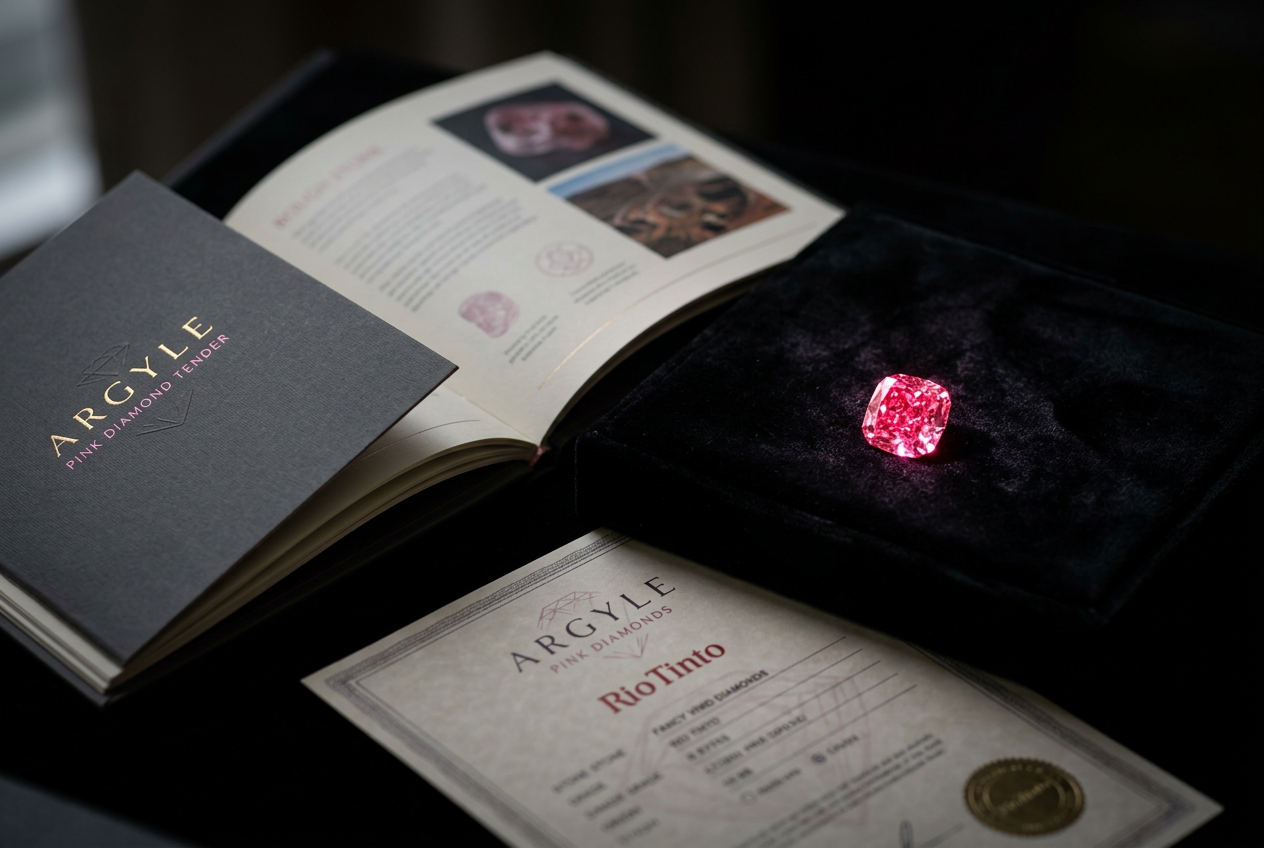
The short answer: Not all Argyle pink diamonds are equal — the provenance hierarchy matters enormously. Tender stones (the annual top 50–70 lots offered by sealed bid) command the highest premiums. Inscribed stones (girdle laser-engraved post-2005) are next. Original-certificate non-inscribed stones follow. Undocumented "known Argyle" attribution sits at the bottom. Each tier trades at a different price, and knowing which you have is the entire ballgame.
The Argyle mine closed November 3, 2020. There is no new supply. Every pink diamond from Argyle that will ever exist already exists — pulled from the ground, cut, and in someone's collection, safe, or safety deposit box. The question now is entirely about documentation: what you have, what proves it, and how provenance translates to dollar value.
I've handled Argyle material across all four tiers of the provenance hierarchy. Here's how the market actually prices each one.
What is an Argyle tender stone and why does it matter?
The Argyle Pink Diamond Tender was an annual invitation-only sale held by Rio Tinto. Each year, Argyle's production team hand-selected the 50–70 finest pink, red, and violet diamonds from that year's mine output. These weren't the largest stones — they were the finest color stones. The selection criteria prioritized color saturation above all else.
Invited bidders — typically the world's top pink diamond dealers, a select group of collectors, and occasionally major jewelry houses — received a viewing package with each stone's specifications, a tender booklet (which is now itself a collectible document), and submitted sealed bids for individual lots. Winning bidders received their stones along with a Tender Certificate: a formal document issued by Rio Tinto identifying the stone by lot number, carat weight, shape, color grade, and tender year.
Tender stones carry the maximum Argyle premium — typically 80–120% above a GIA-graded equivalent pink diamond without Argyle documentation. Why? Three reasons. First, these were handpicked from the mine's best annual production. Second, the documentation chain is airtight — Rio Tinto's own records tie the stone to a specific tender lot. Third, the tender booklets and certificates have become primary historical documents as the mine recedes into history. Owning a tender stone is owning a piece of Argyle's legacy, and that cultural value is real and appreciating.
What are Argyle-inscribed stones?
Beginning around 2005, Argyle began laser-inscribing a selection of their diamonds with "ARGYLE" on the girdle — visible under 10x magnification. This wasn't done to all commercial production; it applied to stones above a certain quality threshold that Rio Tinto wanted to certify as authentic Argyle origin.
The inscription is verifiable. Under a standard loupe at 10x, the inscription is clearly readable on the girdle facet. It doesn't affect the stone's weight, color, or optical properties. An inscribed Argyle pink trades at a meaningful premium — typically 50–80% above undocumented equivalent material — because the origin verification requires nothing more than a loupe.
Important clarification: inscription doesn't mean tender grade. Many tender stones were inscribed, but not all inscribed stones went through the tender. The inscription confirms Argyle origin. The tender certificate confirms both Argyle origin and selection as one of the mine's finest annual production. If you have both — an inscribed stone with its original tender certificate — you have the most documented Argyle pink possible outside of a museum.
A note on what's not sufficient: a GIA report stating "Australia" as origin does not establish Argyle provenance. Argyle was not the only Australian diamond mine. The Merlin mine in the Northern Territory and the Ellendale mine in Western Australia also produced diamonds. "Australia" on a GIA origin call could mean Argyle or it could mean something else entirely. For the Argyle premium, you need Argyle-specific documentation.
What about non-inscribed Argyle with original certificate?
Some Argyle diamonds — particularly pre-2005 stones that predate the inscription program — exist with original Rio Tinto / Argyle Pink Diamonds documentation but without girdle inscription. These are the "Certificate of Authenticity" pieces: Rio Tinto issued certificates with the stone's specifications, the Argyle logo, and a unique identification number.
These trade at a real premium — typically 40–60% above undocumented material for equivalent color and size. The certificate is the documentation. The chain of custody matters here: a certificate accompanied by records showing the stone has been in one collection since original purchase is worth more than a certificate where the stone has changed hands multiple times with gaps in the paper trail. Sophisticated buyers will ask for purchase records.
Condition of the documentation matters. An original Argyle certificate in pristine condition with a matching tender booklet and correspondence from the period is genuinely valuable paper. A photocopy of a certificate, even a perfect one, isn't the same thing.
How do dealers appraise undocumented "known Argyle" material?
This is the hardest tier to value. "Known Argyle" attribution — a dealer saying "I bought this from the Argyle network, it's Australian, it's almost certainly Argyle" — is a trade conversation, not a documented claim. Some of it is legitimate: pink diamonds that were distributed through Argyle's commercial network without tender documentation, sold in the 1990s or early 2000s before the inscription program, and now in collections without original papers.
These stones trade on their GIA grading (color, clarity, carat weight, cut) plus whatever premium the trade believes in. A 1ct Fancy Vivid Pink without documentation from a reputable dealer with a credible purchase history might trade at 20–30% above a comparable non-Argyle pink. The same stone from an unknown seller with a verbal "trust me, it's Argyle" gets zero premium.
My practice: I won't pay an Argyle premium for undocumented material. I'll price it on the GIA grade alone and if the seller wants more, they need to provide documentation I can verify. That's the right policy for any serious buyer.
Frequently Asked Questions
What is an Argyle tender stone exactly?
An Argyle tender stone is a pink, red, or violet diamond hand-selected by Rio Tinto's team for the annual Argyle Pink Diamond Tender — an invitation-only sale held each year until the mine's closure in 2020. Between 50 and 70 stones were selected annually from the mine's production based on exceptional color quality. Winning bidders at the sealed-bid tender received their stones accompanied by an official Tender Certificate issued by Rio Tinto identifying the stone's lot number, carat weight, shape, color grade, and tender year. This documentation chain — from mine production through tender selection to winning bidder — is the most complete provenance record possible for an Argyle pink and drives the highest premiums in the market. Tender stones from the final years of the mine (2018–2020) are particularly sought after as the last of their kind.
How do I know if my Argyle diamond is inscribed?
Examine the girdle — the narrow band around the diamond's circumference — under a 10x loupe or jeweler's loupe. If the diamond is Argyle-inscribed, you'll see "ARGYLE" engraved in the girdle facet, typically in small but clearly readable lettering. The inscription is laser-applied and permanent; it cannot be polished off without significantly reducing the stone's weight. If you can't read it yourself, any jeweler with a standard loupe can check in thirty seconds. You can also ask the dealer or auction house you purchased from — reputable sources will have this documented in their records. If the stone came with original Argyle papers, the certificate should note whether inscription was applied. Inscription was not applied to every Argyle commercial-grade stone, primarily to higher-quality production from approximately 2005 onward.
Can a pink diamond be verified as Argyle without original papers?
Partially. An inscribed diamond can be verified as Argyle-origin through the girdle inscription alone — that's a physical mark that doesn't require paperwork. For non-inscribed stones without original documentation, there's no definitive verification method available to individual buyers. Argyle's operations have ceased and Rio Tinto no longer maintains an active verification service. Some specialist pink diamond dealers — particularly those who were authorized Argyle partners during the mine's operation — retain records and knowledge that can support or dispute attribution claims. A few auction houses with deep Argyle expertise can make informed assessments on undocumented stones. But "verified without papers" is not the same as documented provenance, and the price should reflect the difference. If you're being asked to pay a premium for undocumented "Argyle" material, walk away unless the seller is one of the handful of firms with genuine institutional knowledge and a reputation to protect.
Written by Lawrence Paul
Lawrence Paul is a fine jewelry dealer based in New York's Diamond District with over 20 years of experience buying and selling signed vintage and estate jewelry. He is President of Spectra Fine Jewelry at 44 West 47th Street, Suite GF1, New York, NY 10036.
Continue Reading
Get the Collector's Newsletter
Join collectors who get authentication tips, market insights, and new guide alerts. No spam, just practical knowledge.
Need Help?
Send photos of a piece you're evaluating. We'll give you a straight read—no pressure, no BS.
Contact Spectra Fine Jewelry →Ready to Browse Authenticated Pieces?
Every item at Spectra Fine Jewelry goes through our verification process before it hits the case. No guesswork. No surprises.