British Hallmarks Explained: Date Letters, Assay Offices, and What They Mean
Published: January 19, 2026
British hallmarks are the gold standard for precious metal verification—literally. The UK hallmarking system dates back to 1300, making it one of the oldest consumer protection schemes in the world. When you see proper British hallmarks on a piece, you're looking at independent verification with centuries of documentation behind it.
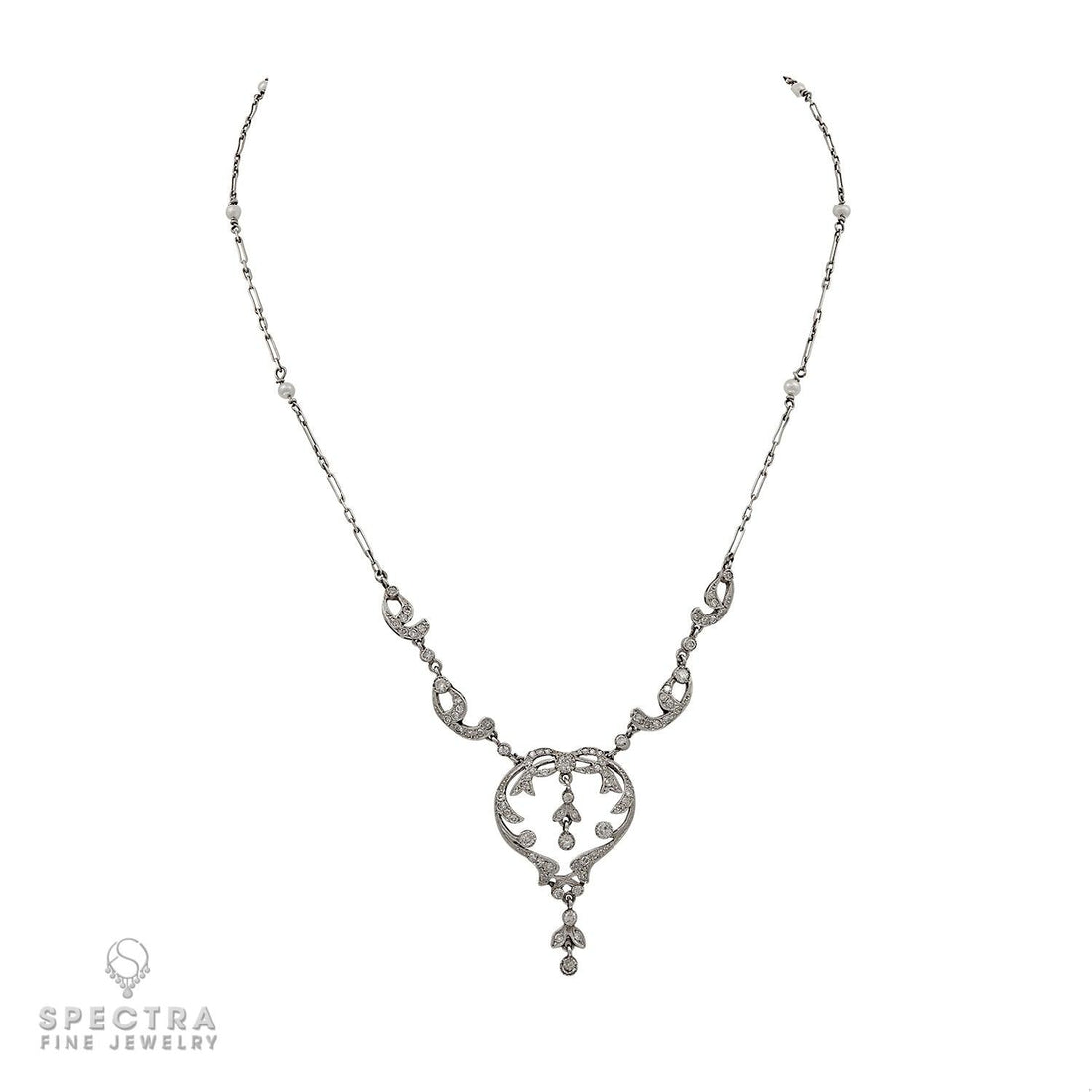 Antique Edwardian era diamond and pearl necklace—British pieces from this period carry hallmarks that can date them to a specific year
If you collect vintage or antique jewelry, understanding British hallmarks opens up a world of information. Here's how to read them.
Why British Hallmarks Matter
Unlike many countries where manufacturers self-declare metal content, British hallmarks are applied by independent assay offices after testing. The assay office has no stake in the piece—they test the metal and stamp it only if it passes.
What this means:
- British hallmarks are independent verification of metal content
- The system is legally enforced
- Records exist going back centuries
- Date letters allow precise dating of pieces
For collectors, this is excellent. You can often date a British piece to a specific year based on hallmarks alone.
The Complete British Hallmark
A full British hallmark (called a "hallmark stack") includes multiple marks:
- Sponsor's Mark (who submitted the piece for testing)
- Standard Mark (what metal and purity)
- Assay Office Mark (which office tested it)
- Date Letter (when it was hallmarked)
Modern pieces may also include the Common Control Mark (CCM) for international recognition.
Sponsor's Mark (Maker's Mark)
The sponsor's mark identifies who submitted the piece for hallmarking. This is typically the manufacturer, but could also be an importer or retailer who takes responsibility.
Format:
- Usually initials in a distinctive shape/shield
- Shape was mandated at different periods
- Modern marks are registered with the assay office
What it tells you:
- Who made or sponsored the piece
- Can be researched in maker's mark registers
- Not the same as a retail brand name (though brands have sponsor's marks)
Example: Cartier London has registered sponsor's marks. A piece from Cartier London would show Cartier's sponsor mark alongside British hallmarks.
Standard Mark (Fineness)
The standard mark tells you what metal and purity.
Gold Standards
22 carat (916 fineness) Symbol: Crown + 22 (England) or thistle + 22 (Scotland) 916 parts per thousand gold
18 carat (750 fineness) Symbol: Crown + 18 / 750 750 parts per thousand gold Most common for fine jewelry
14 carat (585 fineness) Symbol: 585 585 parts per thousand gold Less traditional in UK
9 carat (375 fineness) Symbol: Crown + 9 / 375 375 parts per thousand gold Common in UK commercial jewelry
Need help converting between fineness marks and karat values? Our precious metals converter does the math for you.
Silver Standards
Sterling Silver (925) Symbol: Lion passant (walking lion facing left) 925 parts per thousand silver Most common silver standard
Britannia Silver (958) Symbol: Figure of Britannia 958 parts per thousand silver Higher purity than sterling
Platinum
950 Platinum Symbol: Orb (ball and cross) 950 parts per thousand platinum
850 Platinum Symbol: Orb with 850 850 parts per thousand platinum
Palladium
950 Palladium Symbol: Special palladium mark 500/950 parts per thousand
Assay Office Marks
Four assay offices currently operate in the UK:
London
Symbol: Leopard's Head
  /@\
 / @ \    ← Crowned leopard head (historical)
 \___/       Uncrowned leopard head (modern)
- Oldest assay office (1300)
- Most common mark on London-made jewelry
- Crown removed from mark in 1821
Birmingham
Symbol: Anchor
   |
  \|/     ← Anchor
   |
   |
- Established 1773
- Major jewelry production center
- Handles large volume
Sheffield
Symbol: Rose (Yorkshire Rose)
  @@@
 @@@@@    ← Stylized rose
  @@@
- Established 1773
- Originally silver and gold
- Full precious metals now
Edinburgh
Symbol: Castle
 __|__
|     |   ← Castle towers
|__|__|
- Scottish assay office
- Established 1457
- Handles Scottish pieces
Historical offices (no longer operating but marks found on antique pieces):
- Chester (closed 1962) - three wheat sheaves
- Glasgow (closed 1964) - tree, fish, bell
- Dublin - harp (technically Irish, not UK)
- Newcastle (closed 1884) - three castles
Date Letters: Dating Your Piece
Date letters are the most useful hallmark feature for collectors. Each assay office uses letters (A-Z, typically) that change annually, allowing pieces to be dated to a specific year.
How it works:
- Each year gets a different letter
- The letter style/font changes each cycle
- The shield shape changes each cycle
- Combining letter + font + shield = specific year
Practical example: A London hallmark with lowercase gothic "a" in a shaped shield might be 1896. The same "a" in a different shield shape might be 1936.
Resources: Date letter tables are published by assay offices and in reference books. You need to:
- Identify the assay office
- Find the date letter table for that office
- Match the letter style and shield shape
Online resources: All UK assay offices publish their date letter charts online. Free reference.
Reading a Complete Hallmark Stack
Here's how marks appear on a piece:
┌─────────────────────────────────┐
│                                 │
│  [JW]  [750]  [Anchor]  [k]    │
│                                 │
│  Sponsor  Gold  Birmingham Year │
│                                 │
└─────────────────────────────────┘
Reading this:
- JW = Sponsor/maker (registered with assay office)
- 750 = 18 carat gold
- Anchor = Birmingham assay office
- k = Date letter (year depends on style)
Partial and Worn Hallmarks
On vintage and antique pieces, hallmarks may be:
Partial: Some marks visible, others worn away or removed by polishing/repairs.
Worn: Clear marks that have become shallow and hard to read.
Obscured: Located in hard-to-see areas or covered by later additions.
Missing a date letter: Some modern pieces don't include date letters (it's not always mandatory).
What to do:
- Use magnification (loupe essential)
- Good lighting at various angles
- Compare to reference images
- If marks are too worn, focus on other authentication factors
Import Hallmarks
Pieces imported into the UK for sale receive special import hallmarks:
Pre-1999:
- Different assay office symbols for imports
- Fineness marks may differ from domestic
Post-1999:
- Common Control Mark (CCM) accepted
- Standardized international marks recognized
What to look for: A piece with French eagle head marks AND British hallmarks likely entered the UK through proper channels and was tested again.
When Hallmarks Are Absent
Small items exemption: Very small pieces (below weight thresholds) may be exempt from hallmarking.
Antique pieces: Very old pieces may pre-date systematic hallmarking.
Foreign pieces never sold in UK: Pieces made for other markets weren't hallmarked in the UK.
Altered pieces: Repairs, resizing, or modifications may remove or damage hallmarks.
Fakes and frauds: Obviously, illegitimate pieces won't have proper hallmarks.
Spotting Fake British Hallmarks
Counterfeiters sometimes fake British hallmarks. Look for:
Poor quality impressions: Real hallmarks are crisp and clear. Fakes often look mushy or poorly defined.
Wrong combinations: A London leopard head with Birmingham date letters makes no sense.
Anachronistic marks: A "Victorian" piece with modern-style marks.
Missing components: Legitimate hallmarks appear as complete sets, not isolated marks.
Wrong placement: Marks should appear in logical locations for the piece type.
Using Hallmarks for Authentication
British hallmarks help authentication by establishing:
Metal content: Independently verified gold/silver/platinum purity.
Age: Date letters pin down when the piece was marked.
Origin: Assay office tells you where it was submitted for testing.
Maker identity: Sponsor's mark can be researched.
These don't prove:
- That the piece is by a specific brand (unless sponsor's mark is that brand's)
- That all parts are original
- Current condition or quality
- Market value
British hallmarks are one part of the authentication puzzle. For a complete framework, see our authentication guide.
Reference: Key Symbols
| Symbol | Meaning |
|---|---|
| Lion passant | Sterling silver (925) |
| Britannia figure | Britannia silver (958) |
| Crown + 18/750 | 18ct gold |
| Crown + 9/375 | 9ct gold |
| Orb | Platinum |
| Leopard head | London assay |
| Anchor | Birmingham assay |
| Rose | Sheffield assay |
| Castle | Edinburgh assay |
Resources for Further Study
Assay office websites:
- London: assayofficelondon.co.uk
- Birmingham: theassayoffice.com
- Sheffield: assayoffice.co.uk
- Edinburgh: edinburghassayoffice.co.uk
Reference books:
- Bradbury's Book of Hallmarks
- Jackson's Hallmarks
Online databases:
- Assay office websites include searchable date letter charts
- Maker's mark databases (varying completeness)
Practical Takeaway
British hallmarks are among the most useful authentication tools available:
- Look for the complete stack (sponsor, standard, assay office, date)
- Use date letters to establish age
- Verify marks are consistent (right office, right era, right style)
- Research sponsor's marks if the maker matters
- Remember what hallmarks prove and don't prove
For hallmarks from other countries, see our comprehensive hallmarks guide covering French, Italian, and American marks as well.
When you see proper British hallmarks on a piece, you have independent verification that the metal is what it claims to be. That's valuable—and it's why the British system has been copied worldwide.
Need Help Interpreting Hallmarks?
Send photos. We'll help identify what you're looking at.
Independent educational resource. Information references UK assay office documentation and standard numismatic references.
Continue Reading
Get the Collector's Newsletter
Join collectors who get authentication tips, market insights, and new guide alerts. No spam, just practical knowledge.
Need Help?
Send photos of a piece you're evaluating. We'll give you a straight read—no pressure, no BS.
Contact Spectra Fine Jewelry →Ready to Browse Authenticated Pieces?
Every item at Spectra Fine Jewelry goes through our verification process before it hits the case. No guesswork. No surprises.