Ceylon Sapphires vs. Kashmir Sapphires: Price Difference Explained
Published: June 19, 2026
The short answer: A top-tier unheated Kashmir sapphire commands $50,000–$150,000+ per carat at auction. An equivalent-quality unheated Ceylon sapphire runs $5,000–$20,000 per carat. That's a 5–15x premium for Kashmir origin — and it's held for thirty years without budging.
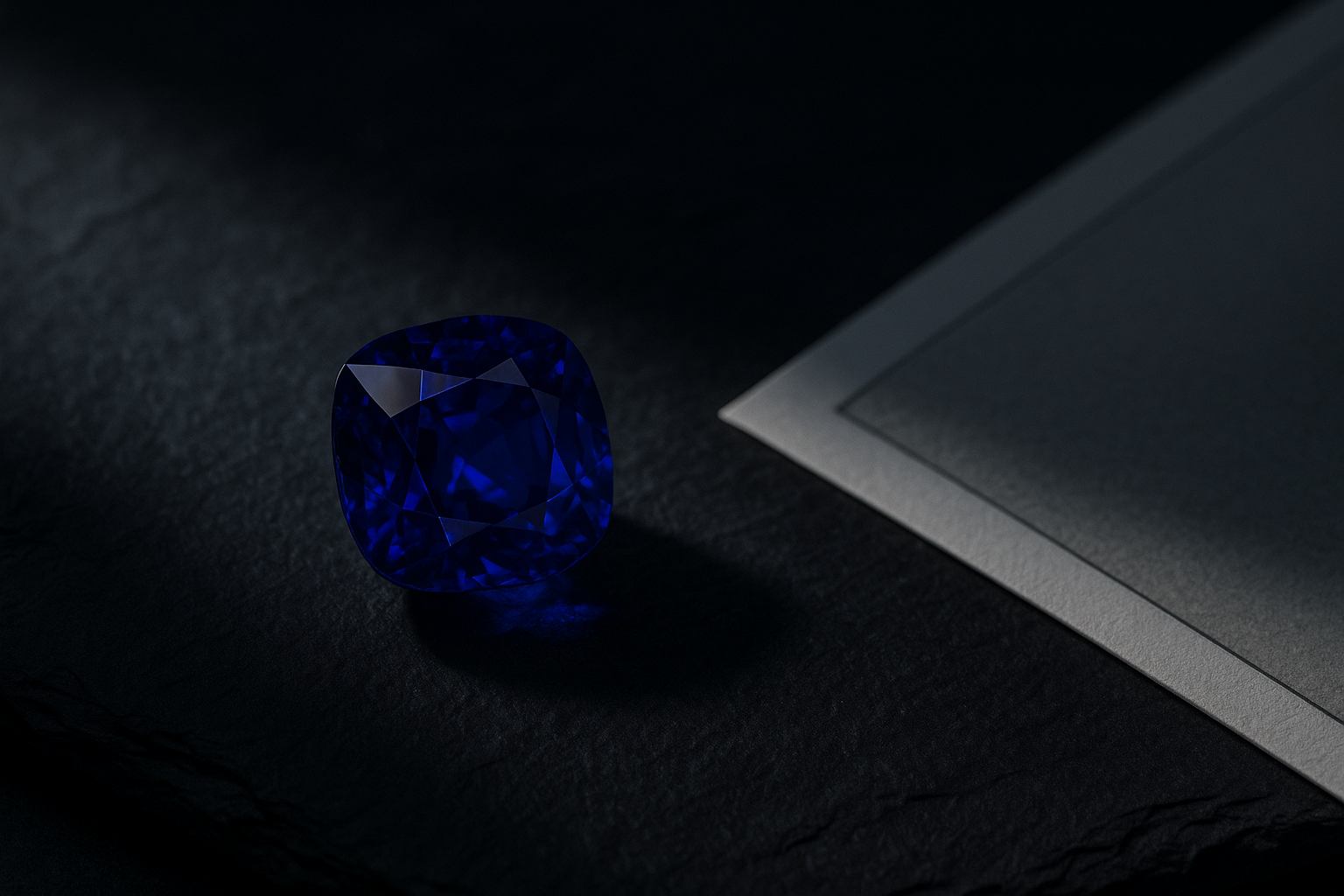
I've handled maybe thirty true Kashmir sapphires in my entire career. Not "Kashmir-type," not "Kashmir-like" — stones with an SSEF or Gübelin report that reads "Kashmir" in the origin block. That number should tell you something. I've handled thousands of Ceylon sapphires.
The market draws a line between these two origins that is as wide as anything in colored stones. It's not subtle. It's not a matter of preference. It's a price chasm that separates what most serious buyers can afford from what only the top half-percent of collectors will ever own.
Here's exactly what drives the difference.
Why Are Kashmir Sapphires So Much More Expensive Than Ceylon?
The answer starts at a mine that hasn't produced a single sapphire in nearly a century.
Kashmir sapphires came from a single deposit in the northwestern Himalayas, discovered by a landslide around 1881. The mine operated for less than fifty years — and most of the serious production happened in the first decade. The Maharaja of Kashmir took control of the deposit early on, and by the 1930s, commercial output was functionally over. What exists above ground today is all there will ever be.
That's the first driver: absolute finite supply. Every Kashmir on the market is a vintage stone. Nobody is prospecting. Nobody is opening a new pit. The geology of that specific pocket — where iron and titanium interacted with the corundum under uniquely low-temperature metamorphic conditions — produced a blue that labs and dealers describe as "velvety." It's not just marketing copy. Under a microscope, Kashmir sapphires show microscopic rutile silk that scatters light in a way that softens the color without dulling it. The stone glows. A Ceylon sapphire at its best is brilliant and open. A Kashmir at its best looks lit from inside.
Supply-wise: Ceylon produces steady volume. Sri Lanka has been mining sapphires continuously for over 2,000 years. Ratnapura, Elahera — these districts still produce fine material today. Heat treatment is common and accepted. You can source an unheated 5-carat Ceylon blue with decent saturation. You cannot source a 5-carat unheated Kashmir with any regularity at all. When one surfaces at Christie's Geneva or Sotheby's New York, the room gets quiet.
What's the Actual Price Per Carat Right Now?
I'll give you real numbers, not ranges designed to cover every stone on earth.
Kashmir — unheated, strong blue, SSEF or Gübelin origin:
- 1–3 carats: $30,000–$80,000 per carat
- 3–7 carats: $60,000–$150,000 per carat
- 10+ carats: $150,000–$250,000+ per carat — and finding one at all is the real challenge
Ceylon — unheated, top blue, SSEF or Gübelin origin (no GIA for colored stone origin, that's not what GIA does):
- 1–3 carats: $3,000–$8,000 per carat
- 3–7 carats: $6,000–$15,000 per carat
- 10+ carats: $10,000–$25,000 per carat
Heated Ceylon blues drop further — figure 40–60% less than unheated at comparable color. But here's what nobody tells you: a truly electric unheated Ceylon sapphire with vivid saturation and a clean face-up can outperform an average Kashmir with sleepy color and heavy inclusions. Origin isn't magic. The stone still has to perform.
The Sri Lanka sapphire price range is wide because Ceylon produces everything from pale commercial blues to world-class stones. Kashmir's range is also wide — but the floor is simply higher because no Kashmir is a cheap stone.
What Actually Determines Ceylon vs. Kashmir Sapphire Value?
Five factors separate the trade level from the trophy level:
-
Origin confirmation. For Kashmir, an SSEF or Gübelin origin report is non-negotiable. A stone without one trades as "Kashmir-type" at a massive discount — sometimes 80% off. For Ceylon, the right labs also matter. I recommend SSEF and Gübelin for colored stone origin work. AGL is also strong. GIA is the standard for diamonds — but for colored stone origin and treatment determination, it's not the lab I'd point someone toward.
-
Heat status. Unheated is the standard at the top of both markets. For Kashmir, heating is so rare as to be almost a non-issue — most were never heated. For Ceylon, unheated commands a substantial premium, but heated stones are still highly marketable. Know what you're buying.
-
Color quality. A Ceylon sapphire with vivid, saturated royal blue and no gray mask can compete visually with stones priced 5x higher. The best Ceylon blues have a slightly open, brilliant look that some buyers genuinely prefer over the sleepy velvet of Kashmir. I've seen collectors pass on a $400,000 Kashmir for a $40,000 Ceylon because they liked how the Ceylon looked on the hand better. That happens.
-
Size. Kashmir sapphires over 5 carats are legitimately rare. Over 10 carats is a museum-level event. Ceylon produces large stones regularly — 20, 30, 50 carats exist in the market. At those sizes, even a mid-grade Ceylon blue becomes important.
-
Provenance. A Kashmir from the Nizam of Hyderabad's collection? Add a zero. A Ceylon blue from a known Ratnapura pocket with documented mine-to-market history? Worth more than a generic stone with a lab report. Provenance matters more now than it did ten years ago, and that trend isn't slowing down.
Which One Should a Serious Collector Buy Right Now?
If you have the budget and the patience, buy Kashmir. There is no substitute origin. The mine is closed forever. Global wealth concentration means the pool of buyers for trophy Kashmir sapphires expands while the pool of stones does not. That math only goes one direction.
If your budget is $15,000–$50,000, buy the best unheated Ceylon sapphire you can find. Ignore the origin FOMO. A 5-carat unheated Ceylon blue with SSEF certification, vivid saturation, and a clean face-up is a serious stone that will hold value and trade easily. It's also wearable — most collectors I know are more comfortable putting a $30,000 Ceylon sapphire ring on their finger than a $400,000 Kashmir. Jewelry that stays in a safe doesn't do anyone any good.
What I would not do is buy a low-grade Kashmir just to own the name. A sleepy, heavily included Kashmir with weak color is still expensive — and it won't give you the experience you're paying for. The stone should be beautiful first. Origin is the confirmation, not the excuse.
I'd rather own a top Ceylon than a bottom Kashmir. Most dealers I respect would say the same thing.
Frequently Asked Questions
Is a Ceylon sapphire a good investment compared to a Kashmir sapphire?
A top-quality unheated Ceylon sapphire is an excellent store of value — but it's not the same investment class as Kashmir. Kashmir sapphires have appreciated reliably for 30+ years because the supply is permanently capped and demand is global. Ceylon sapphires are more liquid, more wearable, and more accessible, but they don't carry the same scarcity premium. Think of it this way: a great Ceylon sapphire is like a blue-chip stock. A great Kashmir is like a rare painting. Both can grow your money, but only one is a trophy asset that the world's wealthiest collectors compete for. Buy Ceylon for beauty and durability. Buy Kashmir if you're building a collection at the institutional level.
Why does a Kashmir sapphire's origin command such a high Ceylon vs Kashmir sapphire value premium?
It's the intersection of geology and market mechanics. Kashmir produced sapphires with a specific microscopic structure — fine rutile silk that creates that velvety glow — from a single pocket mined out by the 1930s. No other deposit replicates it exactly. Meanwhile, the number of serious collectors globally has grown exponentially, particularly from China, the Middle East, and Southeast Asia. Fixed supply meeting expanding demand is the simplest economic story there is — and Kashmir sapphires are a textbook case. When one appears at auction, there are always more qualified bidders than stones.
Does GIA certify Kashmir sapphire origin?
GIA does issue origin opinions on colored stones, but here's where you need to be precise: for sapphires, rubies, emeralds, and other colored gems, the Swiss labs — SSEF (Basel) and Gübelin (Lucerne) — are the recognized gold standard for origin determination. AGL in New York is also highly respected. GIA is the undisputed authority for diamond grading, but for colored stone origin and treatment work, the market votes with its wallet — SSEF and Gübelin reports command the strongest prices and the least skepticism at auction. If I'm buying a serious Kashmir or Burmese stone, I want one of those two Swiss reports in hand.
Written by Lawrence Paul
Lawrence Paul is a fine jewelry dealer based in New York's Diamond District with over 20 years of experience buying and selling signed vintage and estate jewelry. He is President of Spectra Fine Jewelry at 44 West 47th Street, Suite GF1, New York, NY 10036.
Continue Reading
Get the Collector's Newsletter
Join collectors who get authentication tips, market insights, and new guide alerts. No spam, just practical knowledge.
Need Help?
Send photos of a piece you're evaluating. We'll give you a straight read—no pressure, no BS.
Contact Spectra Fine Jewelry →Ready to Browse Authenticated Pieces?
Every item at Spectra Fine Jewelry goes through our verification process before it hits the case. No guesswork. No surprises.