Colombian Emeralds: Why Origin Matters and What "No Oil" Really Means
Published: May 16, 2026
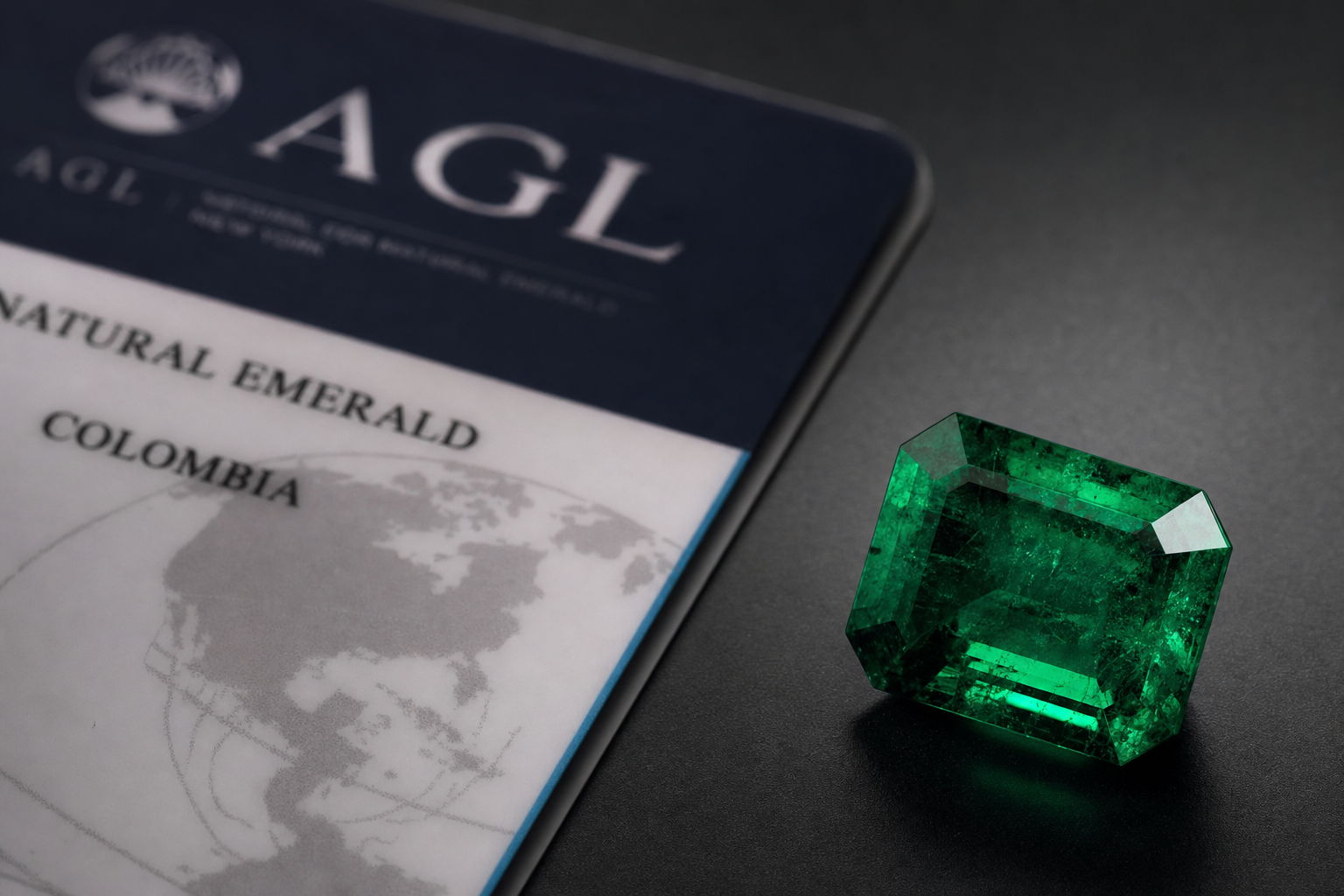
The short answer: Colombian emeralds command the highest premiums in the emerald market because of their unique "jardin" (garden) inclusion pattern and intense green color from chromium and vanadium. "No oil" on a cert means no fracture-filling treatment was detected — a designation that can triple the per-carat price over a heavily oiled equivalent stone.
Roughly 70% of the world's finest emeralds come from Colombia. That's not marketing — it's why the term "Colombian" carries such weight in the trade. I've bought Colombian emeralds from three mining districts: Muzo, Chivor, and Coscuez. Each produces a distinct stone. The differences are subtle but real, and they affect price.
Here's what I actually look for when an emerald comes across my desk, and what the certification language means in practice.
Why does Colombian origin command such a premium?
Colombian emeralds form in a hydrothermal process involving black shale host rock and saline fluids. The chromium and vanadium content produces a saturated green with a slight warmth — sometimes called "Colombian green" or "traffic light green" — that differs from Zambian emeralds (cooler, more bluish) and Brazilian emeralds (often less saturated, more yellowish).
Muzo produces the most saturated, "oily" green emeralds — deep, warm, intensely chromic. Top Muzo stones are the reference standard for Colombian emerald color. Prices for clean, unenhanced Muzo at 3ct+ start around $30,000 per carat and go north of $100,000 for exceptional stones.
Chivor produces slightly cooler, more bluish-green emeralds with a different inclusion character — three-phase inclusions (solid, liquid, and gas) that are diagnostic of the deposit. Chivor stones are prized by collectors for their distinctiveness.
Coscuez tends toward larger crystals, often more heavily fractured, historically the source for many commercial-grade stones.
AGL differentiates origin within Colombia on their reports. A "Muzo" origin call adds premium. Most reports just say "Colombia" — still valuable, but without the sub-district premium.
What does "no oil" actually mean on an emerald certificate?
This is the most misunderstood term in the colored stone market.
Emeralds grow with abundant fractures and inclusions — the trade calls it "jardin" (garden). It's normal, expected, and not a defect in the way clarity issues are in diamonds. The problem is that these fractures reach the surface, and historically the trade developed the practice of filling them with cedar oil (later synthetic resins and polymers) to improve apparent clarity.
Oiling is so universal that AGL and other labs use a graduated scale:
- None — no detectable filling. This is the top designation.
- Insignificant — minimal filling, essentially no impact on appearance.
- Minor — some filling present, minor impact.
- Moderate — meaningful filling, noticeably affects apparent clarity.
- Significant — heavily oiled, would look substantially different without treatment.
The price impact is dramatic. An unenhanced ("none") 3ct Colombian emerald with good color might sell for $25,000 per carat. The same stone with "significant" oiling might bring $8,000–$10,000 per carat. Same origin. Same size. Same color. One word on a report — a 60–70% price difference.
I've seen buyers pay "no oil" prices for "moderate" stones because they didn't understand the cert language. The disclosure is right there on the report. Reading it matters.
When should I insist on which lab for emeralds?
AGL is the standard for Colombian emeralds in the U.S. market. Their enhancement grading scale is the most detailed, their origin calls are rigorous, and their report language is precise. For anything above $15,000, I want current AGL paper.
Gübelin (Lucerne) is the European equivalent — equally rigorous, equally accepted at Christie's and Sotheby's. Some buyers specifically want Gübelin for the Swiss provenance.
SSEF does emerald work but is less focused on it than the other two. GIA does emerald origin and treatment, and their work has improved, but AGL and Gübelin have the deeper emerald reference databases.
For Zambian emeralds — excellent stones, legitimate market — Gübelin has particularly strong Zambian reference data from the Kagem mine. Either AGL or Gübelin is fine.
What should I actually pay for Colombian emeralds right now?
Current market ranges (AGL-certified, Colombian origin):
- 3ct+, none/insignificant enhancement, strong color: $20,000–$60,000/ct
- 3ct+, minor enhancement, strong color: $10,000–$20,000/ct
- 3ct+, moderate/significant enhancement: $5,000–$10,000/ct
- 1–3ct, no enhancement, good color: $8,000–$20,000/ct
- Under 1ct, no enhancement: $3,000–$8,000/ct
Zambian at comparable quality runs 40–60% of Colombian prices — not because they're inferior gems, but because the origin premium for Colombia is real and embedded in the market.
One thing I always tell buyers: don't buy an emerald for investment unless you know what you're doing. The treatment variable makes comparisons difficult, and the market is illiquid compared to rubies and sapphires. Buy emeralds because you love them and want to wear them. The right stone at a fair price, properly certified, will hold its value — but it's not a commodity.
Frequently Asked Questions
Is oiling an emerald permanent or does it need to be redone?
Cedar oil and some synthetic resins can dry out over time, especially if the emerald is exposed to ultrasonic cleaning, harsh chemicals, or extended heat (direct sunlight, hot water). When the fill dries, the fractures become more visible and the stone may look cloudier than when originally treated. This is one reason I recommend cleaning emeralds only with warm water and a soft brush — no ultrasonic, no steam. Re-oiling is possible and done by some dealers, but it's a treatment that should be disclosed on resale. If you buy an "insignificant" stone and it's ultrasonically cleaned at a jeweler, you might end up with something that looks "moderate." That's a real risk. Ask before any cleaning procedure.
Can I verify Colombian origin without a full AGL report?
Not reliably. The difference between Colombian, Zambian, and Brazilian emerald can be determined visually by an experienced gemologist who's handled thousands of stones — but visual identification is probabilistic, not definitive. Trace element analysis (laser ablation ICP-MS) is the only reliable method, and that requires lab equipment. For a $500 emerald, skip the lab work. For anything above $5,000, the $400–700 lab report pays for itself on the first negotiation. I've never had a buyer complain that I insisted on certification. I've had buyers complain after they skipped it.
Are Zambian emeralds worth buying, or should I only buy Colombian?
Zambian emeralds are excellent stones and I buy them regularly. The Kagem mine in Zambia produces emeralds with exceptional clarity — significantly cleaner than most Colombian material at comparable size — and a distinctive cool blue-green color that some buyers prefer. The "Colombian premium" is real but it's a market convention, not a quality absolute. A 5ct Zambian with Gübelin "none" enhancement and strong color at $12,000 per carat might be a better stone to wear and enjoy than a $25,000 Colombian with significant treatment. Know what you're buying, price it correctly, and don't let origin be the only variable you optimize for. I've owned Zambian emeralds I loved more than my Colombians.
Written by Lawrence Paul
Lawrence Paul is a fine jewelry dealer based in New York's Diamond District with over 20 years of experience buying and selling signed vintage and estate jewelry. He is President of Spectra Fine Jewelry at 44 West 47th Street, Suite GF1, New York, NY 10036.
Continue Reading
Get the Collector's Newsletter
Join collectors who get authentication tips, market insights, and new guide alerts. No spam, just practical knowledge.
Need Help?
Send photos of a piece you're evaluating. We'll give you a straight read—no pressure, no BS.
Contact Spectra Fine Jewelry →Ready to Browse Authenticated Pieces?
Every item at Spectra Fine Jewelry goes through our verification process before it hits the case. No guesswork. No surprises.