Fancy Color Diamonds: Pink, Blue, Orange, Red — What Actually Matters
Published: June 12, 2026
The short answer: A 1-carat Fancy Vivid Blue can trade at $1.2 million per carat while a 3-carat Fancy Yellow of the same size might fetch $9,000 per carat. Color is everything. Hue, tone, saturation — plus an iron law of rarity that makes orange and red the scarcest colors on earth.
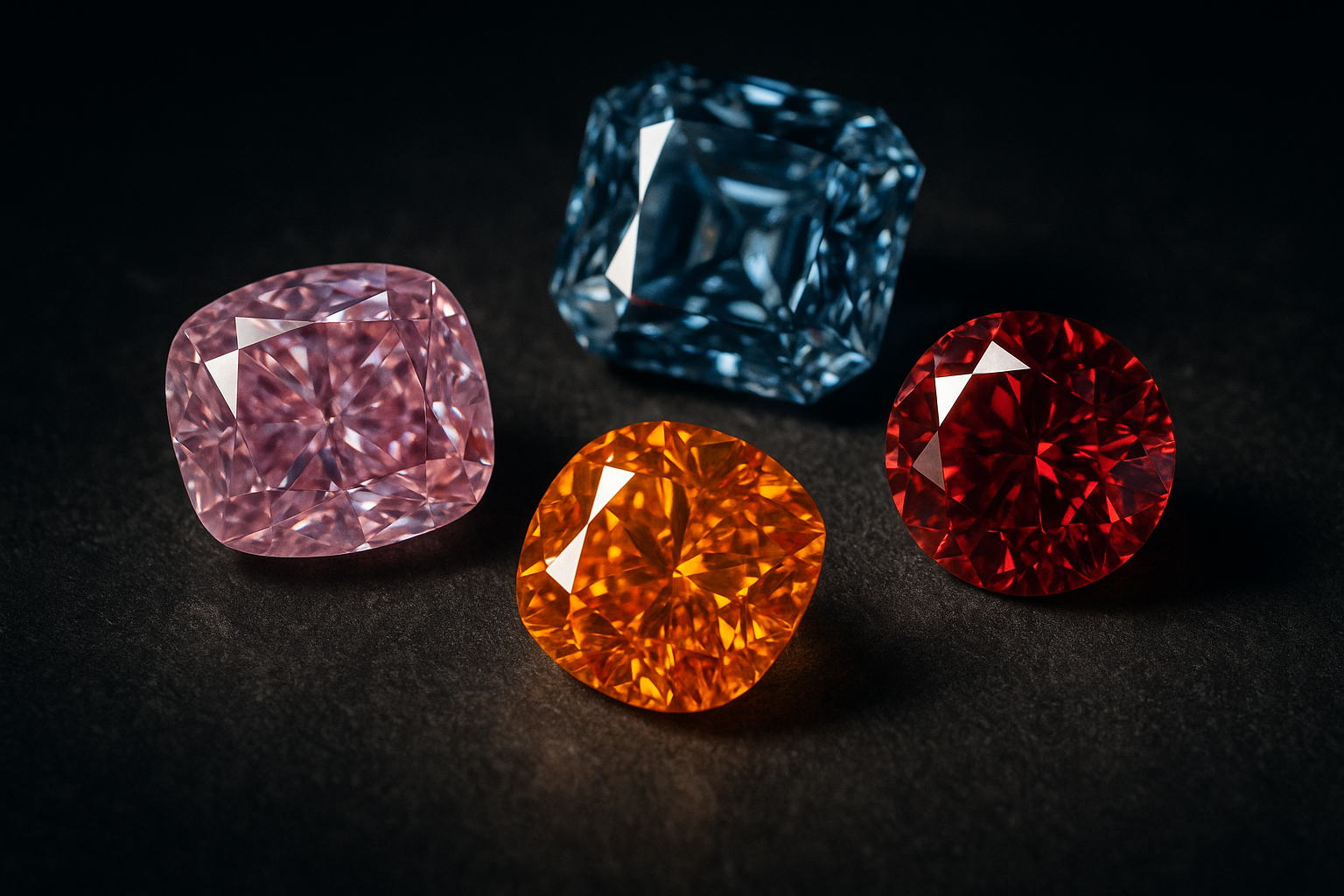
I've handled a 0.95-carat Fancy Vivid Purplish Pink Argyle at a private viewing in Geneva that stopped the room. Five dealers, three collectors, and nobody said a word for about ten seconds. That's what a truly rare fancy color diamond does — it makes professionals go quiet. I've been buying and selling these stones since 2009, and I can tell you the market for fancy color diamonds follows different rules than the white diamond trade. If you're comparing them to D-Flawless rounds, you're already lost.
The graded white diamond market is a precision instrument. Color, clarity, cut — you can chart it on Rapaport to the dollar. Fancy colors? You're dealing with objects where no two are alike, where the difference between Fancy Intense and Fancy Vivid can be a 3x multiplier, and where a stone's origin can add a zero to the price before anyone blinks. I've bought and sold enough of them to know what actually drives value — and what's just noise.
What Determines Fancy Color Diamond Value?
Three words: color, color, and color. Everything else is secondary.
A D-Flawless round sells on the absence of color. A fancy color diamond sells on the presence of it — and the market grades that presence with obsessive precision. GIA (the only lab that matters for diamond grading) evaluates fancy colors on three axes: hue (the actual color — blue, pink, orange), tone (how light or dark), and saturation (how intense that color reads to the eye).
The grading scale runs: Faint → Very Light → Light → Fancy Light → Fancy → Fancy Intense → Fancy Vivid → Fancy Deep/Fancy Dark. Each step up is a meaningful price jump. A Fancy Intense Pink and a Fancy Vivid Pink of the same carat weight aren't in the same conversation — the Vivid trades at two to three times the price. I've seen it play out in real transactions more times than I can count.
Then there's modifier colors. A "Purplish Pink" versus a "Brownish Pink" versus a pure "Pink" — that second modifier word is a six-figure difference on a 2-carat stone. Brownish or grayish modifiers crush value. Purplish or orangy modifiers, when they add depth without muddying the primary hue, can actually enhance it.
Clarity matters less than you think. In white diamonds, VS1 versus SI1 is a real conversation. In fancy color diamonds, I've seen I1-purity Argyle pinks sell for more than internally flawless yellows of the same weight. Color intensity simply overrides clarity concerns. You're buying the hue — the inclusion is secondary unless it threatens durability or transparency.
Cut is functional, not fetishized. Fancy color diamonds are rarely cut for ideal light return the way a triple-excellent round brilliant is. They're cut to maximize face-up color saturation. That often means deeper pavilions, off-kilter proportions, or shapes that concentrate color in the corners (cushions, radiants). A fancy color diamond with "ideal" cut proportions often reads lighter in color — and loses value. The stone that looks more saturated wins.
Why Are Blue Diamonds So Expensive?
Blue diamonds are expensive because boron — the trace element that makes them blue — almost doesn't exist in the earth's mantle where diamonds form. That's not marketing. That's geology.
Type IIb diamonds (the classification for boron-containing stones) represent less than 0.1% of all natural diamonds. Within that tiny slice, only a handful show enough blue to reach Fancy grade. The Cullinan mine in South Africa produced most of the world's significant blues, and that mine is well past peak production. Rio Tinto's Argyle mine — the primary source of pinks — closed in 2020. Supply is shrinking while demand, particularly from Asian and Middle Eastern collectors, keeps climbing.
A 1-carat Fancy Vivid Blue at auction runs $800,000 to $1.4 million per carat depending on the specific hue. At Christie's Geneva, I've watched a Fancy Vivid Blue cushion go for CHF 3.8 million — about $4.7 million at the time — at just over 3 carats. That's the kind of number that makes even the diamond trade stop and stare.
The 2023 sale of "The Bleu Royal" — a 17.61-carat Fancy Vivid Blue internally flawless — at Christie's Geneva for CHF 39.5 million ($44 million) set a benchmark that rippled through every dealer's office on 47th Street. But you don't need to be in that stratosphere. A Fancy Intense Blue in the 0.50 to 1.00-carat range can be had for $150,000 to $400,000 per carat, and those stones trade regularly between dealers.
Smaller blues with secondary gray modifiers (Grayish Blue, Gray-Blue) trade at significant discounts — sometimes 60 to 70% off pure blue prices. They're the entry point, and for clients who want the word "blue" on a GIA report without the seven-figure commitment, they're worth a look.
What Makes Orange Diamonds the Rarest?
Pure orange diamonds — no brown modifier, no yellow modifier, just straight orange — are rarer than pink and blue combined. In 17 years in this business, I've handled maybe a dozen genuine Fancy Vivid Orange stones. I've handled more red diamonds than oranges, and reds are the unicorns of the trade.
Most "orange" diamonds on the market carry a brown, yellow, or brownish-yellowish modifier. A pure orange — what GIA calls "Fancy Vivid Orange" with no modifying hue — is so scarce that most jewelers go an entire career without seeing one in person. The 14.82-carat "Orange" sold at Christie's Geneva in 2013 for CHF 32.6 million ($35.5 million). That's $2.4 million per carat — a number that still gets quoted across dealing desks.
The color comes from nitrogen atoms arranged in a specific way within the crystal lattice — different from the arrangement that produces yellow. This particular atomic configuration is extraordinarily rare, which means the supply of pure orange diamonds is measured in single digits per year globally.
If you're buying orange, you have to accept a trade-off. The purest oranges are almost always small — typically under 1 carat, often under 0.50 carats. Larger stones nearly always show secondary hues. A Fancy Vivid Yellowish Orange in a 2-carat range might run $150,000 to $300,000 per carat. A pure Fancy Vivid Orange of even 1 carat — if you can find one — will be a seven-figure stone.
How Should You Actually Buy a Fancy Color Diamond?
I tell every client the same thing: buy the color first, the report second, and forget about investment unless you're playing at the very top of the market.
Here's what I mean:
-
See the stone before you buy the report. GIA color grades for fancy colors involve human judgment at the end of the day. Two stones with identical Fancy Intense Pink grades can look meaningfully different in person. One pops. One doesn't. You need to know which one you're buying.
-
Modifiers are everything. A "Brownish Pink" is not a "Purplish Pink." Read the full color description on the GIA report — every word. If you can't see the stone in person, get calibrated photos and video from someone who knows how to shoot fancy colors (hint: it's harder than it looks to capture what the eye sees).
-
Size expectations differ by color. Pinks and blues in the 1–3 carat range are realistic targets for serious buyers. Pure orange and red — you're taking what the market offers, and it won't be big.
-
Argyle provenance adds a premium for pinks. An Argyle-mined pink with the Argyle certificate and laser inscription will trade 20–50% above a comparable non-Argyle pink. Is it worth it? If you're a collector — yes. If you're buying a beautiful pink to wear — maybe not.
-
Fluorescence is your friend in blues. Strong blue fluorescence in a fancy blue diamond can actually enhance the apparent color. In colorless diamonds, fluorescence sometimes gets treated like a defect. In blues, it's a feature.
If you're buying a fancy color diamond over $100,000, you should be buying from someone who owns their inventory and knows the stone personally — not a marketplace listing service. Ask your dealer: "Have you seen this stone in person?" If the answer isn't an immediate yes, walk. There are too many variables in fancy color diamond value to trust a third-party listing.
Frequently Asked Questions
What's the difference between Fancy Intense and Fancy Vivid?
Fancy Intense and Fancy Vivid are two adjacent grades on GIA's color scale for fancy color diamonds. The difference is saturation — how much pure color the eye perceives. A Fancy Vivid stone shows stronger, more concentrated color than a Fancy Intense stone of the same hue. The price jump between these two grades is substantial: on a 1-carat pink, you might pay $200,000 per carat for Fancy Intense and $500,000 to $700,000 per carat for Fancy Vivid. I've seen stones where the difference is so subtle that only the GIA report tells you which is which — and I've seen others where the Vivid screams and the Intense whispers. Always see the stone. The grade is a guide, not the final word.
Are fancy color diamonds a good investment?
The top tier — Fancy Vivid Pink, Fancy Vivid Blue, and pure orange or red diamonds over 1 carat — has appreciated steadily for two decades. Argyle pinks have outperformed most asset classes since the mine's 2020 closure. That said, the majority of fancy colored diamonds are not investment-grade. Fancy Yellow and Fancy Brown stones in commercial sizes are abundant and track closer to commodity pricing. If someone pitches you a "champagne diamond" as an investment, ask to see their buy-back offer in writing. I've been doing this since 2009: the investment-grade stuff represents maybe 5% of all fancy color diamonds that trade. Buy because you love the stone. If it appreciates, that's a bonus.
Does GIA grade fancy color diamonds differently from white diamonds?
Yes. GIA's fancy color grading is fundamentally different from the D-to-Z scale used for colorless diamonds. In a colorless diamond, you're measuring the absence of color — the closer to D (colorless), the higher the value. In a fancy color diamond, you're measuring the presence of color — hue, tone, and saturation — and more color generally means more value. GIA is the definitive lab for diamond grading across the board. For colored stones (sapphires, rubies, emeralds), the relevant labs are SSEF, Gübelin, and AGL — not GIA. But for any diamond, fancy colored or colorless, GIA is the standard. Period.
Written by Lawrence Paul
Lawrence Paul is a fine jewelry dealer based in New York's Diamond District with over 20 years of experience buying and selling signed vintage and estate jewelry. He is President of Spectra Fine Jewelry at 44 West 47th Street, Suite GF1, New York, NY 10036.
Continue Reading
Get the Collector's Newsletter
Join collectors who get authentication tips, market insights, and new guide alerts. No spam, just practical knowledge.
Need Help?
Send photos of a piece you're evaluating. We'll give you a straight read—no pressure, no BS.
Contact Spectra Fine Jewelry →Ready to Browse Authenticated Pieces?
Every item at Spectra Fine Jewelry goes through our verification process before it hits the case. No guesswork. No surprises.