GIA vs AGL vs SSEF: Which Lab Report Actually Matters for Sapphires and Rubies
Published: May 21, 2026
The short answer: For sapphires and rubies, GIA reports are nearly worthless where it counts — origin and treatment. SSEF and Gübelin are the gold standard. AGL is the best American option, especially their Prestige reports. If someone's waving a GIA report at you for a Kashmir sapphire, walk.
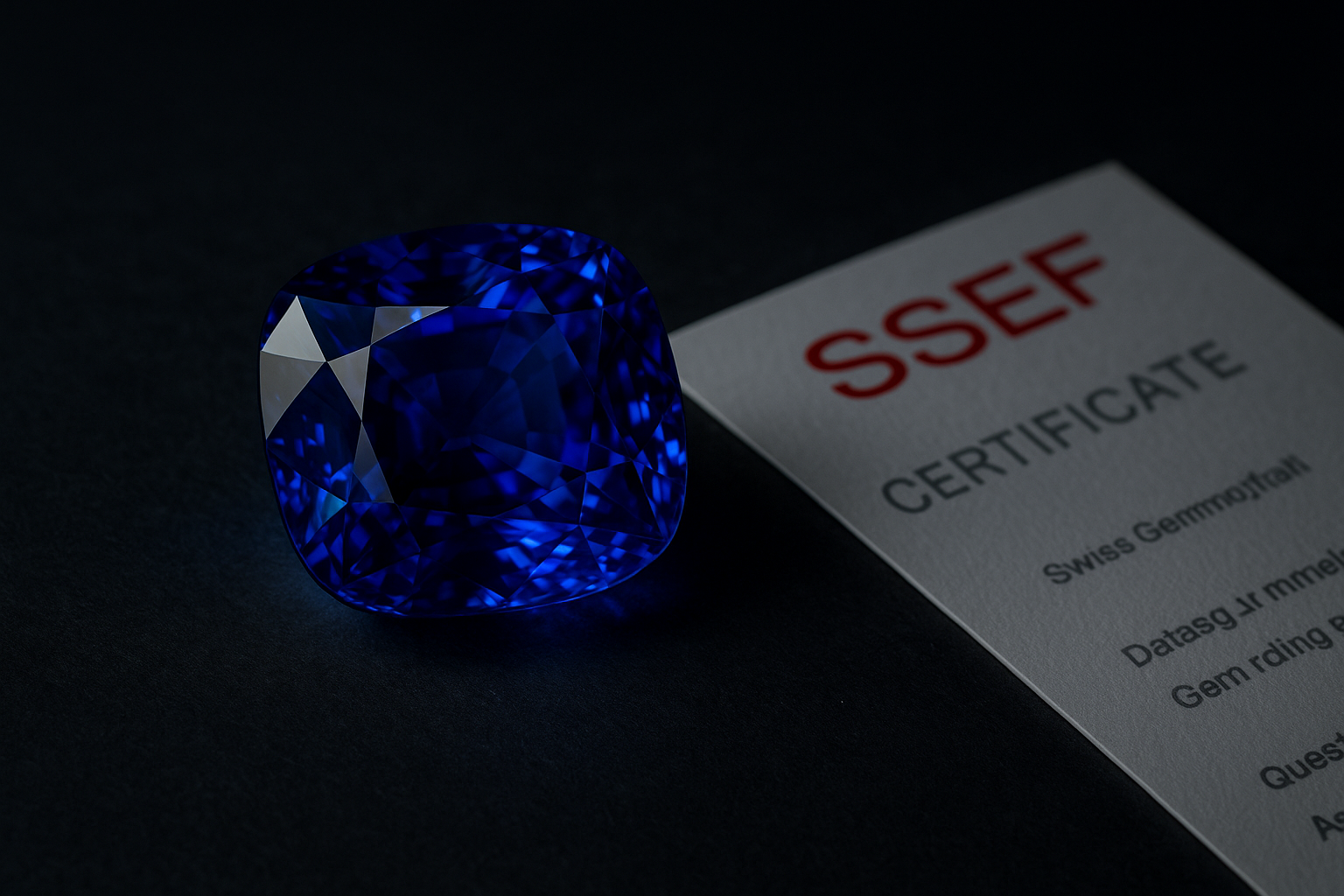
I've watched a dealer in Bangkok try to sell a glass-filled ruby with a GIA report that said "corundum" and listed heat treatment as "inconclusive." The buyer — a jeweler from London who should've known better — paid $47,000 for a stone worth maybe $1,200 on a good day.
That's not GIA's fault, exactly. It's the fault of anyone who thinks a diamond lab knows what to do with a Burmese ruby.
I buy and sell sapphires and rubies every week from my office on 47th Street. I've sat in the auction rooms at Christie's Geneva and watched an 8.09-carat Kashmir sapphire ring sell for CHF 437,000 — and I can tell you exactly which lab reports the serious bidders had in their hands. None of them were GIA.
Here's what you need to know before you spend real money.
Why doesn't GIA work for colored stones?
GIA built its reputation on diamonds. The 4Cs system, the D-to-Z color scale — all GIA. They're the diamond authority, period.
But colored stone grading is a completely different animal. With diamonds, you're looking for absence of color. With sapphires and rubies, you're evaluating presence of color, plus origin determination, plus treatment detection — and those last two are where GIA falls apart.
I've seen GIA reports on Kashmir sapphires that list origin as "undetermined" when SSEF confirmed Kashmir without hesitation. I've seen GIA miss low-temperature heat treatment on a 5.22-carat Burmese ruby that AGL caught immediately. When you're talking about a stone where origin alone can swing the value $40,000 to $400,000, "undetermined" isn't helpful — it's expensive.
GIA simply doesn't see enough high-end colored stones to build the reference collections that SSEF and Gübelin maintain in Switzerland. It's a volume problem. They're the biggest lab in the world for diamonds. For colored stones, they're playing catch-up.
What makes SSEF and Gübelin the real authorities?
Both labs are based in Switzerland — SSEF in Basel, Gübelin in Lucerne — and both have spent decades building the world's most comprehensive reference collections of gemstones from specific mines.
When SSEF says a sapphire is from Kashmir, that opinion is based on comparing your stone against thousands of documented Kashmir specimens in their collection, using chemical fingerprinting, microscopy, and spectroscopic analysis that GIA simply doesn't deploy at the same level for colored stones.
I sent a 3.18-carat unheated Burmese ruby to SSEF last year. The report came back with origin "Burma (Myanmar)," no indications of heat, and a full appendix page explaining exactly which trace element ratios and inclusion features confirmed that origin. That's the level of detail that moves a stone from "nice ruby" to "investment-grade Burmese."
Gübelin is equally rigorous and arguably even more conservative on origin calls. If they're not sure, they'll say so. That conservatism is why a Gübelin "Burma" call on a ruby carries more weight at auction than almost any other document. I've seen two otherwise identical stones — same color, same clarity, same carat weight — where the one with the Gübelin report sold for 15–20% more. The market knows the difference.
Where does AGL fit?
AGL — American Gemological Laboratories, based in New York — is the best option without sending your stone to Switzerland. Chris Smith runs the lab, and he knows colored stones as well as anyone in the world.
AGL's Prestige reports are their top-tier document. They include a full origin opinion, treatment analysis, and a detailed color grading that uses their proprietary color grading system. For a collector buying in the US market, an AGL Prestige report on a sapphire or ruby is fully acceptable — I use them regularly for stones I'm not sending overseas.
Their standard reports are more basic. Fine for insurance purposes or entry-level stones, but if you're spending over $20,000 on a colored stone, get the Prestige version. The extra $200–300 in lab fees is the cheapest insurance you'll ever buy.
One thing AGL does that the Swiss labs don't: their treatment descriptions are sometimes more granular on the exact type of filler or resin used in emerald treatments. That detail matters if you're evaluating whether a stone can be re-treated to improve appearance.
So which report should you actually get?
Here's my practical framework, built from handling hundreds of stones:
-
Spending under $15,000 on a sapphire or ruby: AGL standard report is sufficient. Don't waste money on SSEF at this level — the shipping, insurance, and lab fees will eat into your margin.
-
$15,000–$50,000: AGL Prestige report, minimum. If the stone has potential Kashmir or Burmese origin, spring for SSEF. A Kashmir origin call will multiply your value, and AGL's origin reference collection doesn't match SSEF's depth on Kashmir.
-
$50,000–$250,000: SSEF or Gübelin. Period. At this price level, a GIA report is a red flag. If I'm buying a stone in this range and the seller only has GIA, I assume they're hiding something — either the origin is wrong, the treatment is worse than described, or the stone has a synthetic coating they don't want a real lab to catch.
-
Over $250,000: Get both SSEF and Gübelin. At auction, stones in this bracket with dual Swiss reports consistently outperform those with single reports. The Christie's Magnificent Jewels sale in Geneva last November proved this again — a 12.47-carat Burmese ruby with both SSEF and Gübelin reports hammered at CHF 2.1 million against a CHF 1.2 million low estimate. The underbidder told me afterward he stopped specifically because the dual reports left zero doubt about origin.
-
Always note the report number. SSEF reports (format: 123456), Gübelin (format: 24XXXXX), and AGL (format: CS XXXXX) should all be verifiable on the lab's website. If a seller won't give you the report number before payment, that's your exit signal.
If you're buying a sapphire or ruby and someone hands you a GIA report as proof of origin, you're not looking at documentation — you're looking at a sales prop. Nice layout. Good photography. Wrong lab for the job.
Frequently Asked Questions
Can GIA identify heat treatment in sapphires and rubies? GIA can detect obvious heat treatment — high-temperature burn-in with visible telltale inclusions. Where they struggle is low-temperature heat, which is the most common treatment for fine Burmese rubies and Ceylon sapphires. I've personally cross-checked stones where GIA called "no indications of heating" and SSEF found low-temp heat residues. If the treatment question matters to the value — and at any level above $10,000, it absolutely matters — don't lean on GIA for that call. The Swiss labs use advanced spectroscopic techniques that detect trace element diffusion patterns GIA's standard colored stone protocol often misses.
Why do auction catalogs rarely show GIA reports for colored stones? Because the auction houses know what the serious bidders demand. Pick up any Christie's or Sotheby's Magnificent Jewels catalog — the Kashmir sapphires, Burmese rubies, and Colombian emeralds are accompanied by SSEF, Gübelin, or AGL reports. GIA appears almost exclusively for diamonds. This isn't snobbery. The auction specialists know that a Swiss lab report adds 10–25% to the hammer price on important colored stones. They're not going to leave that money on the table by submitting stones to the wrong lab.
Should I get a new report if a stone I'm buying only has a GIA document? Yes — before you close. Make it a condition of the sale that the stone passes SSEF or AGL Prestige at your cost. If the seller refuses, that tells you everything you need to know. I did exactly this with a 4.08-carat "unheated Burma" ruby offered to me with only a GIA report in 2023. Sent it to AGL. Came back Mozambique with high-temperature heat. The price difference: roughly $95,000. The seller disappeared. The $385 AGL fee saved me the most expensive mistake I almost made that year.
Written by Lawrence Paul
Lawrence Paul is a fine jewelry dealer based in New York's Diamond District with over 20 years of experience buying and selling signed vintage and estate jewelry. He is President of Spectra Fine Jewelry at 44 West 47th Street, Suite GF1, New York, NY 10036.
Continue Reading
Get the Collector's Newsletter
Join collectors who get authentication tips, market insights, and new guide alerts. No spam, just practical knowledge.
Need Help?
Send photos of a piece you're evaluating. We'll give you a straight read—no pressure, no BS.
Contact Spectra Fine Jewelry →Ready to Browse Authenticated Pieces?
Every item at Spectra Fine Jewelry goes through our verification process before it hits the case. No guesswork. No surprises.