GIA vs AGL vs SSEF: Which Lab Report Actually Matters for Sapphires and Rubies
Published: May 16, 2026
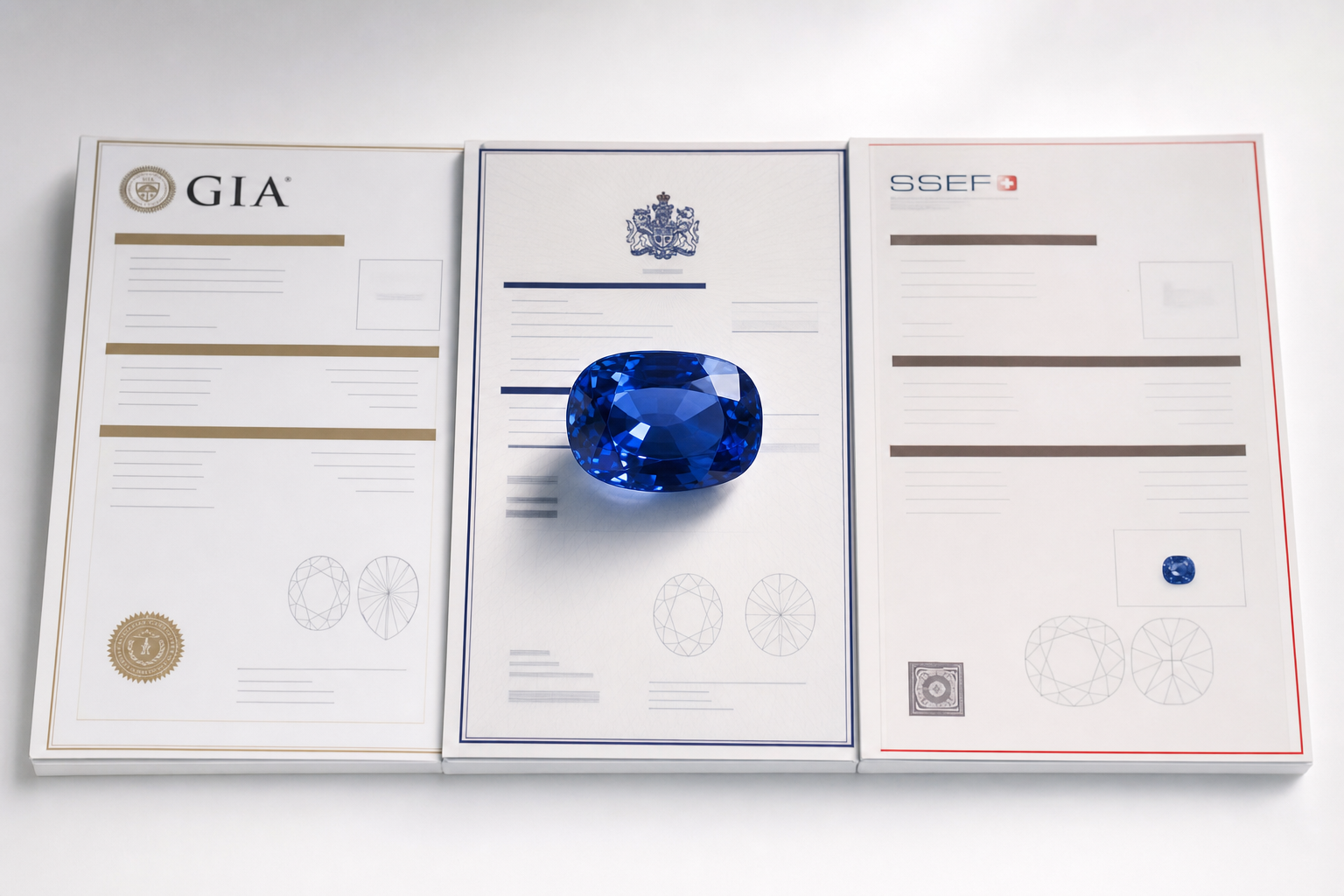
The short answer: For colored stones, SSEF and Gübelin are the gold standard — their origin determination and treatment detection are the most rigorous in the trade. AGL is the top American lab. GIA, excellent for diamonds, is third or fourth choice for sapphires and rubies because its origin call methodology has historically lagged. The report you need depends entirely on what you're buying.
A client called me last year, excited about a 4-carat "Ceylon sapphire, unheated, GIA certified." The price was $28,000. I asked her to send me a photo of the report. GIA origin call: Sri Lanka. Heat treatment: "No indications of heating." The stone looked beautiful. She was ready to wire.
I told her to get it to SSEF before she did anything.
SSEF came back two weeks later: Madagascar. Unheated, yes — that part GIA got right. But Madagascar, not Sri Lanka. At the correct origin call, the stone was worth maybe $18,000. She saved $10,000 by spending $700 on a second opinion.
That's why lab choice matters.
Why is GIA not the right lab for colored stone origin?
GIA is the best diamond grading lab in the world. Their 4C grading system is the global standard for good reason — it's consistent, rigorous, and they do it at enormous scale. For diamonds, there is no better paper.
For colored stones, the picture is more complicated. Origin determination for sapphires and rubies requires building comprehensive trace element databases from known deposits and running laser ablation ICP-MS analysis against them. It requires gemologists who specialize in corundum origin and have spent careers building institutional knowledge about the spectral fingerprints of Mogok versus Mong Hsu versus Ilakaka versus Andranondambo.
GIA entered the colored stone origin business later than SSEF and Gübelin and has spent years building their reference library. Their heating determination is generally solid. Their origin calls have improved substantially in the last decade. But when a $200,000 Kashmir sapphire is on the table, I want the lab that has been doing this since 1974 and has reference material from the Padar valley itself. That's SSEF Basel.
What do SSEF and Gübelin actually do differently?
Both Swiss labs run full spectroscopic analysis — UV-Vis, FTIR, Raman, and laser ablation ICP-MS for trace element mapping. The difference is the reference database and the institutional expertise.
SSEF (Swiss Gemmological Institute, Basel) has been building their Kashmir, Burma, and Ceylon reference databases since the 1970s. Their director Henry Hänni published foundational research on corundum origin determination. When SSEF writes "Kashmir, no indications of heating," that call is backed by decades of comparative analysis against stones with documented provenance from the Padar valley.
Gübelin (Lucerne) has comparable methodology and similarly deep archives. Their reports are slightly more formal in presentation; the trade accepts them equally to SSEF. For the highest-value stones, I often see buyers requesting both.
AGL (American Gemological Laboratories, New York) is the leading American lab for colored stones. Their origin determination is rigorous, their treatment detection is thorough, and their report language is very specific about what they found and didn't find. For anything trading in the U.S. market, AGL paper adds credibility. Some buyers prefer SSEF or Gübelin specifically for the Swiss imprimatur, but AGL is legitimate first-tier.
What does the report language actually mean?
This is where buyers get confused, and where I've seen the most expensive mistakes.
"No indications of heating" or "No heat" — the stone shows no spectroscopic evidence of heat treatment. This is not the same as "guaranteed never heated." It means the lab found no evidence. Unheated is the highest value classification.
"Indications of heating" — heat treatment detected. Value impact: significant, typically 60–70% reduction versus unheated equivalent for Burmese ruby and Kashmir sapphire.
"Indications of clarity enhancement" — the stone has been treated with oil, resin, or glass filling to improve apparent clarity. For emeralds, this is a spectrum: "no indications," "insignificant," "minor," "moderate," "significant." For rubies, glass filling is a catastrophic value killer — a glass-filled ruby is not a fine ruby.
Origin call — "Sri Lanka," "Burma (Myanmar)," "Kashmir" — this is a probabilistic determination based on trace element analysis. Not absolute. Labs say "consistent with" in their formal language. But in the trade, a SSEF call of Kashmir is treated as definitive until proven otherwise.
When should I insist on which lab?
- Kashmir sapphire over $50,000: SSEF or Gübelin, no exceptions
- Burma ruby over $30,000: AGL, SSEF, or Gübelin — GIA acceptable but I'd want a Swiss second opinion above $100k
- Colombian emerald over $20,000: AGL for origin + treatment is the standard; Gübelin also accepted
- Ceylon sapphire: AGL, SSEF, or Gübelin all fine
- Paraiba tourmaline: AGL or SSEF for copper-bearing origin call specifically
- Diamonds: GIA first, always
A GIA report on a colored stone isn't worthless — the heating determination is generally reliable and the grading is useful. But for origin calls on stones where origin drives 50–300% price premiums, I want Swiss paper or AGL. Every time.
Frequently Asked Questions
Can I get a second opinion from a different lab if I don't trust the first report?
Yes, and for high-value purchases I often recommend it. Sending a stone to both SSEF and Gübelin is common practice for Kashmir sapphires above $200,000 or Burmese rubies above $150,000. The labs occasionally disagree on origin — more often on ambiguous cases like Madagascar vs. Ceylon, or Mong Hsu vs. Mogok. When labs disagree, the more conservative call (lower-value origin) is generally what the market uses. If I'm buying and the labs disagree, I price at the lower call. If I'm selling and they disagree, I get the stone to a third lab before pricing.
How long do lab reports stay valid?
A report never expires technically, but the trade has informal standards. A report older than 10 years on a high-value stone will often prompt a buyer to request fresh testing — not because the stone changed, but because lab methodology improved and origin determination for some deposits has gotten more precise. A 2005 SSEF report calling a stone Kashmir was issued before some of the most recent spectral reference work was completed. I've seen origin calls change on re-submission — that 2005 Kashmir came back in 2023 as "consistent with Ceylon." For any transaction above $75,000, I want a report issued within the last five years.
What's the difference between a "full report" and a "brief" or "identification report"?
Labs offer tiered service. A brief or identification report confirms species, variety, and basic treatment status — useful for insurance or quick reference. A full report includes comprehensive origin determination, detailed spectroscopic analysis, and the complete treatment assessment. For colored stones where origin drives value, you need the full report. A "brief" that says "natural corundum, heated" tells you almost nothing useful. Always specify the full report when submitting, and confirm origin determination is included — it's sometimes an add-on service.
Written by Lawrence Paul
Lawrence Paul is a fine jewelry dealer based in New York's Diamond District with over 20 years of experience buying and selling signed vintage and estate jewelry. He is President of Spectra Fine Jewelry at 44 West 47th Street, Suite GF1, New York, NY 10036.
Continue Reading
Get the Collector's Newsletter
Join collectors who get authentication tips, market insights, and new guide alerts. No spam, just practical knowledge.
Need Help?
Send photos of a piece you're evaluating. We'll give you a straight read—no pressure, no BS.
Contact Spectra Fine Jewelry →Ready to Browse Authenticated Pieces?
Every item at Spectra Fine Jewelry goes through our verification process before it hits the case. No guesswork. No surprises.