Harry Winston vs. Cartier: How They Differ and What Collectors Should Know
Published: June 5, 2026
The short answer: Harry Winston is the jeweler who built a reputation on the finest diamonds in the world. Cartier is the jeweler who defined design movements for 170 years. Winston's value calculus runs stone-first — the diamond drives the price. Cartier's equation is design-first — the signature, the period, and the condition often matter more than the center stone.
I've handled a Winston 20-carat D Flawless oval ring and a Cartier Tutti Frutti bracelet in the same week. The Winston was breathtaking because of one thing: that stone. You couldn't look away from it. The Cartier was a symphony — rubies, emeralds, diamonds, sapphires all calibrated into something no single stone could achieve alone. That's the difference in one sentence. One house bets everything on the diamond. The other bets on the entire composition.
I'm on West 47th Street five days a week, and when a serious collector walks in asking about signed vintage jewelry, two names dominate the conversation. They're the heavyweights. But they play completely different games, and buying one versus the other demands different expertise.
What Makes Harry Winston Estate Jewelry Different?
Harry Winston didn't start as a designer. He started as a diamond buyer, and he was ferocious about it. By the time he was being called the "King of Diamonds," he'd owned the Hope, the Oppenheimer, and the Winston Blue — stones most jewelers only read about.
That obsession is baked into every piece that left his atelier.
A vintage Winston piece from the 1960s or 1970s almost always revolves around the center stone. The mounting exists to serve it. Platinum settings are deliberately minimal — three-prong heads, tapered baguette shoulders, nothing that competes with what he was actually selling. I've handled enough Winston estate pieces to know the pattern: the diamond gets the certificate, the diamond carries the value, and the "Winston" name is the multiplier on top of that.
When you buy a vintage Harry Winston ring at auction — say, Christie's Geneva, May 2018, Lot 327, a 3.04-carat D VVS1 Type IIa with a GIA report — you're buying the stone. The Winston signature adds 30-60% to what that diamond would trade for un-mounted. Sometimes more if it's a known collection piece.
The signature cluster design — pear-shaped and marquise diamonds gathered around a center stone, all seeming to float — that's Winston. Nobody did invisible settings before him at that level. Those clusters still show up at Sotheby's and Christie's, and they still command premiums because the diamonds in them were selected by the best diamond house that ever existed.
How Does Cartier Build Value Differently?
Cartier thinks in decades. Louis Cartier was pushing platinum over silver in the 1890s before most jewelers understood what platinum could do. The Tutti Frutti style hit in the 1920s — carved emeralds, rubies, and sapphires in Indian-inspired motifs — and a good Tutti Frutti bracelet trades for seven figures today because you can't recreate that proportion of cut and color without Cartier's workshop knowledge.
I bought a Cartier London 1960s sapphire and diamond cluster ring three years ago. GIA had the sapphire at 8.72 carats, Ceylon origin, no heat. But what made the piece wasn't the stone — it was the Cartier London workshop. Those artisans had a specific way of setting shoulders, a specific gold alloy for the shank, a specific rhythm to the cluster layout that the Paris and New York workshops didn't replicate exactly. Collectors chase Cartier London pieces specifically for those details.
Cartier's value architecture looks like this: design signature first, period second, workshop third, condition fourth, and center stone somewhere after that. A 3-carat H VS1 diamond in a Cartier Art Deco bracelet from 1925 carries more value than a 5-carat D IF in an unsigned Deco piece. The Cartier name rewrites the math.
Their serial numbers matter. Any Cartier piece from the 1920s through the 1990s should carry a serial number that traces back to the house archives. No serial, no premium — or at least, a heavily discounted one. I've walked away from unsigned Cartier-style pieces more times than I can count. Buy the signature, not the look.
Which Brand Holds Value Better?
Different answer depending on the piece.
A Harry Winston diamond line bracelet from the 1980s — all round brilliants in graduated platinum settings — trades within a tight range. The diamonds are graded, the GIA reports are current, and the market prices those stones daily. There's no mystery. You know what you're paying for.
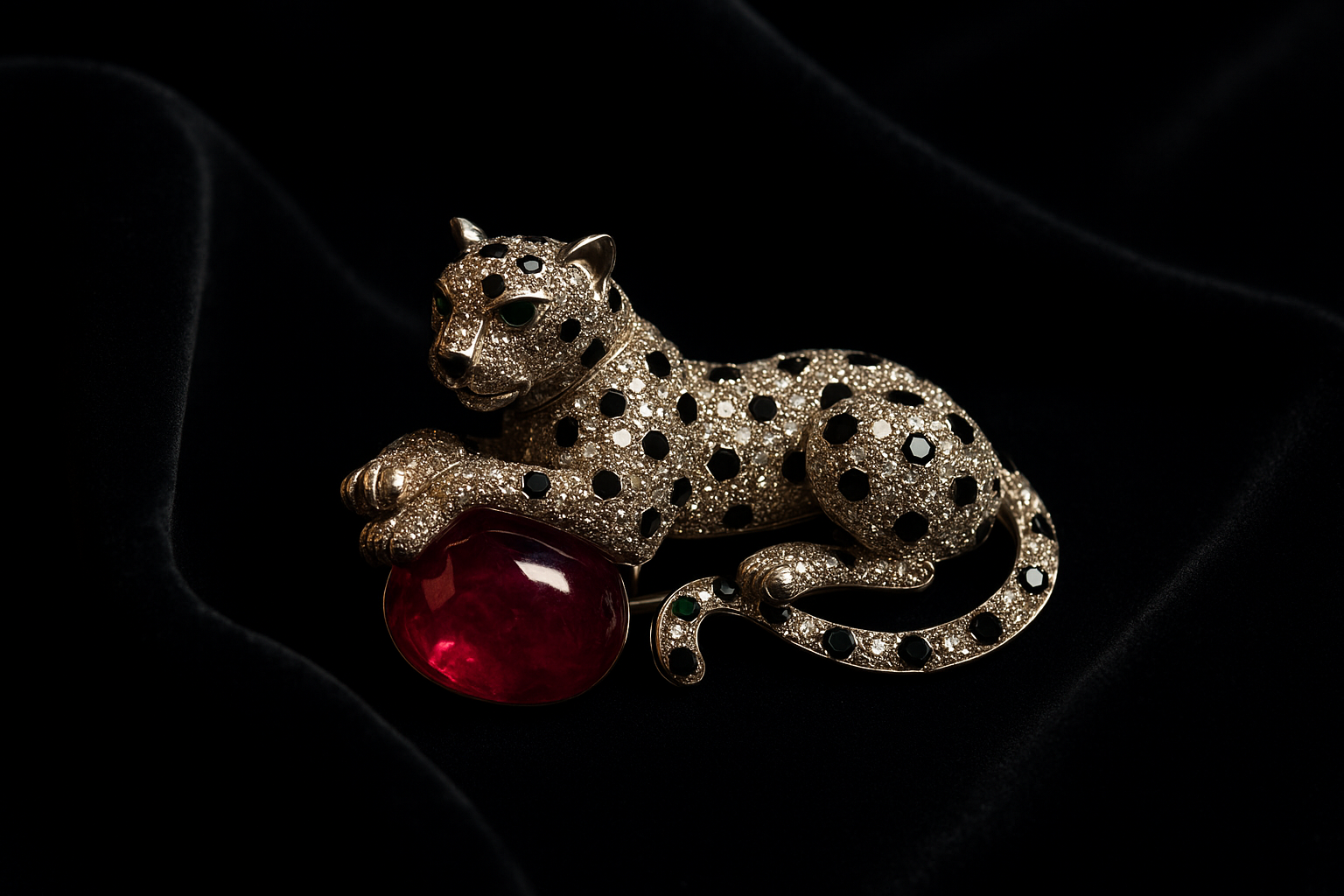
A Cartier Panthère bracelet with emerald eyes, diamonds, and onyx spots from the 1970s is a different animal. Those trade on condition of the enamel, originality of the emerald cabochons, presence of French assay marks, and whether the clasp is original or replaced. Two seemingly identical Panthère bracelets can diverge by 40% on price. The Winston is a math problem. The Cartier is a connoisseurship test.
In my experience on 47th Street: Winston holds steady, predictable value tied to diamond market movement. Cartier swings on collector demand, museum exhibition cycles, and which period style is hot. Right now, Cartier 1970s Aldo Cipullo-era pieces are surging — the Juste un Clou and Love bracelet originals, not the modern production. Winston's a safer bet. Cartier's a smarter one if you know the periods.
What Should You Look For When Buying Either?
If you're buying Harry Winston estate jewelry:
- Get a current GIA report on any center stone over 1 carat. Not the original cert from 1992. A current one. Grading standards tighten.
- Confirm the mounting is original Winston, not a stone that was dropped into a Winston-style head. The shank should carry the Winston maker's mark and serial.
- Type IIa designation on the GIA report adds premium — Winston sourced Type IIa diamonds obsessively.
- Cluster pieces with original paperwork from the Winston salon will sell faster and higher.
If you're buying vintage Cartier:
- Check for the Cartier signature, serial number, and French assay marks (eagle head for 18K gold, dog head for platinum pre-1912).
- Period matters more than carat weight. Art Deco (1910s-1930s) and Retro (1940s) pieces carry the strongest collector premiums.
- Cartier London workshop pieces (marked "Cartier London") are scarcer than Paris or New York and trade at a premium.
- For colored stones in Cartier pieces, SSEF or Gübelin reports are the standard — not GIA. GIA's colored stone origin and treatment determination doesn't hold the same weight in the Cartier collector world. Know that before you take a Tutti Frutti bracelet to the wrong lab.
- Tutti Frutti pieces require an AGL or SSEF report on every significant colored stone. Don't buy one without it.
I've seen too many buyers walk into the auction room with money and walk out with the wrong piece because they didn't know question four from question seven. The money's the easy part. Knowing what you're looking at is the decade-in-the-trade part.
Frequently Asked Questions
Does Cartier or Harry Winston make better investment jewelry?
Neither brand makes "investment jewelry" in the equity sense — jewelry isn't liquid, you're paying retail premium, and resale routes are narrow. But among signed vintage, Winston carries more predictable floor value because it's diamond-anchored. Cartier can outperform if you buy the right period piece at auction. I've seen Cartier 1920s Tutti Frutti bracelets double in 5-6 years. I've also seen Cartier 1990s production pieces lose 30% of purchase price. Winston diamond solitaires from any era trade closer to spot diamond value plus a steady name premium. Winston is the Toyota Land Cruiser of signed jewelry. Cartier is the vintage Porsche — higher ceiling, more ways to get it wrong.
How can I tell if a Harry Winston piece is authentic?
Winston pieces carry a maker's mark — typically "HW" or "Harry Winston" stamped inside the shank or on the gallery — plus a serial number. Vintage pieces from the 1960s-1980s should also carry platinum hallmarks (usually "PT950" or "PLAT"). The mounting quality tells you most of what you need to know: Winston settings are surgical. Prongs are precise, pavé is even, and the metalwork doesn't show porosity or casting flaws. Fakes get the stones wrong — Winston never mounted a diamond below F color or VS2 clarity in a signature piece. If the center stone looks warm or has visible inclusions, walk. Have a GIA report on any center stone. If the seller can't produce both the Winston serial and a current GIA cert on a stone over 1 carat, the price should reflect that gap significantly.
Should I buy vintage Harry Winston from auction or from a dealer?
Both work, but the value lies at auction. Dealers on 47th Street and Bond Street know the Winston premium and price accordingly. Christie's Geneva Magnificent Jewels in May and Sotheby's New York Magnificent Jewels in April are where serious Winston pieces trade. You'll pay buyer's premium (26-27% at Christie's under CHF 1.2M) on top of hammer, and you need to factor that into your ceiling. I buy Winston at auction because the competition thins out after the first few lots and the dealers who dominate the room are calculating the same resale math you are. The private dealer route saves time but costs margin. If you know your numbers — diamond grade, Type IIa status, comparable auction results from the last 18 months — auction is where you'll find the real value.
Written by Lawrence Paul
Lawrence Paul is a fine jewelry dealer based in New York's Diamond District with over 20 years of experience buying and selling signed vintage and estate jewelry. He is President of Spectra Fine Jewelry at 44 West 47th Street, Suite GF1, New York, NY 10036.
Continue Reading
Get the Collector's Newsletter
Join collectors who get authentication tips, market insights, and new guide alerts. No spam, just practical knowledge.
Need Help?
Send photos of a piece you're evaluating. We'll give you a straight read—no pressure, no BS.
Contact Spectra Fine Jewelry →Ready to Browse Authenticated Pieces?
Every item at Spectra Fine Jewelry goes through our verification process before it hits the case. No guesswork. No surprises.