How I Authenticate Vintage Cartier: What I Look For Before I Buy
Published: May 18, 2026
The short answer: I start with the hallmarks — every time. A real vintage Cartier piece carries specific French assay marks, a struck Cartier signature, and a serial number that places it in the right era. If the stamps don't line up, I don't buy. The metal tells the story before the design ever does.
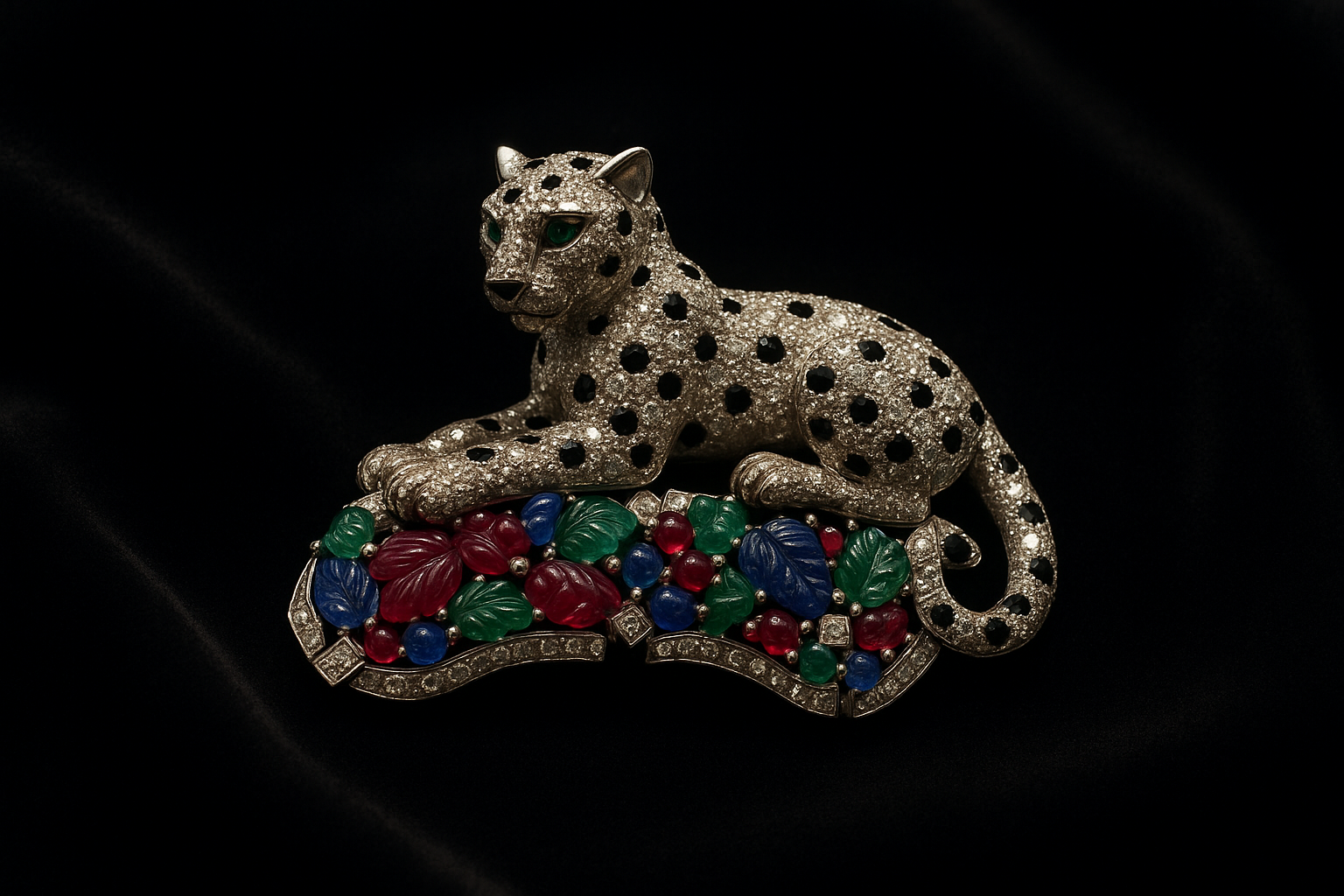
The first fake Cartier I ever saw was a "Panther" brooch someone brought into the office on 47th Street. The stones were wrong. The gold color was off by half a shade. But what killed it instantly? The Cartier signature on the back was rotary-tool engraved — sloppy, inconsistent depth, wrong font entirely. A real Cartier hallmark is struck, not engraved. Once you've held enough of them, you can feel the difference before you even see it.
I've been buying vintage Cartier since 2009. That's 17 years of opening clasps, squinting through a loupe at serial numbers, and walking away from pieces that almost fooled me. Here's what I actually look at when a Cartier piece lands on my desk.
What Hallmarks Am I Looking For on Vintage Cartier?
The hallmark is the first thing I check and the fastest way to kill a deal.
French Cartier jewelry — which is most of what I handle — carries the eagle head assay mark for 18K gold. That's the tête d'aigle, the French government guarantee stamp in use since 1838. On platinum pieces from French workshops, you'll see the dog head (tête de chien). These aren't Cartier-specific — they're official French assay marks — but they confirm the metal was tested in France.
Then I look at the Cartier signature. On pre-1970s pieces, it's almost always "Cartier" in a hand-engraved script with a particular flow. Not block letters. Not a laser-etched font that looks surgically perfect. Post-1970s pieces moved to a cleaner stamped font, but crucially — it's still struck, not rotary-tool engraved. The depth, the sharpness of the edges, the consistency of the impression. All of it matters.
Serial numbers come next. Cartier serials follow a rough chronology. A five-digit number with no letter prefix puts you pre-1970. Six digits starting with a letter lands in the 1970s or later. I cross-reference the serial with the style and construction. A serial that says 1985 paired with a clasp mechanism from the 1950s — I'm out. One wrong signal, and I assume everything is wrong.
Something most people overlook: French Cartier pieces sometimes carry a tiny lozenge-shaped maker's mark with initials inside. That identifies the actual workshop that fabricated the piece. Cartier used several workshops over the decades — Péry et Fils, Verger Frères, and others. A correct maker's mark for the era is a strong positive. When I see one that matches, I breathe a little easier.
How Do I Check the Construction and Craftsmanship?
I pick it up. I open the clasp. I close it. I feel the weight. Then I do it again.
Vintage Cartier has a specific hand — a density, a balance that comes from old-world fabrication. A Love bracelet from the 1970s simply doesn't feel like one from 2020. The edges on the vintage piece are softer. The polish has a different depth. The locking mechanism has a mechanical precision that modern production doesn't quite replicate.
For bracelets and necklaces, the clasp tells me more than the front of the piece. Cartier clasp designs evolved through distinct eras — the hinge pin placement, the safety catch mechanism, the way the tongue seats into the clasp body. I've memorized the evolution. A 1940s clasp on a piece sold as 1970s? No chance. The chronology has to be airtight.
I also check the back. This is something serious dealers know and amateurs skip: Cartier finished the reverse of their pieces. A brooch or pendant with a rough, cast-looking back is almost certainly wrong. The reverse should show the same quality of fabrication as the front, even if the design is simpler. If the back looks like an afterthought, the whole piece is suspect.
For stone-set Cartier, I go straight to the setting work. Cartier setters were — and still are — among the best anywhere. Prongs uniform. Bezels perfectly smooth. No visible tool marks under 10x magnification. Sloppy setting work on a "Cartier" piece is a hard stop for me.
What About the Stones?
People fixate on the metal and ignore the stones. That's a mistake.
A vintage Cartier piece with replacement stones can still be authentic. But replacement stones gut the value — sometimes by 30-40%. I loupe every single stone. I check for chips, abrasions, and mismatched color or clarity within the same piece. If one diamond in a line bracelet is whiter or has a different cutting style than its neighbors, someone's been in there.
For diamond-set Cartier, I expect stones that match the era. A 1950s brooch set with modern ideal-cut round brilliants? That doesn't add up. Old European cuts, transitional cuts, early round brilliants — the cutting styles evolved, and the stones should feel period-appropriate.
For colored stones — sapphires, rubies, emeralds — you want SSEF, Gübelin, or AGL. GIA is not the standard for colored stone origin or treatment. I don't care how many people hand me a GIA report for a Burmese ruby in a Cartier mounting. I'm sending it to Switzerland for a second opinion. I've watched too many origin calls get revised when the stone hit SSEF or Gübelin to take a GIA colored-stone report at face value.
What Red Flags Make Me Walk Away Immediately?
Laser-etched signatures on pre-1990s pieces. I don't negotiate. I don't get a second opinion. I hand the piece back and I'm done.
A serial number that's been polished thin or partially obliterated. Cartier struck serials deep enough to survive a lifetime of wear. When I see a faint, barely-there serial, someone's been aggressive with the polishing wheel — or someone's been tampering. Either way, I'm out.
Mixed-era signals. A 1960s serial paired with a 1980s clasp mechanism. A hallmark format that doesn't match the claimed year. One inconsistency, and I assume the whole piece has a problem. I'd rather be wrong and miss a deal than wrong and own a fake.
And here's one that trips up beginners: no wear on a 50-year-old piece. Vintage jewelry should look vintage. Not abused — lived in. A perfectly pristine 1960s Cartier brooch with zero signs of age is either a museum piece or it's too good to be true. I've learned the hard way which one it usually is.
Frequently Asked Questions
Can Cartier authenticate a vintage piece for me?
Cartier's archive department can research pieces — sometimes. They maintain records going back to the late 19th century, but access isn't automatic and the process isn't fast. I've used them for significant pieces where provenance matters for resale or auction. You present the piece at a Cartier boutique, pay a research fee, and wait — weeks, sometimes longer. But know this: Cartier won't authenticate a piece you don't own, and they won't issue anything resembling a gemological lab certificate. It's an archive search, not an appraisal. Useful, but not a substitute for knowing what you're looking at yourself.
What's the difference between Cartier Paris, Cartier New York, and Cartier London pieces?
The three houses operated semi-independently through much of the 20th century. "Cartier Paris" means French manufacture with French assay marks and typically 18K gold. "Cartier New York" means American-market production, often in 14K (more common in the US) and without French hallmarks. "Cartier London" pieces are the rarest of the three — British hallmarks with date letters, town marks, and maker's marks. The London workshop produced extraordinary quality, and those pieces consistently command a premium at auction. By the 1970s, the three houses unified under "Cartier" without a city designation, which is what you see on most modern production.
How much does authentication affect the price of a vintage Cartier piece?
Dramatically. An unsigned or improperly hallmarked Cartier piece might sell for melt value plus a small premium — if anyone buys it at all. A properly hallmarked, fully authenticated piece with original box and papers? That's an entirely different price range. I've seen the difference be 2-3x on comparable pieces. At auction, the premium on solid provenance runs even wider. Christie's and Sotheby's cataloguers examine Cartier pieces as carefully as any dealer on 47th Street — their condition reports document every hallmark, every serial, every maker's mark. When I'm buying for inventory, authentication isn't a checkbox. It's the entire basis of the purchase.
Written by Lawrence Paul
Lawrence Paul is a fine jewelry dealer based in New York's Diamond District with over 20 years of experience buying and selling signed vintage and estate jewelry. He is President of Spectra Fine Jewelry at 44 West 47th Street, Suite GF1, New York, NY 10036.
Continue Reading
Get the Collector's Newsletter
Join collectors who get authentication tips, market insights, and new guide alerts. No spam, just practical knowledge.
Need Help?
Send photos of a piece you're evaluating. We'll give you a straight read—no pressure, no BS.
Contact Spectra Fine Jewelry →Ready to Browse Authenticated Pieces?
Every item at Spectra Fine Jewelry goes through our verification process before it hits the case. No guesswork. No surprises.