How I Authenticate Vintage Cartier: What I Look For Before I Buy
Published: May 16, 2026
The short answer: Authenticating vintage Cartier requires checking signature placement, hallmark depth, serial number format by era, and construction quality against known references. Fakes get the easy stuff right — they fail on solder joints, gallery work, and period-specific stamps. When in doubt, send it to Cartier Tradition in Geneva or a specialist auction house.
I've been buying vintage Cartier since the late 1980s. I've handled Tutti Frutti bracelets from the 1930s, Trinity rings from every decade, Panthère brooches that came directly from estates, and yes — I've passed on pieces that turned out to be brilliant forgeries. The forgery game has gotten significantly better in the last fifteen years. A bad fake is obvious in five seconds. A good fake takes me twenty minutes and a loupe. A great fake takes a trip to Geneva.
Here's what I actually do when a vintage Cartier piece lands on my desk.
What hallmarks should a real vintage Cartier have?
The first thing I check is the signature itself. Cartier signed pieces differently depending on the workshop, era, and market. Paris pieces from the 1920s–30s are usually marked "Cartier Paris" with the workshop master's mark and French assay marks — the eagle's head for 18k gold, the dog's head for platinum. London pieces carry English assay marks with the date letter system. New York pieces from the same era often say "Cartier" alone or "Cartier New York" without European hallmarks.
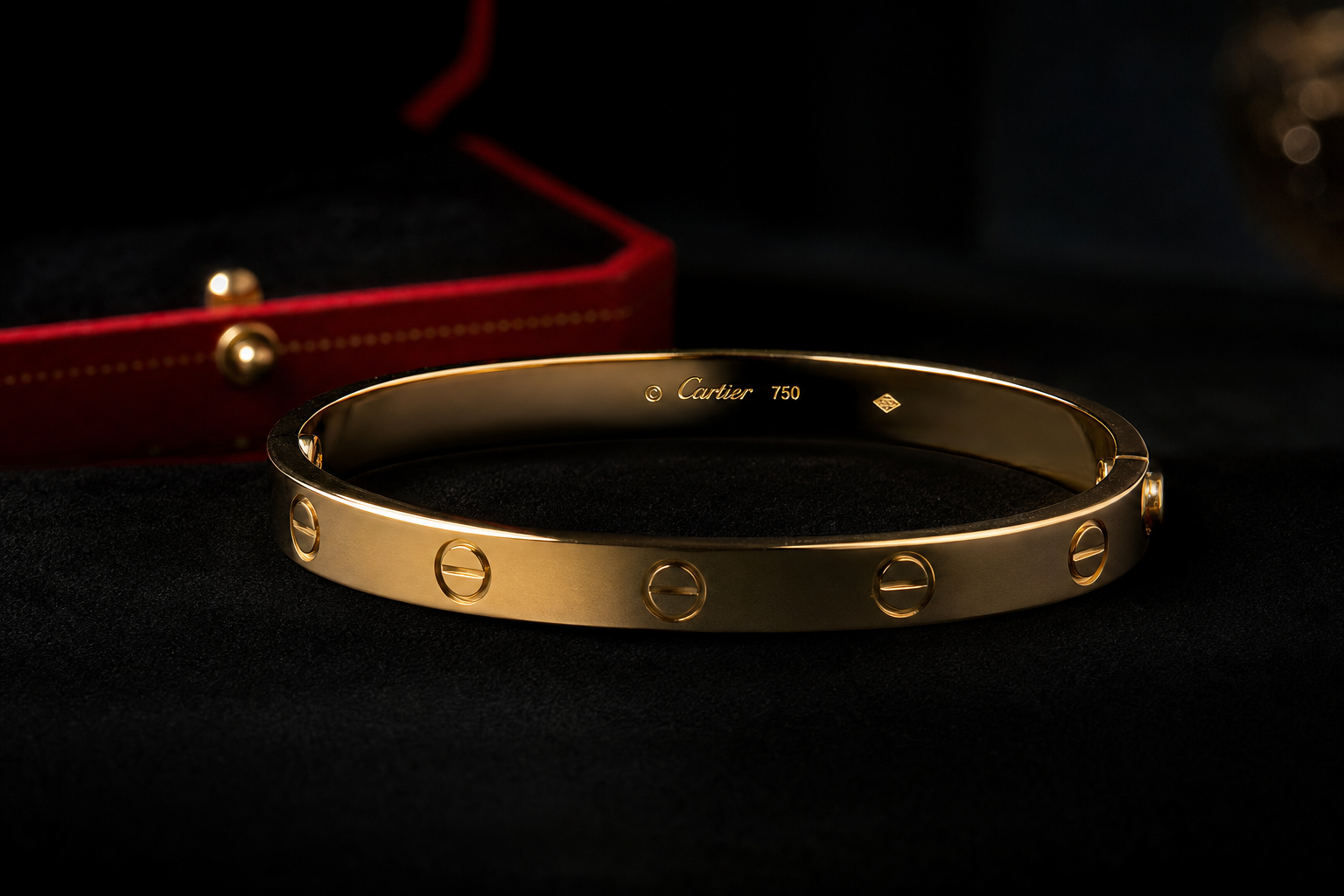
By the 1970s and 1980s the signature standardized to "Cartier" plus a serial number plus the metal content (750 for 18k, 950 for platinum). Modern pieces add the country of origin and reference number.
What I'm looking at under the loupe: the depth and crispness of the stamp. Real Cartier stamps are deep, sharp, and consistently spaced. Counterfeit stamps are often shallow, sometimes wavy, and the letters can look slightly off-kilter. The "C" in Cartier should have a specific curve — fakers consistently get the typography wrong.
How do Cartier serial numbers work?
Serial number format depends entirely on the era. Pre-WWII Paris pieces often have a four or five digit serial. Post-war pieces moved to longer numbers. From roughly the 1980s onward, you see the format we know today — a letter prefix or just a long alphanumeric string.
The serial alone doesn't authenticate. What it does is let me cross-reference with Cartier Tradition, the maison's heritage department in Geneva. For a fee, they'll tell you whether the piece is in their archives, when it was made, and sometimes who it was sold to originally. If a serial doesn't match anything in their books and the piece claims to be Paris-made from a documented period, I walk away.
That said — Cartier didn't keep perfect records, especially for the New York workshop and pieces that went through retail rather than salon channels. A piece missing from the archives isn't automatically fake. It just means I need more evidence.
What do counterfeiters get wrong on vintage Cartier?
This is where experience matters more than reference books.
Gallery work and undersides. Flip a real Tutti Frutti bracelet over. The back is finished as carefully as the front. Carved stones are set with individual prongs, the gallery is openwork, every junction is hand-finished. Counterfeit pieces almost always show machine-cut galleries, casting porosity on the undersides, and sloppy solder joints.
Stone setting on Panthère pieces. Real vintage Panthère brooches and rings use specific setting techniques for the spots — usually onyx or black enamel set into channels or individual bezels. The emerald eyes are set in a particular way that's hard to fake. Fakes often use glued-in stones or pressed enamel that wears wrong over decades.
Weight and balance. A real 1920s Cartier brooch has density and balance you feel in your fingers. Counterfeiters can match the gold weight but they can't always match the construction weight — how the mass is distributed across the piece.
Patina and wear patterns. Real vintage Cartier wears in predictable ways. Trinity rings develop specific scratch patterns on the rolling bands. Watch cases show wear on the lugs where the strap pulled for decades. Fakes either look too perfect or have artificially aged patina that doesn't match natural wear physics.
Where do I send a piece for final verification?
For anything I'm putting real money behind, three options:
- Cartier Tradition in Geneva — the gold standard. They'll authenticate against the maison archives and provide a certificate. Turnaround is slow — sometimes months — but their word is final in the trade.
- Christie's or Sotheby's specialist departments — their vintage jewelry specialists handle hundreds of Cartier pieces a year. If I'm consigning, they authenticate anyway. If I'm buying, I'll pay for a consultation.
- Independent specialists — Lee Siegelson, Fred Leighton's team, Hancocks in London. Dealers who've handled thousands of vintage Cartier pieces and can authenticate in person in minutes.
My actual process when a piece comes in:
- Visual inspection under 10x loupe — signature, hallmarks, serial, construction
- Weigh it and check dimensions against known specifications for that model and era
- Photograph everything — front, back, hallmarks, any wear or damage
- Cross-reference the serial with Cartier Tradition if the piece warrants it
- Check the provenance paperwork — original receipts, estate documents, prior auction records
- Get a second opinion from someone in my network if anything feels off
If I have any doubt after that process — I pass. There's always another piece. A vintage Cartier purchase made on hope and a handshake will cost you a hundred times what saying no costs you.
The market for vintage Cartier has never been stronger and the forgery operations have never been more sophisticated. Authentication isn't paranoia. It's the price of admission.
Frequently Asked Questions
Does Cartier authenticate vintage pieces for free?
No. Cartier Tradition in Geneva charges for authentication services and the process can take months. The fee varies based on the piece and the depth of research required. They also reserve the right to decline authentication on pieces they can't conclusively verify against their archives. For a significant piece — anything over $50,000 — the fee is irrelevant compared to the value of a definitive answer. For smaller pieces, you're often better off working with an auction house specialist or independent expert who can give you a faster, less expensive opinion. I use Cartier Tradition selectively, mostly for pieces I'm consigning to major auctions or selling to serious collectors who want maison-backed paperwork.
Can a vintage Cartier piece be real but have been altered?
Absolutely, and this is one of the most common situations I deal with. A piece might be 100% authentic Cartier from 1925 but have been resized, had a clasp replaced, or had stones swapped out at some point in the last century. Those alterations affect value significantly. A ring resized at Cartier's own workshop is generally fine. A ring resized at a local jeweler in 1962 with a non-Cartier shank addition is a problem. I call these "married" pieces — authentic components combined in a way that wasn't original. They're not fakes, but they're not fully original either, and price them accordingly. Always ask: is every component original? When was any work done, and by whom?
What's the most faked vintage Cartier piece right now?
Love bracelets from the 1970s are the most commonly faked at the entry level. At the high end, Tutti Frutti pieces from the 1920s–30s are the trophy forgery — a convincing fake can be constructed from period components that individually test as authentic. I've seen bracelets assembled from three or four different Cartier pieces of the era combined into something that never existed originally. The stones are real, the gold is real, the hallmarks are period — but the object itself is a construction. That's why I care so much about the gallery work and the internal construction. You can't fake fifty years of consistent aging across a piece assembled last year.
Written by Lawrence Paul
Lawrence Paul is a fine jewelry dealer based in New York's Diamond District with over 20 years of experience buying and selling signed vintage and estate jewelry. He is President of Spectra Fine Jewelry at 44 West 47th Street, Suite GF1, New York, NY 10036.
Continue Reading
Get the Collector's Newsletter
Join collectors who get authentication tips, market insights, and new guide alerts. No spam, just practical knowledge.
Need Help?
Send photos of a piece you're evaluating. We'll give you a straight read—no pressure, no BS.
Contact Spectra Fine Jewelry →Ready to Browse Authenticated Pieces?
Every item at Spectra Fine Jewelry goes through our verification process before it hits the case. No guesswork. No surprises.