How to Authenticate Bulgari Serpenti: What Real Vintage Looks Like
Published: June 5, 2026
The short answer: Real vintage Bulgari Serpenti pieces from 1960s–1980s have a physical feel that counterfeits can't replicate — the Tubogas coil has spring memory, uniform tension, and machine-crisp edges. No solder joints. Period. Check the hallmarks next: BVLGARI with a V, 750 gold, Italian maker's star and province code stamped cleanly, not lasered on. If the coil feels limp, walk away.
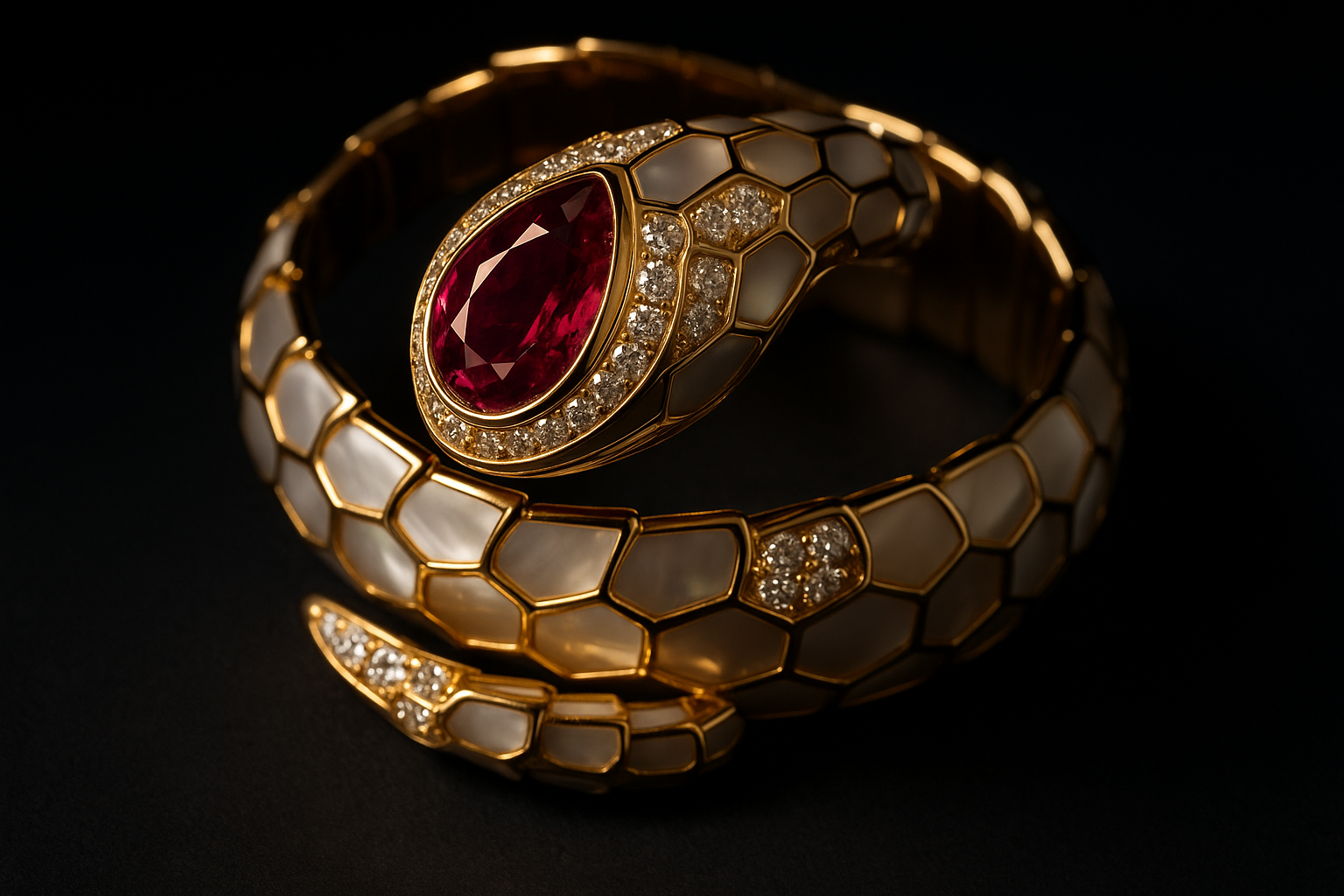
I handled a 1968 Serpenti three-coil watch at the office three weeks ago — yellow gold, ruby eyes, manual-wind Jaeger-LeCoultre movement inside. The instant it hit my palm I knew it was right. These pieces don't just sit on the wrist. They grip. That Tubogas coil has a mechanical memory. When you stretch the bracelet open, it springs back with controlled, even resistance across every single winding. Fakes feel dead. No tension. No memory in the metal. That's your first clue before you even look at a hallmark.
Bulgari launched the Serpenti in the late 1940s, but the pieces that matter — the collectible vintage ones — are the Tubogas wrap watches and bracelets from the 1960s through early 1980s. These are what cross the block at Christie's Geneva and Sotheby's Hong Kong. These are what serious signed-jewelry collectors chase. And these are what counterfeiters target most aggressively.
How Can You Tell a Real Tubogas Coil from a Fake?
The Tubogas construction is the authentication — everything else is secondary. It's a technique Bulgari adapted from industrial gas-pipe manufacturing: thin 18K gold strips are wound into interlocking coils under high tension, then shaped and stamped into a flexible, spring-loaded bracelet. No soldering. No welds. Each coil interlocks mechanically with the next.
Hold a real one. Compress two adjacent coils gently between your thumb and forefinger. You'll feel even, consistent resistance — every coil responds identically. It should feel like a precision instrument, not costume jewelry.
Now here's what separates a dealer from someone about to get burned: look at the gaps between coils. On an authentic vintage piece, those gaps are uniform to the millimeter. Every coil sits at the same angle relative to the next. The edge of each gold band is crisp — a clean, slightly beveled 45° kiss on the corner that catches light as the piece moves on the wrist. Cast fakes have rounded, soft, blurry edges. Once you've seen fifty real ones, the difference is immediate and irreversible.
Fakes are almost always cast — the coils molded as a single section or assembled from cast segments. You'll see tool marks, inconsistent spacing, or worst of all, visible solder lines where someone tried to fake the coil construction by joining separate rings. Real Tubogas has zero visible joins. Zero. If you see one, it's wrong.
What Do the Hallmarks and Stamps Tell You?
Every vintage Serpenti sold for the Italian market carries specific, legally-required marks. You need to know which ones belong to which era.
On 1960s–1970s pieces, look for four things:
- BVLGARI engraved on the interior of the head or the flat underside of the first coil — always spelled with a V in the classical Latin letterform, never a U
- 750 stamp for 18K gold (or 18K / 18KT on pieces manufactured for export)
- A five-pointed star followed by a number — the Italian maker's registration mark identifying the specific workshop
- A province code — typically AL (Alessandria), MI (Milan), or VI (Vicenza) — stamped inside a horizontal lozenge or rectangle
Post-1970s pieces usually add MADE IN ITALY below or beside the BVLGARI signature.
Placement matters as much as the marks themselves. On Tubogas bracelets, the hallmark is always on the flat underside of the head element — near the hinge or the base where the tail meets the watch case or gem-set clasp. If you find the mark on a visible exterior surface, on the outside of a coil, or stamped at an uneven depth, something is off. Real Bulgari hallmarking is deep, clean, and deliberately placed where it doesn't interfere with the design.
One thing I see constantly: vintage pieces polished to death. The hallmark gets softened, worn shallow, barely legible. That doesn't mean it's fake — but it does destroy the value. A heavily polished Serpenti loses the coil beveling that defines it. Once that crispness is gone, it's gone forever. I pass on over-polished pieces unless the price reflects it.
Which Serpenti Models Are Worth Real Money?
Not all Serpentis are equal. Here's how the market actually breaks down:
1. The Tubogas multi-coil wrap watch (1960s–1970s) This is the trophy. Three-coil and four-coil versions in yellow gold, especially with natural ruby or emerald eyes, are the six-figure pieces at auction. The movements were supplied by Jaeger-LeCoultre, Piaget, or Movado — early ones are manual-wind, and the caliber should be signed by the manufacture that produced it. If you open the case back and find an unsigned generic quartz movement in something claiming to be 1960s, you've got a replacement or a fake. Straight to the point.
2. The Tubogas bracelet-only (no watch) Less common than the watch versions, often undervalued, and genuinely harder to find. Same coil construction, same head design, but a gem-set body scale or decorative element instead of a watch dial. A clean 1970s example with original polychrome enamel scales is rare. I see maybe two or three a year that are truly untouched.
3. Two-coil Serpenti watches (1960s) The simpler sibling — two wraps instead of three. More wearable, less expensive, but real Bulgari craftsmanship throughout. Five years ago you could grab a clean one under $20,000. Today a full-set example with original papers runs closer to $28,000–$38,000.
4. Enamel-scale Serpentis (1970s–1980s) Different construction entirely. These used articulated gold band segments with polychrome enamel in green, blue, red, or white. Still highly collectible, but the enamel is fragile. Check every single scale under 10× magnification. Cracks, chips, or — worst — repainted enamel destroys the value. Original enamel has a depth and very slight surface irregularity that's virtually impossible to replicate.
5. Diamond and gem-set versions Bulgari produced pavé diamond heads and ruby/sapphire/emerald-set eye variations for high-end retail. If the stones are original, these command significant premiums. But here's the minefield: I've seen dozens of pieces where the original eyes were replaced, usually poorly, with lower-quality stones or synthetics. Original Bulgari-set rubies and emeralds have a distinct cutting style — cushion or mixed-cut, calibrated precisely to the bezel, with color consistent with era-appropriate sourcing. If the stone looks too perfect or the setting shows extra prong marks, the piece has been tampered with.
What Should You Do Before Buying a Vintage Serpenti?
Here's my process. Use it.
-
Feel the tension. Pick it up. Stretch the coils gently — not aggressively, just enough to test the spring-back. Real Tubogas has memory and uniform resistance. Dead/uneven coils = walk.
-
Check coil uniformity. Every gap identical. Every edge crisp and beveled. No solder visible anywhere. No casting texture on the gold surface.
-
Inspect the hallmark. BVLGARI with a V. 750. Star + number. Province code. Deep, clean stamping — not surface-level laser etching. Correct placement on the underside of the head.
-
Open the watch back (if applicable). Movement should be signed — Jaeger-LeCoultre, Piaget, Movado, or later Bulgari calibers. A generic quartz in a 1960s piece is a dealbreaker.
-
Loupe the eyes. Ruby and emerald eyes should be natural with inclusions visible. Synthetic or paste eyes = either a fake or a replacement on an otherwise real piece. Both destroy value.
-
Weigh it. A three-coil gold Tubogas watch should be substantial — these are dense, all-gold mechanisms. Lightweight pieces are plated or hollow-cast fakes.
-
Ask for provenance. Original box, papers, or prior Christie's/Sotheby's lot provenance eliminates authentication doubt. I pay a premium for good paperwork every single time, and you should too.
There is no substitute for handling dozens of these. The differences between a real Serpenti and a good fake are physical — weight, spring tension, edge sharpness, the way the gold catches light across the bevel. Photos can hide a lot. A loupe cannot.
Frequently Asked Questions
How much is a vintage Bulgari Serpenti worth?
A clean two-coil Tubogas watch from the 1960s in yellow gold runs $28,000 to $45,000 at retail today — more if it has ruby or emerald eyes and original papers. Three-coil and four-coil versions, especially with diamond-pavé heads, regularly hit $80,000 to $150,000+ at Christie's and Sotheby's. Elizabeth Taylor's personal gold and diamond Serpenti watch sold for just under $1 million at Christie's New York in December 2011, but celebrity provenance multiplies value in ways that don't reflect the broader market. Condition is everything. A heavily polished Tubogas piece with a replaced movement is worth half — sometimes less — of an untouched original with matching provenance.
Does Bulgari still use real Tubogas construction?
Yes, but modern production isn't vintage production. Contemporary Serpenti pieces use a version of the Tubogas technique, but the manufacturing tolerances have changed, the gold alloy is slightly different, and the overall feel is lighter and more uniform. A 1960s coil has a heavier, smoother, more organic action. A 2025 piece feels stiffer and more machine-precise — not worse, just different. The vintage market is where collector money concentrates for investment-grade pieces. Modern Serpentis depreciate after purchase. Well-chosen vintage ones don't.
What's the difference between Bulgari and Bvlgari?
Same company, different contexts. BVLGARI — spelled with a V in the classical Latin letterform — is the logo and the hallmark physically stamped into the jewelry itself. Bulgari with a U is the standard English spelling used in writing: catalogs, articles, auction listings, and the company's own modern branding. If you see "BVLGARI" stamped into the gold, that's correct. If you see "BULGARI" with a U engraved or stamped into the metal on a piece someone is selling as authentic, you're holding a counterfeit. There's no ambiguity on this.
Lawrence Paul is the owner of Spectra Fine Jewelry, located at 44 West 47th Street in New York City's Diamond District. He has been buying jewelry since 2009 — 17 years in the trade — and specializes in signed estate jewelry, Kashmir sapphires, no-heat Burma rubies, Colombian and Zambian emeralds, Paraíba tourmalines, and fancy color diamonds. He buys and sells at Christie's, Sotheby's, and major international auction houses. Member of the DMIA and New York Diamond Dealers Club (DDC).
Written by Lawrence Paul
Lawrence Paul is a fine jewelry dealer based in New York's Diamond District with over 20 years of experience buying and selling signed vintage and estate jewelry. He is President of Spectra Fine Jewelry at 44 West 47th Street, Suite GF1, New York, NY 10036.
Continue Reading
Get the Collector's Newsletter
Join collectors who get authentication tips, market insights, and new guide alerts. No spam, just practical knowledge.
Need Help?
Send photos of a piece you're evaluating. We'll give you a straight read—no pressure, no BS.
Contact Spectra Fine Jewelry →Ready to Browse Authenticated Pieces?
Every item at Spectra Fine Jewelry goes through our verification process before it hits the case. No guesswork. No surprises.