Now I'll write the article in Lawrence's voice, following all content rules. This is a Spectra direct-write — I'll handle it here as quarterback since it's a single on-demand article.
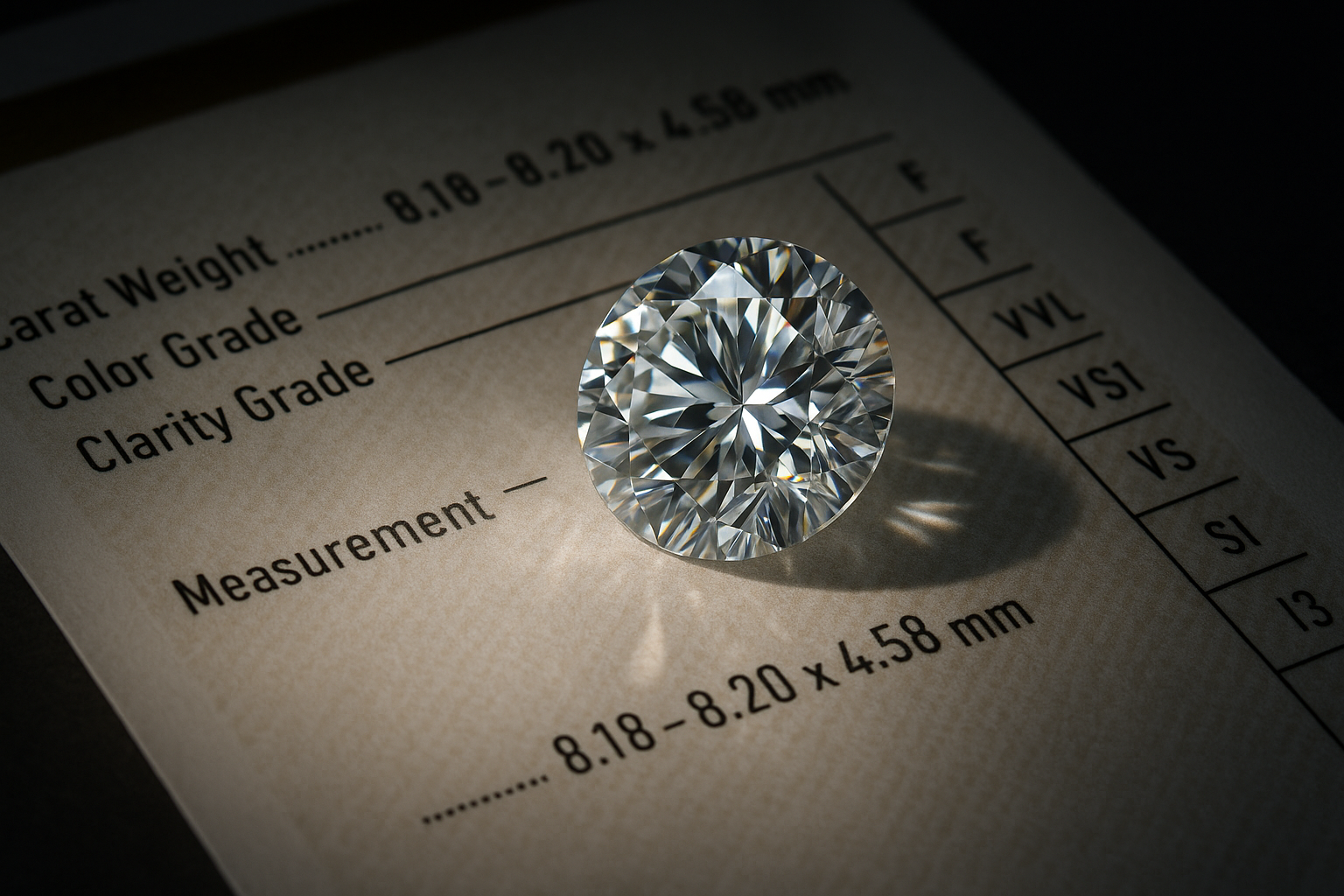
How to Read a GIA Diamond Certificate: What Every Number Means
Published: June 18, 2026
The short answer: A GIA certificate maps every characteristic that determines a diamond's value — the 4Cs, proportions, fluorescence, and an inclusion plot that's as unique as a fingerprint. The report number at the top is the key: enter it at GIA's Report Check, and you're reading a document that the global diamond trade treats as the only standard that matters.
I've handled thousands of GIA reports across a counter on West 47th Street. I can tell you exactly which numbers a dealer's eyes go to first — and which ones most buyers waste time obsessing over. A GIA diamond grading report isn't a receipt. It's a map. Read it right and you know exactly what you're buying. Read it wrong and you're paying for lines on paper instead of what's in the stone.
Here's how to actually read one.
What does the GIA report number actually mean?
The report number in the top-right corner is your first move. Every GIA report gets a unique 10-digit number. Type it into GIA's Report Check portal and you'll pull the full grading record from their database.
This matters for one reason: verification. I've personally seen laser-inscribed girdles that didn't match the paper someone was holding. A seller hands you a laminated cert — fine. Pull it up live. If the report number doesn't resolve, or the data on-screen doesn't match the paper, walk. No conversation needed.
The report number is also micro-laser-inscribed on the diamond's girdle for most stones graded GIA. Hold it under 20x magnification and you'll see "GIA" followed by that number, invisible to the naked eye. A stone without the inscription isn't necessarily fake — some owners choose not to inscribe. But I prefer it there. It closes the loop between paper and stone.
What should you look at first on a GIA grading report?
Skip the 4Cs for a second. Look at the date. A report from 2015 has been through more hands than a report from last month. GIA grading standards tighten over time. A D color from 2008 might get an E or F if resubmitted today. I've recut stones that came back with noticeably different grades — not because the diamond changed, but because GIA's tolerances did.
After the date, go to Measurements and Proportions. These tell you if the stone is cut well — the single biggest driver of how a diamond actually performs in light. A D/Flawless with a 72% depth and a 65% table is going to look dead compared to an H/VS2 with perfect angles. I'd rather sell you the H every time.
The key proportions on a round brilliant:
- Table %: 54–60% is the sweet spot. Higher than 62% and light leaks out the top.
- Depth %: 59–62.5%. Drop below 58% or push past 63% and brilliance takes a hit.
- Crown angle: 33.5–35°. This is where dealers spend their time. Get the crown angle wrong and the whole pavilion structure is fighting itself.
- Pavilion angle: 40.6–41°. Too shallow and you get the "fish eye" effect. Too steep and light escapes through the bottom.
GIA doesn't print an overall cut grade on fancy shapes (oval, pear, cushion, emerald, marquise, radiant). That's where experience matters. I look at the ratio, the depth percentages, and the facet alignment visually.
What does the clarity plot tell you that the grade doesn't?
Flip to the plot diagram — the little line drawing of the diamond with red and green markings. Red marks are internal characteristics (inclusions). Green marks are surface-reaching or external features. Black outlines in the plot show extra facets, naturals, or cavities.
Here's what experienced buyers actually look for:
- Location obsessions are rational. An inclusion directly under the table at 12 o'clock is ten times more visible than the same inclusion buried near the girdle at 3 o'clock. GIA doesn't factor position into the grade — you should.
- Black crystal vs. white feather. A VS2 with a single black carbon dead-center is a rougher wear than an SI1 with a white feather tucked under a crown facet. The grade is just a label.
- Cavities and naturals on the girdle: common on antique cuts. Old mine and old European cuts from the 19th century nearly always show these. It's not a defect — it's character.
- "Clarity based on clouds not shown." Read that line carefully. It means the stone has cloud-like transparency issues that GIA can't map as discrete inclusions. I've seen diamonds with this notation that looked hazy in direct sunlight while grading VS2 on paper. If you see that phrase, view the stone in natural light before committing.
Does fluorescence matter?
It matters more than most buyers realize — but not always the way people think.
GIA grades fluorescence from None to Faint, Medium, Strong, and Very Strong, and notes the color (almost always blue). Strong blue fluorescence in a D–F colorless diamond can create a milky or oily appearance in sunlight. I've seen it. The trade discounts these stones, sometimes heavily.
But here's the part nobody tells you: Strong blue fluorescence in an H–J or lower color diamond can actually improve the face-up appearance. The blue cancels out the faint yellow undertone, making the stone look whiter than its grade. These are some of the best value buys in the market. A J color with strong blue fluorescence can face up like an H — and you'll pay J money for it.
One detail most buyers skip: the Clarity Characteristics box tells you what's inside. "Feather, Cloud, Crystal" is standard fare. "Laser drill hole" means the stone was fracture-filled or treated — that's a clarity-enhanced diamond, which GIA won't grade for a full report (they'll issue a different document). "Indented Natural" just means a piece of the original rough's skin remains — common and harmless.
How to read a GIA report in 30 seconds
- Report number → pull it live at GIA Report Check. Match the data.
- Date → older than 5 years? Factor in potential grade drift.
- Measurements + proportions → table, depth, crown, pavilion. This is where performance lives.
- Clarity plot → location of inclusions matters more than the grade letter. One black dot under the table vs. three feathers near the girdle: the SI1 with feathers wins.
- Fluorescence → strong blue on a D–F? Walk. Strong blue on an I–J? Strong buy.
- Polish / Symmetry → Excellent to Very Good is standard. Fair or lower on either and I'm checking the stone under a microscope for what they saw.
- Comments section → "clarity based on clouds not shown" or "internal graining" are the lines that change everything. Read every word.
The GIA report is the single most useful document in the diamond trade. But it's a starting point — not a substitute for looking at the stone yourself. I've never bought a significant diamond based on a cert alone. Neither should you.
Frequently Asked Questions
Are online GIA report checks reliable?
Yes — and you should check every time. GIA's Report Check at gia.edu is the authoritative record. If the online record and the paper don't match, the paper is worthless. I check reports before every purchase over $5,000. It takes 30 seconds. The online version also shows whether the stone was ever submitted for an update or duplicate, which can flag a report that's been floating around the market for years.
Does a GIA report guarantee the diamond's value?
No. A GIA report confirms identity and characteristics — it does not assign value. Two diamonds with identical GIA grades can trade 20–30% apart based on cut quality, transparency, fluorescence, and visual personality. I've compared matching F/VS1 rounds side by side where one had life and fire and the other looked flat. Same cert, different stone. The report gives you the data. Your eyes give you the answer.
What's the difference between a full GIA report and a dossier?
A GIA Diamond Grading Report (the full document) covers diamonds 0.15 carats and up and includes the clarity plot diagram. A GIA Diamond Dossier is a more compact document for stones 0.15–1.99 carats that omits the plot — you get the grade without the map. The grading standard is identical. If you're buying a stone under 1 carat with a Dossier, the 4Cs and proportions are just as reliable. Over 2 carats, you'll always see the full report with the plot.
Written by Lawrence Paul
Lawrence Paul is a fine jewelry dealer based in New York's Diamond District with over 20 years of experience buying and selling signed vintage and estate jewelry. He is President of Spectra Fine Jewelry at 44 West 47th Street, Suite GF1, New York, NY 10036.
Continue Reading
Get the Collector's Newsletter
Join collectors who get authentication tips, market insights, and new guide alerts. No spam, just practical knowledge.
Need Help?
Send photos of a piece you're evaluating. We'll give you a straight read—no pressure, no BS.
Contact Spectra Fine Jewelry →Ready to Browse Authenticated Pieces?
Every item at Spectra Fine Jewelry goes through our verification process before it hits the case. No guesswork. No surprises.