Padparadscha Sapphire: The Rarest Color in Corundum
Published: June 20, 2026
The short answer: A true padparadscha sapphire is a natural, unheated corundum displaying a simultaneous pink-and-orange color — like a Sri Lankan sunset — with zero brown modifier. Fine stones trade at $15,000–$60,000 per carat, and the very top (10+ carats, unheated, SSEF/Gübelin-certified) can push past $100,000 per carat at auction.
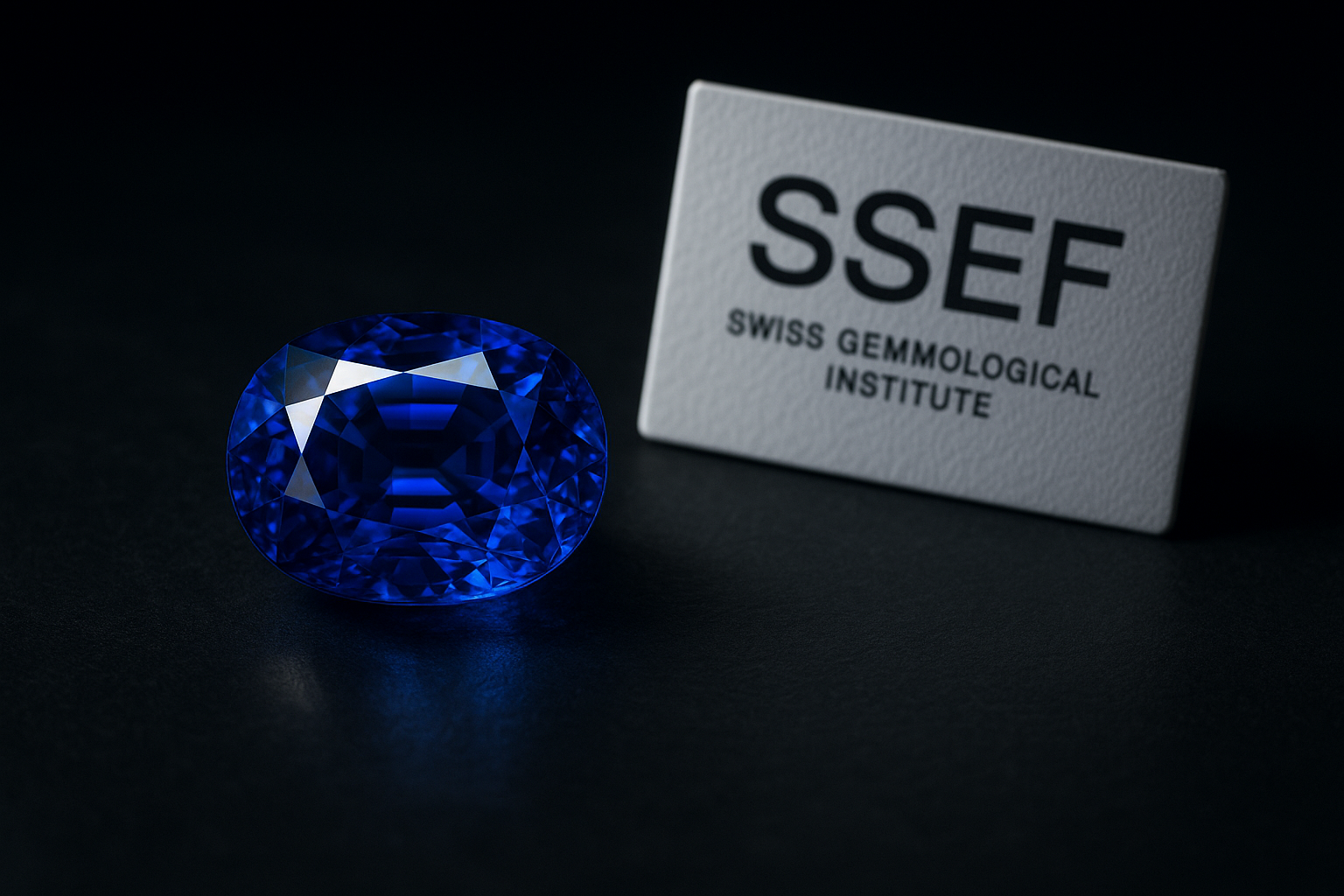
I've sold exactly three padparadschas I'd call world-class in 17 years of buying. That's not a failure of sourcing — that's the market. Most "padparadschas" circulating today are heated, beryllium-diffused, or simply orange-pink stones someone slapped a romantic name on. A genuine unheated padparadscha with proper lab papers from SSEF or Gübelin is harder to find than a Kashmir sapphire above five carats. I don't say that lightly.
The name itself tells you everything. Padma raga — Sanskrit for "lotus color." Not salmon. Not peach. Not sunset if "sunset" means brown. The lotus blossom at dawn: a delicate fusion of pink and orange occupying the same crystal at the same time. The stone doesn't switch colors depending on the light (that's color-change, a different phenomenon). It shows both simultaneously. Every time I've placed one in front of a serious collector, there's a pause — that moment where the brain catches up to what the eye is seeing.
What Defines a True Padparadscha — and What Doesn't?
Here's where the trade splits from the labs, and the labs split from each other. The LMHC (Laboratory Manual Harmonisation Committee) defines padparadscha as a corundum of "pinkish orange to orangey pink with low to medium saturation and light tone." Clean enough on paper. In practice, it's a bloodbath.
GIA, SSEF, and Gübelin each apply the term differently. GIA is generous — I've seen them label stones "padparadscha" that I'd call fancy pink-orange. SSEF and Gübelin are stricter, and for colored stones, those are the two labs that matter. If you're spending serious money on a padparadscha and the stone comes with only a GIA report, you're not getting the full picture on origin or treatment. SSEF (Swiss) and Gübelin (Swiss) are the authorities for colored gemstone origin and treatment determination. AGL (American Gemological Laboratories) in New York is also respected for colored stone analysis, particularly for treatment assessment.
The single biggest dealbreaker: brown. If there's a brown modifier — even a whisper — it's not a padparadscha. It's an orange sapphire with marketing. The second dealbreaker: artificial treatment. Heat is the enemy of padparadscha value. Beryllium diffusion is outright fraud if undisclosed. A true padparadscha must be unheated for top-tier value, and any treatment beyond traditional heating destroys collector-grade pricing.
Another thing nobody tells you: padparadscha isn't a variety of sapphire. It's a color designation. Chemically, it's the same aluminum oxide as every other sapphire. The color comes from a precise, delicate balance of chromium (pink) and iron with a specific charge state (orange). Nature almost never gets this mix right, and when it does, it's typically in stones under two carats.
Why Does Padparadscha Cost More Than Most Blue Sapphires?
Simple math. For every 10,000 carats of fine blue sapphire that comes out of Sri Lanka, you might get 50 carats of genuine padparadscha — and of those, maybe five will be unheated and clean enough to certificate without treatment controversy.
I've watched the padparadscha market do something unusual: it doesn't track the broader sapphire market. When blue sapphire prices dipped in 2015–2016, padparadscha held. When Kashmir and Burmese sapphires exploded at auction from 2018 onward, padparadscha prices didn't spike in sympathy — they just climbed steadily, quietly, with almost no supply-side relief. That's the sign of a market driven by genuine scarcity, not auction momentum.
Current pricing, real numbers from what I see trading: a clean one-carat unheated padparadscha with SSEF papers and strong color saturation will run $20,000–$35,000 per carat. A two-to-three carat stone with even color distribution and no windowing: $35,000–$55,000 per carat. Five carats and above, the per-carat figure jumps because the stones barely exist — $60,000–$80,000 per carat, and at the ten-carat level you're in trophy territory where price-per-carat comparisons become meaningless. The record-holder, a 14.65-carat Ceylon padparadscha, sold at Christie's for $770,000 in 2018 — roughly $52,500 per carat, which I'd argue was a bargain for a stone of that size and color fidelity.
Compare that to a fine unheated blue Ceylon sapphire at $3,000–$8,000 per carat, or even a Burmese unheated blue at $15,000–$30,000, and you see the premium padparadscha commands.
How Do I Know If a Padparadscha Is Real?
- Lab report first. Not optional. SSEF or Gübelin. If the seller can't produce one, the stone is not a padparadscha at the price they're asking — period.
- Look for the brown trap. Tilt the stone under daylight. If you see brown at any angle, it's an orange sapphire, not a padparadscha. Walk away.
- Check the color distribution. A real padparadscha shows pink and orange simultaneously across the face of the stone, not in zones or patches. Zoning is common in sapphire but tanks padparadscha value because the unified color is the entire point.
- Demand unheated status. A heated padparadscha is worth 30–50% less than its unheated equivalent, and at the top end of the market, heating makes the stone nearly unsellable to serious collectors.
- Weigh the stone before you fall in love. The vast majority of certified unheated padparadschas are under two carats. If someone offers you a five-carat "padparadscha" with no lab report or a no-name lab, the odds of it being what they claim are near zero.
- Provenance matters. The finest padparadschas come from Sri Lanka (Ceylon). Madagascar produces similar colors, but the market still discounts them relative to Ceylon origin. Vietnam and Tanzania produce stones that occasionally get the designation, but collector demand clusters around Ceylon material.
Is a Padparadscha a Better Investment Than a Kashmir or Burmese Sapphire?
Depends what you mean by better. A top Kashmir sapphire above ten carats is a blue-chip asset with a 150-year auction record — you know exactly what it's worth and who's buying. Padparadscha is thinner, less liquid, with fewer comparable sales. That's the risk.
The upside: fewer stones exist, demand is growing from Asian collectors who understand the cultural weight of the lotus color, and there's no synthetic or treated product that convincingly replicates the real thing. Beryllium-diffused orange-pink sapphires flood the market at $200 per carat, but anyone spending real money knows the difference. The gap between the treated commercial stuff and the genuine article is unbridgeable, which protects the top.
My honest take: buy a padparadscha because you want to own one of the rarest colors in nature, not because you're trying to beat the S&P 500. The people who've made money on padparadscha are the ones who bought before 2010 and the ones who will hold for the next twenty years. Everything in between is noise.
The stone that haunts me: a 4.82-carat unheated Ceylon padparadscha I passed on at a Hong Kong fair in 2013 — $18,000 per carat. The same stone, or its twin, would trade north of $55,000 today. That's the padparadscha market in one story. You don't get many chances, and the good ones don't come back around.
Frequently Asked Questions
What does "padparadscha" actually mean? The word comes from the Sinhalese padma raga, meaning "lotus blossom color." The lotus holds deep significance across South and Southeast Asian cultures — purity, enlightenment, divine beauty. When Singhalese gem cutters in Sri Lanka first applied it to sapphires displaying a simultaneous pink-orange hue, they were making a precise aesthetic claim: the stone should evoke the delicate blush of a lotus petal at dawn, not the saturated orange of a sunset or the muddy tones of a wilting flower. The term has been co-opted by marketers over the past two decades, which is why a lab report from SSEF or Gübelin is the only thing that separates a genuine padparadscha from an orange-pink sapphire with a fancy story.
Why is padparadscha so much more expensive than other sapphires? Supply is vanishingly small. Sri Lanka produces most of the world's genuine padparadschas, and the mines simply don't yield them in any meaningful quantity. Madagascar has emerged as a secondary source, but collector preference still favors Ceylon material by a wide margin. Combine geological scarcity with the fact that most rough with padparadscha color potential gets heated (which reduces its premium), and the pool of investment-grade stones shrinks further. Add growing demand from Asian collectors who place cultural value on the lotus color — particularly in China, Japan, and Southeast Asia — and you have a market where demand consistently outstrips the handful of top stones that appear each year.
Can lab-created sapphires replicate padparadscha color? Synthetics can approximate the orange-pink range, and beryllium-diffused natural sapphires can closely mimic padparadscha appearance at a fraction of the cost — which is exactly why you need a lab report. But no synthetic or treated stone replicates what makes a padparadscha valuable: the knowledge that a geological accident produced that precise chromium-iron balance over millions of years in a single location, and that nature only got it right a handful of times. The market understands this. A synthetic padparadscha-colored sapphire is a $150 curiosity. A genuine one-carat unheated Ceylon padparadscha with SSEF papers is a $25,000 asset. That gap exists for a reason, and it isn't closing.
Written by Lawrence Paul
Lawrence Paul is a fine jewelry dealer based in New York's Diamond District with over 20 years of experience buying and selling signed vintage and estate jewelry. He is President of Spectra Fine Jewelry at 44 West 47th Street, Suite GF1, New York, NY 10036.
Continue Reading
Get the Collector's Newsletter
Join collectors who get authentication tips, market insights, and new guide alerts. No spam, just practical knowledge.
Need Help?
Send photos of a piece you're evaluating. We'll give you a straight read—no pressure, no BS.
Contact Spectra Fine Jewelry →Ready to Browse Authenticated Pieces?
Every item at Spectra Fine Jewelry goes through our verification process before it hits the case. No guesswork. No surprises.