Paraiba Tourmaline: Why the Color Matters More Than the Carat
Published: May 26, 2026
The short answer: Paraiba tourmaline value lives and dies by its neon glow — not its carat weight. A 1.8-carat Brazilian stone with saturated electric blue can trade at $60,000 per carat while a 5-carat stone with washed-out color struggles to move at $8,000. Carat weight adjusts the ticket price. Color sets the per-carat multiplier. That's the whole game.
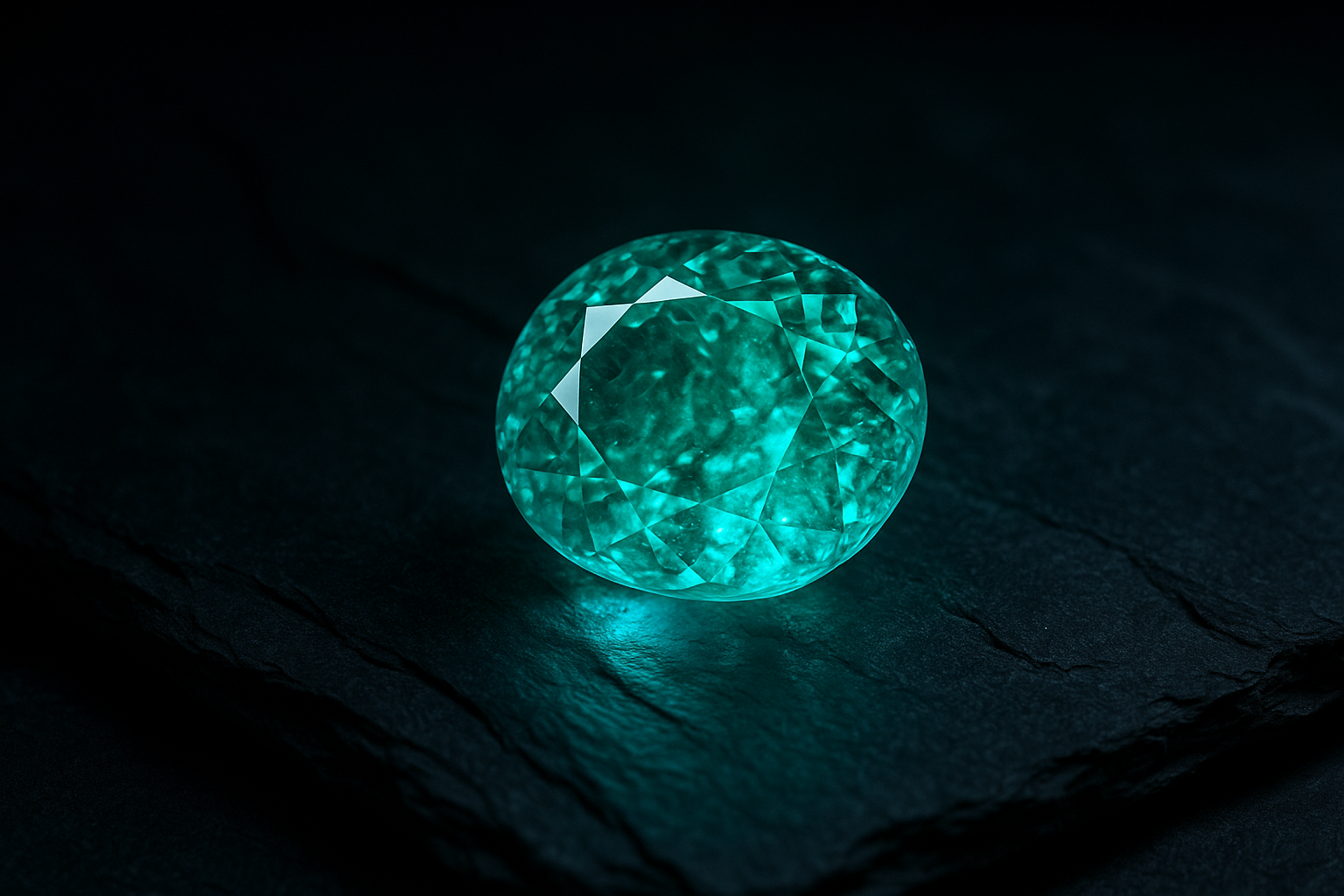
I passed on a 6.38-carat Mozambique Paraiba at AGTA last year. Clean stone. No windowing. The dealer had it priced at $22,000 a carat and clearly thought he was being reasonable — the carat count justified it on paper. I held it under my penlight for maybe four seconds. Stone was dead. Not bad color — just ordinary color. A pleasant turquoise with a whisper of copper, the kind you'd never pick out of a lineup if it didn't have "Paraiba" on the cert. I handed it back.
Three weeks later I bought a 1.91-carat Brazilian Paraiba, lightly included, at $54,000 per carat. The color was obscene — that Windex-blue neon that looks like it's plugged into a wall socket. SSEF cert, minor oil only. Client in Hong Kong bought it within 48 hours. Never even asked the carat weight.
That's the lesson. Paraiba is the only colored stone where I'll tell clients to ignore the scale entirely until they've assessed the glow. Everything else — sapphire, ruby, emerald — size plays a meaningful role in value calculation. With Paraiba, a dead 10-carat stone is just a very expensive paperweight.
What Makes a Paraiba Tourmaline "Neon" — and Why Does It Rule Everything?
Copper and manganese. That's the chemical fingerprint. The copper acts as a chromophore, absorbing certain wavelengths and letting the blue-green punch through with that surreal brightness. Most colored stones need ideal lighting to show their best face. A true neon Paraiba generates its own visual energy — the glow reads in dim office fluorescents, morning light, and even candlelight. It's the reason the stone looks radioactive in photographs.
The neon quality isn't marketing language. SSEF specifically grades it. Gübelin comments on it. AGL references "electric" or "neon" in the color description. When these labs use that language, they're describing a quantifiable level of saturation and brightness driven by copper content. Stones that lack it — and plenty of Mozambique material falls into this bucket — get described as "blue-green" or "greenish-blue" tourmaline with copper-bearing composition noted. The cert still says Paraiba-type. The price difference tells you everything about what matters.
I've had colleagues try to sell "Paraiba-type" stones with lab reports that hedge on the color descriptor. You know the ones — cert says "copper-bearing tourmaline, Paraiba-type" but the color call is "light bluish-green." That's a $4,000-per-carat stone calling itself the same name as a $60,000-per-carat stone. Same species. Completely different asset.
Mozambique vs. Brazil: Does Origin Change the Paraiba Price Per Carat?
Yes. Dramatically. But not for the reason most buyers think.
Brazilian Paraiba — São José da Batalha, the original 1989 discovery — commands a premium that defies logic. A 2-carat Brazilian neon blue with saturated color will regularly outprice a 4-carat Mozambique stone of comparable visual quality. Part of it is rarity: the Brazilian deposit was largely exhausted within a decade. Part of it is market psychology — the same collectors who demand Kashmir over Ceylon for sapphires apply the same origin hierarchy here.
But here's where it gets practical for someone actually buying: top Mozambique material with true neon saturation — and I mean the electric stuff, not the polite blue-green — trades at maybe 30-40% discount to equivalent Brazilian. The gap narrows every year. I've sold Mozambique stones at $35,000 per carat to clients who evaluated them against Brazilian stones priced at $50,000 and couldn't justify the premium with their eyes.
The trap is buying Mozambique material that doesn't have the neon. That's where origin becomes a crutch — a dealer saying "it's still a Paraiba" to paper over weak color. Brazilian origin amplifies an already-great stone. It doesn't rescue a mediocre one.
AGL and SSEF origin reports are the standard here. Gübelin for the trophy pieces. GIA doesn't carry the same weight for colored stone origin determination — I say that as someone who trusts GIA implicitly for diamond grading. Different tools for different jobs.
How to Evaluate Paraiba Tourmaline Value When You're Ready to Buy
Here's the checklist I run every time, and I've probably examined 200 Paraibas in-hand since 2009:
1. Color first. Everything else is a footnote. Turn off the dealer's halogen spots. Ask to see the stone under natural window light and dim office lighting. A true neon Paraiba holds its charge in bad light. A weak one disappears.
2. Saturation beats size every time. I'd rather own a 1.5-carat electric blue than a 4-carat washed-out green-blue. The 1.5 will appreciate. The 4 will sit in the safe.
3. Brazil > Mozambique for investment, Mozambique > Brazil for value at the top end. If you find a Mozambique stone with genuine neon saturation, you're getting 60-70% of the Brazilian experience at a fraction of the price. That's the sweet spot for a personal piece.
4. Inclusions are normal — and far less damaging than weak color. Paraibas are Type III clarity. Most have visible inclusions. The market forgives them. What the market doesn't forgive is a stone that doesn't glow. Don't let a dealer upsell you on "eye-clean" if the color is flat.
5. The cert must explicitly address copper and neon character. If the SSEF, AGL, or Gübelin report uses terms like "copper-bearing" without "neon" or "electric" in the color description, you're buying a different product at a potentially misleading price.
6. Heat treatment is common. Copper diffusion is not the same thing. Know the difference. Natural copper content from formation ≠ artificially introduced copper via diffusion treatment. A proper cert distinguishes these. If the price is too good to be true, have the stone re-checked.
You don't need a 5-carat Paraiba to own something extraordinary. You need a stone that, when you open the parcel paper under bad lighting, still makes you stop and stare. That's the entire test.
Frequently Asked Questions
What's the current paraiba price per carat range?
Brazilian Paraiba tourmaline with true neon saturation trades from roughly $30,000 to over $100,000 per carat for top-color stones under 3 carats. Mozambique material with strong neon runs $10,000 to $45,000 per carat. Once you cross 5 carats, the per-carat price can spike unpredictably — large neon Brazilians are unicorns. But the critical caveat is that these numbers assume excellent color. A 3-carat Brazilian Paraiba with weak saturation might sell for $8,000 per carat while a 1.5-carat neon Mozambique stone fetches $25,000. The per-carat figure is a function of color quality first, carat weight second, origin third. Anyone quoting you a flat per-carat number without discussing color is either uninformed or selling you a weak stone.
Why is paraiba tourmaline neon so valuable compared to other tourmalines?
The copper-manganese combination that creates the neon effect exists in only a handful of deposits worldwide. Standard tourmalines get their color from iron — which produces a darker, less vibrant blue-green. Copper produces brightness that reads as internally lit. The Brazilian deposit that started this in 1989 was so small that total production over its entire life wouldn't fill a shoebox. Mozambique's discovery in the early 2000s expanded supply, but only a fraction of Mozambique material shows the true electric neon that the market values. You're paying for chemistry that nature almost never gets right — and when it does, the result is visually unlike any other gemstone.
Which lab certification matters most for Paraiba tourmaline?
For copper determination and origin — SSEF and Gübelin are the gold standard. AGL's colored stone reports are also widely respected in the US market and I use them regularly. The key is that the report confirms copper content AND describes color character — "neon," "electric," or equivalent language. A report that only confirms "copper-bearing" without addressing the saturation and brightness of the color is telling you half the story. GIA is not the preferred lab for colored stone origin or treatment analysis — that's not a knock on GIA, it's just that SSEF, Gübelin, and AGL have built their reputations specifically on colored stone science. Use the right tool for the stone.
Written by Lawrence Paul
Lawrence Paul is a fine jewelry dealer based in New York's Diamond District with over 20 years of experience buying and selling signed vintage and estate jewelry. He is President of Spectra Fine Jewelry at 44 West 47th Street, Suite GF1, New York, NY 10036.
Continue Reading
Get the Collector's Newsletter
Join collectors who get authentication tips, market insights, and new guide alerts. No spam, just practical knowledge.
Need Help?
Send photos of a piece you're evaluating. We'll give you a straight read—no pressure, no BS.
Contact Spectra Fine Jewelry →Ready to Browse Authenticated Pieces?
Every item at Spectra Fine Jewelry goes through our verification process before it hits the case. No guesswork. No surprises.