Recutting Diamonds to Improve Clarity and Beauty: What Is Actually Possible
Published: June 4, 2026
The short answer: You can absolutely recut a diamond to improve clarity, symmetry, and light performance — I've done it dozens of times. A well-judged recut can remove a black inclusion, fix a deep pavilion, or transform a lifeless stone into something brilliant. But you need to know exactly what you're sacrificing in carat weight before you touch the wheel.
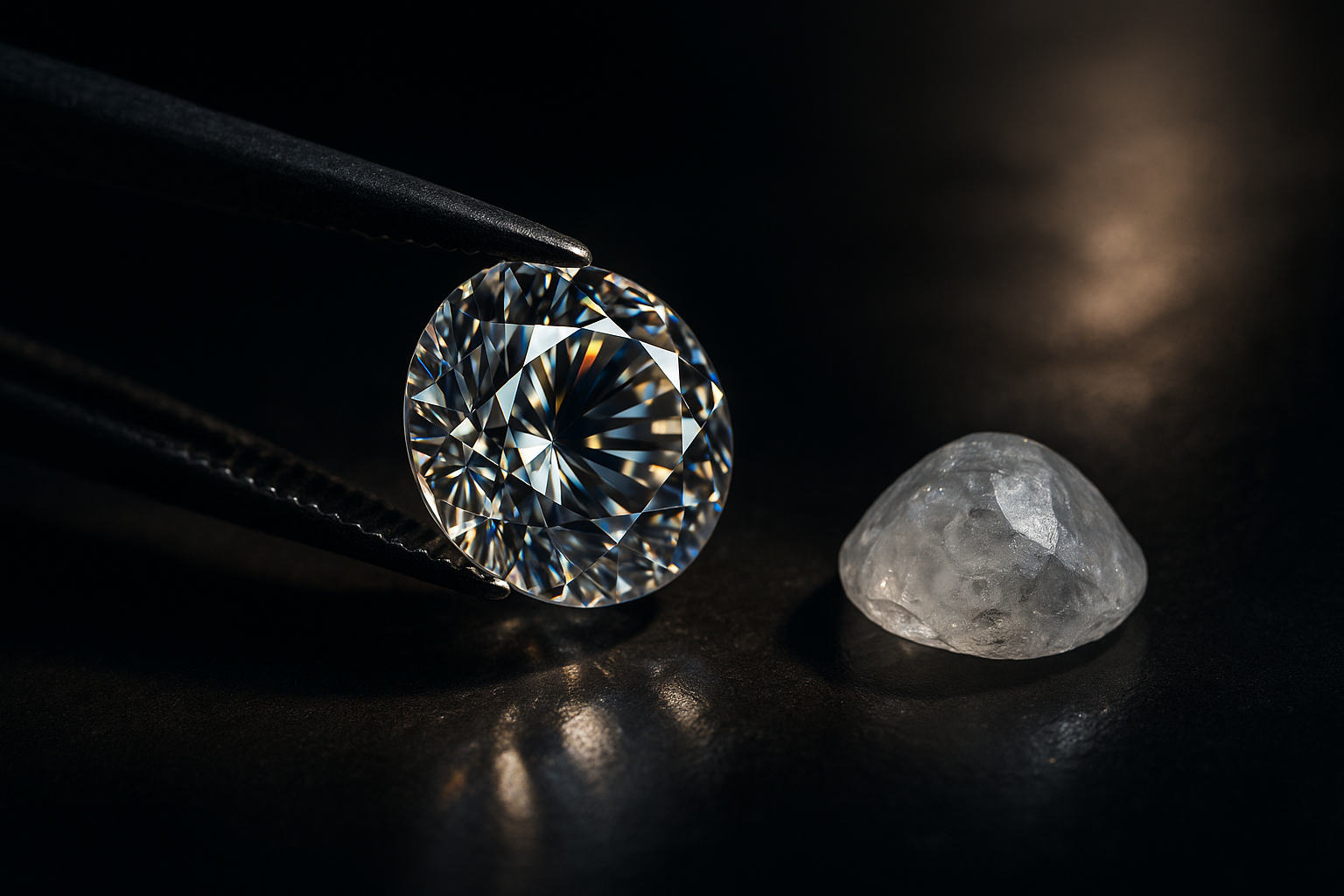
I bought a 3.58-carat round brilliant in 2019 that had everything going for it — G color, excellent symmetry, strong blue fluorescence. But it had a single black carbon spot directly under the table, visible face-up at arm's length. GIA graded it SI2. The stone sat in my safe for six months because nobody wanted an SI2 at that price point, no matter how nice the color was.
I sent it to my cutter with one instruction: lose the black spot. He took 0.19 carats off the crown, recut the table, and repolished the entire stone. The result? 3.39 carats, VS2 clarity, same G color. The stone sold in three weeks at a 22% higher price per carat than what I'd been asking before the recut. That's the math that matters.
How Much Clarity Improvement Can You Actually Get From a Recut?
Improvement depends entirely on where the inclusion sits. This is the single most important variable — not the grade, not the color, not the shape. Location.
If an inclusion is near the girdle edge or just under the bezel facets, you can remove it cleanly with minimal weight loss. I've seen stones jump from SI1 to VS1 with less than 3% carat loss when the inclusion was positioned right. A 2.01-carat cushion I handled went SI1 to VS2 losing only 0.08 carats — the crystal was sitting 0.4mm from the girdle, and the cutter angled the new crown facet just enough to eliminate it.
Inclusions dead-center under the table? That's the hardest case. You're recutting the entire top of the stone, and weight loss stacks up fast. A typical table-centered inclusion removal costs 8–15% of carat weight. It rarely makes financial sense unless the stone is exceptional in every other way, or you bought it specifically for this purpose at a steep discount.
Black inclusions (graphite or sulfide crystals) are the prime targets. Feathers and clouds — forget it. You can't cut out a fracture that runs through the stone, and clouds are collections of microscopic pinpoints that no recut will clean up. Know what you're dealing with before you buy.
Can Repolishing Fix Proportions and Light Performance?
Yes — and this is where most of the value creation actually happens.
I see diamonds every week with excellent color and clarity grades that look dead because the proportions are off. A 60% table on a round brilliant kills fire. A pavilion angle at 41.5 degrees instead of 40.75 creates a nailhead — that dark circle under the table that makes the center look empty. Deep pavilions, steep crowns, thick girdles: all of these are proportion problems, and all of them are fixable with a repolish.
The sweet spot for round brilliants is well-documented. Table 54–58%, depth 59–62.5%, crown angle 34–35°, pavilion angle 40.6–41°. I target these ranges when I'm evaluating a recut candidate. A stone that's currently "Good" or "Fair" on GIA's cut grade can often reach "Very Good" with a repolish, and sometimes "Excellent" if the starting material cooperates.
Weight loss on proportion-only repolishes tends to be modest — 2–5% typically. The payoff comes in marketability. An Excellent-cut G-VS2 sells faster and for more per carat than a Fair-cut G-VS2. Buyers today check cut grade. Twenty years ago they didn't. Now it's the first filter on every search.
One thing worth mentioning: symmetry and polish grades are the easiest to improve. A stone graded "Good" for symmetry often just needs minor facet adjustments. Going from Good to Excellent on polish is straightforward with modern equipment. These changes cost almost nothing in weight and immediately improve the GIA report.
What Kinds of Diamonds Should Never Be Recut?
Fancy shapes — be extremely careful here. A marquise, pear, or heart has a specific length-to-width ratio that buyers expect. Start adjusting pavilion angles and you can destroy the shape's proportions entirely. I've recut fancy shapes, but only when the original cutting was so poor that the stone was effectively unsellable anyway.
Stones with clarity enhanced by fracture-filling. If the diamond was treated with a glass-like substance to hide feathers, that treatment lives inside the stone. Heat from cutting can destroy it, and you're left with a more included diamond than you started with. Check the GIA report comments section — "clarity enhanced" means don't touch it.
Stones under 0.50 carats rarely make economic sense. The per-carat cutting cost eats your margin. The math only works when the absolute dollar value justifies the work.
Fluorescence — here's where it gets interesting. Strong blue fluorescence can mask a slight yellow body color, making an H or I appear whiter face-up. Recutting can change how light moves through the stone and reduce this masking effect. I've seen recut fluorescent stones drop half a color grade. Test the stone under multiple light sources before and after if fluorescence is a factor.
What Does a Recut Actually Cost?
Repolish-only work on a 1- to 3-carat stone runs $200–500 in New York. Full recuts with crown or pavilion work: $500–1,500 depending on complexity and the cutter's reputation. My regular cutter charges $85 per hour, and a straightforward recut takes 4–6 hours. Complicated jobs can run 12–15.
The real cost isn't the cutting fee — it's the carat weight you leave on the floor. On a $15,000-per-carat stone, losing 0.30 carats costs you $4,500. That's the number you need to run before picking up the phone.
I calculate a recut when three things align: the stone was bought below market, the inclusion or proportion problem is surgically fixable, and the expected post-recut per-carat price exceeds the pre-recut price by at least 15%. Below 15%, the risk isn't worth it. Above 15%, I'm making the call.
Start with the GIA report. Map the inclusion location on the plotting diagram. Talk to two cutters — not one. Show them both the stone and the cert. If their weight loss estimates differ by more than 3%, get a third opinion. And never, ever recut a stone you've already sold or consigned. This is spec work, done on your own inventory, on your own risk.
Frequently Asked Questions
Can every diamond be recut to a higher clarity grade?
No. Only diamonds where the grade-setting inclusion sits near the surface — typically within 0.5mm of the girdle or crown facets — can be recut for clarity improvement. An inclusion dead-center under the table can sometimes be removed, but weight loss runs 8–15%, and it rarely makes financial sense unless the stone is exceptional. Black crystal inclusions are the best candidates. Feathers, clouds, and internal graining cannot be cut out because they represent structural features or microscopic inclusion clusters that run through the stone. Always review the GIA plotting diagram before buying a recut candidate.
How much diamond weight do you lose during repolishing?
A proportion-only repolish — adjusting crown angles, pavilion depth, or girdle thickness without targeting a specific inclusion — typically costs 2–5% of carat weight. A 2.00-carat stone might finish at 1.93–1.96 carats. Full recuts that reposition the table or remove crown material to eliminate an inclusion run higher: 5–15% depending on inclusion location and depth. I budget 10% weight loss as the midpoint for planning purposes. The key calculation is whether the post-recut per-carat price increase exceeds the dollar value of the lost weight.
Does GIA re-grade a diamond after it's been recut?
Yes. You submit the repolished or recut stone for a new, full GIA grading report. The original report number is retired. The new report will show the updated carat weight, clarity grade, cut grade (for round brilliants), polish, and symmetry assessments. Proportions will also be re-measured. I always request the new report before offering the stone for sale — buyers want current documentation, not a "before" cert with a story about what changed. The grading fee is the same as any standard GIA submission, and turnaround runs 2–4 weeks depending on service level.
Written by Lawrence Paul
Lawrence Paul is a fine jewelry dealer based in New York's Diamond District with over 20 years of experience buying and selling signed vintage and estate jewelry. He is President of Spectra Fine Jewelry at 44 West 47th Street, Suite GF1, New York, NY 10036.
Continue Reading
Get the Collector's Newsletter
Join collectors who get authentication tips, market insights, and new guide alerts. No spam, just practical knowledge.
Need Help?
Send photos of a piece you're evaluating. We'll give you a straight read—no pressure, no BS.
Contact Spectra Fine Jewelry →Ready to Browse Authenticated Pieces?
Every item at Spectra Fine Jewelry goes through our verification process before it hits the case. No guesswork. No surprises.