SSEF, Gübelin, and AGL: The Only Lab Reports That Matter for Colored Gemstones
Published: May 16, 2026
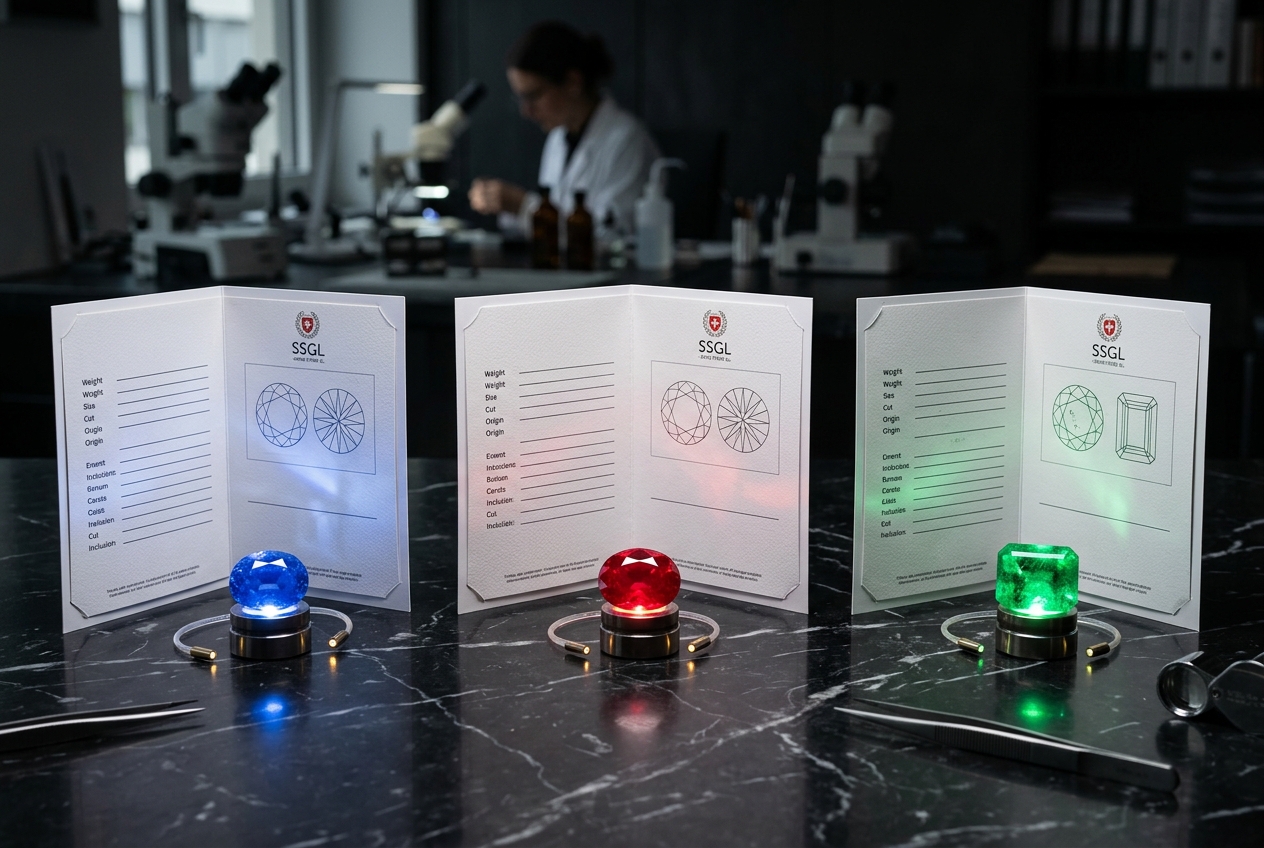
The short answer: GIA is the lab you use for diamonds — that's their lane, and they do it well. For colored stones, the three labs that determine origin and treatment with real authority are SSEF, Gübelin, and AGL. If your sapphire, ruby, or emerald report didn't come from one of these three, you're holding a document that serious dealers won't trust for origin calls.
I've said this on the phone more times than I can count: GIA is a diamond laboratory. Full stop. They grade diamonds better than anyone else on the planet. But when a client hands me a GIA report for a Kashmir sapphire and expects me to pay the Kashmir premium, I have to tell them the same thing I'm telling you now — that report doesn't carry weight for colored stone origin. Not with me, not with any dealer on West 47th Street who actually handles fine goods, and not at the auction houses.
The colored stone world operates on different science, different standards, and different labs. Here's what actually matters.
What Does SSEF Actually Test and Why Is It the Gold Standard?
SSEF — the Swiss Gemmological Institute, based in Basel — has been the reference lab for fine colored stones for decades. When Christie's or Sotheby's catalog a major sapphire or ruby, the SSEF report is the one pinned to the lot description. There's a reason.
SSEF runs laser ablation ICP-MS on every significant colored stone that comes through their lab. This isn't a visual opinion. It's trace-element chemistry — they vaporize a microscopic amount of the stone and measure the elemental fingerprint against a reference database they've been building since the 1970s. That database contains samples from every historically significant corundum deposit: Kashmir, Burma's Mogok Valley, Ceylon, Madagascar, and the newer African sources. When SSEF says "Kashmir origin," what they're actually saying is that the stone's chemical signature matches their Kashmir reference material across multiple trace elements — not just one or two markers, but the full elemental profile.
The same applies to their treatment analysis. "No indications of heating" on an SSEF report means they've examined the stone under high magnification, analyzed its inclusion patterns, and run spectroscopy looking for the telltale structural changes that heat treatment produces. It's not a guess. It's a negative finding based on systematic exclusion.
Their reports also include a full set of photomicrographs of internal inclusions, which serve as a fingerprint for that specific stone. I can match a stone to its SSEF report ten years later just from those inclusion photos.
How Does Gübelin Compare and When Should You Use It?
Gübelin Gem Lab, based in Lucerne, operates at the same level as SSEF with one distinction that matters in certain markets: their historical Kashmir and Burmese reference collections are arguably the most comprehensive in existence. Eduard Gübelin, who founded the lab in the 1920s, personally collected reference material from mines that no longer produce. That legacy collection is what makes a Gübelin origin report — particularly for Kashmir sapphires and Burmese rubies — essentially the final word in the trade.
Gübelin uses the same ICP-MS laser ablation chemistry as SSEF. Their treatment analysis protocol is equally rigorous. The practical difference is that Gübelin is more selective about what they'll issue reports on, and their turnaround times tend to be longer. But for a stone where the price difference between "Burma" and "Mong Hsu" is a factor of ten or more, that premium buys certainty that holds up anywhere.
Where Gübelin really distinguishes themselves is in reporting on historical and research-grade stones. If you have a stone of museum quality, Gübelin's report carries a gravitas that holds particularly well in Asian markets and with older-generation collectors. For everyday high-end commercial goods, SSEF and Gübelin are functionally interchangeable. Both are unimpeachable.
Where Does AGL Fit In?
AGL — the American Gemological Laboratories, based in New York — is the top-tier lab for colored stones in the United States. Their team runs a rigorous operation that, in my experience, produces treatment and origin analyses that any serious dealer will respect.
AGL has been doing this since 1977. Their proprietary color classification system is genuinely useful for communicating quality in the American market. A "Ceylon Type" or "Kashmir Type" notation on an AGL Prestige report tells me exactly what color range the stone represents.
AGL uses the same analytical tools as SSEF and Gübelin — ICP-MS for origin, spectroscopy and microscopy for treatment. Their reports are priced more accessibly than either Swiss lab and their turnaround is faster. For American-market goods that don't justify shipping to Switzerland, AGL is the correct choice.
What Should You Look for in a Legitimate Report?
A legitimate SSEF or Gübelin report for a sapphire or ruby will contain: the species (corundum), variety, carat weight, dimensions, color description, origin determination, treatment finding, and a full set of photomicrographs.
The language matters enormously. "No indications of thermal enhancement" is the gold standard — unheated. "Indications of minor heating" means the stone saw heat but light by trade standards. "Indications of heating with residues" means flux-heated, which trades at a significant discount.
For origin, SSEF and Gübelin will only state a geographic origin when they're confident. If the data is inconclusive, the report says "origin undetermined." A lab that never says "undetermined" is a lab you shouldn't trust.
Counterfeit SSEF and Gübelin reports exist. Verify any report number directly on their websites before wiring money. Takes thirty seconds and has saved clients from disaster more times than I can count.
Frequently Asked Questions
Does GIA grade colored stones?
GIA does issue colored stone identification reports, and they're competent at basic gemological identification — species, variety, basic characteristics. But GIA does not routinely provide geographic origin determination for colored stones, and their treatment analysis for colored stones does not carry the same weight as SSEF, Gübelin, or AGL in the trade. GIA's core competency is diamond grading, period. When I'm buying a Burma ruby or a Kashmir sapphire, I want an SSEF or Gübelin report with origin and treatment analysis. The auction houses understand this — you never see GIA reports attached to the top colored stone lots at Christie's Geneva or Sotheby's Magnificent Jewels. There's a reason for that, and it's not politics.
What does SSEF certified mean?
An SSEF certificate on a colored stone means the stone was analyzed by the Swiss Gemmological Institute in Basel using laser ablation ICP-MS trace element analysis, spectroscopy, and high-magnification microscopy. The report states the species, variety, geographic origin (when determinable), and treatment status. "SSEF certified" specifically for a sapphire or ruby means the stone's chemistry was compared against SSEF's reference database — built over 50+ years of collecting samples from Kashmir, Mogok, Ceylon, and every other significant deposit — and the origin call reflects that comparison. It's not a certificate of quality like a diamond grade. It's a certificate of origin and treatment status, issued by the lab the auction houses trust most.
How do I know if my ruby is Burmese — which lab should I use?
Send it to SSEF or Gübelin. Both have extensive Mogok reference material and decades of experience distinguishing Burmese ruby from Mozambique, Thailand, Madagascar, and other origins. For a stone you're planning to sell or insure at Burmese prices, I'd actually recommend submitting to both — a dual SSEF/Gübelin certification is bankable at any major auction house and removes any doubt from a sophisticated buyer's mind. AGL is also a valid option for U.S. transactions. If the stone comes back "Burma (Myanmar), no indications of heating" from either Swiss lab, you have one of the most valuable portable assets in the colored stone market. The lab fee is irrelevant against what that determination is worth.
Written by Lawrence Paul
Lawrence Paul is a fine jewelry dealer based in New York's Diamond District with over 20 years of experience buying and selling signed vintage and estate jewelry. He is President of Spectra Fine Jewelry at 44 West 47th Street, Suite GF1, New York, NY 10036.
Continue Reading
Get the Collector's Newsletter
Join collectors who get authentication tips, market insights, and new guide alerts. No spam, just practical knowledge.
Need Help?
Send photos of a piece you're evaluating. We'll give you a straight read—no pressure, no BS.
Contact Spectra Fine Jewelry →Ready to Browse Authenticated Pieces?
Every item at Spectra Fine Jewelry goes through our verification process before it hits the case. No guesswork. No surprises.