Van Cleef & Arpels Alhambra: How to Tell Vintage from Modern
Published: June 3, 2026
The short answer: Vintage Alhambra pieces (roughly pre-2000) carry thinner, sharper clover edges, hand-engraved serial numbers, and 18K gold that's warmer than current production. Modern pieces are heavier, with softer edges, laser engraving, and slightly cooler-toned gold. The clasp, the hallmark placement, and the serial number format will tell you in 30 seconds whether you're looking at a 1974 original or a 2024 boutique piece.
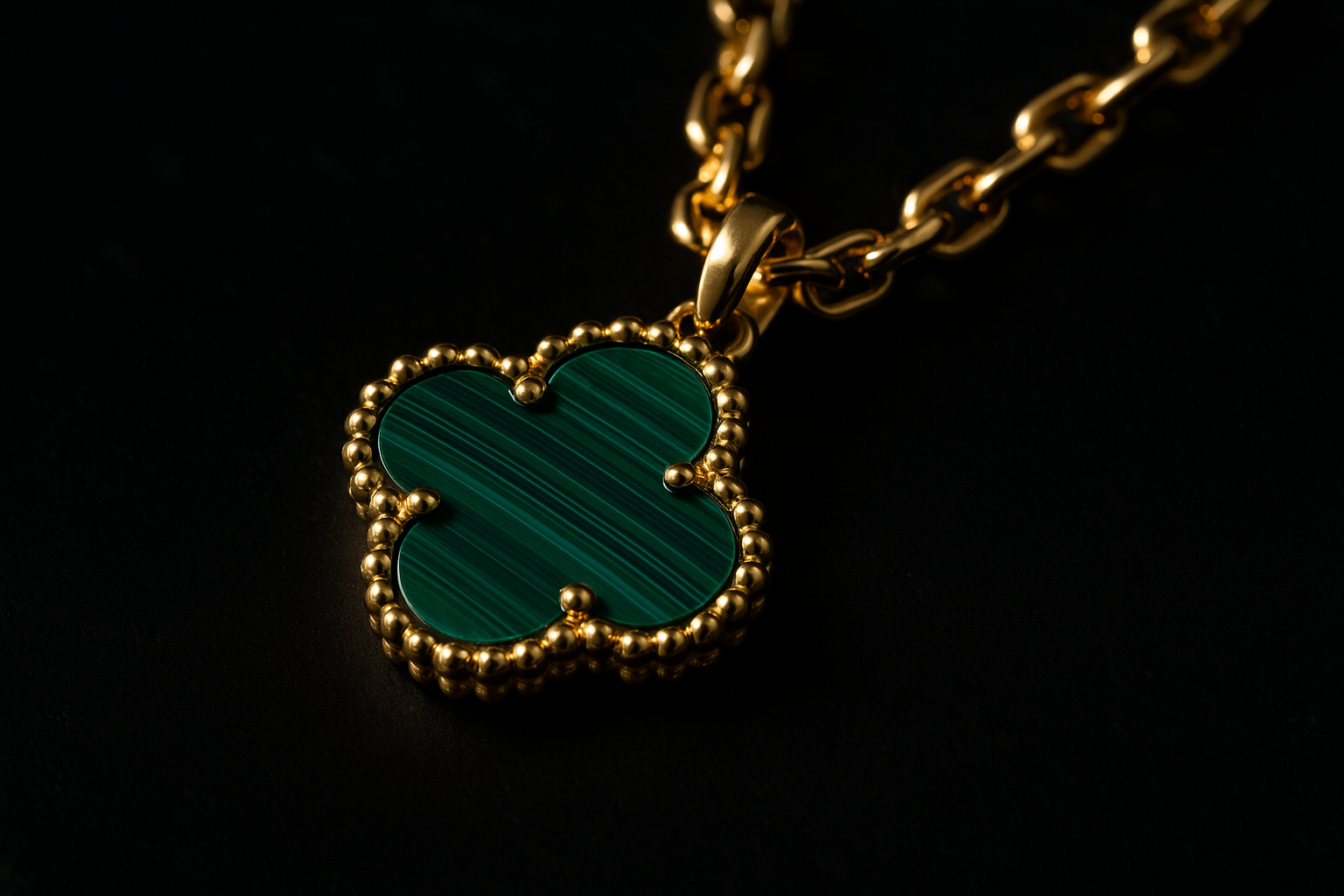
I bought my first vintage Alhambra necklace in 2014 — a 20-motif yellow gold with mother-of-pearl from the early 1980s. The seller didn't know what she had. I spotted the thin beading around each clover from across the room. That piece went to a private client three days later for nearly double what I paid. Seventeen years in the trade, and Alhambra is still the collection I get asked about most — specifically, "Is this old or new?"
The difference matters. A vintage Alhambra from the 1970s or 1980s trades at a different number than last year's boutique purchase. Knowing what you're looking at isn't academic — it's money.
How Can You Tell a 1970s Alhambra from a 2020s Piece?
Start with the gold. Early Alhambra production used 18K gold with a visibly warmer hue — the alloy had a higher copper-to-silver ratio than what VCA pours today. Modern Alhambra gold reads slightly cooler, almost leaning toward the champagne side of yellow. Hold a 1974 brooch next to a 2024 pendant and the color difference jumps out.
The clover motifs themselves tell the story. Vintage quatrefoils have sharper, more defined edges where each lobe meets its neighbor. The beading — those tiny gold dots tracing each clover — sits tighter and lower on vintage pieces. Modern production beads are slightly larger and sit higher off the surface. Run your fingernail around a vintage motif's bezel and you'll feel the crispness. A new one feels rounded, almost soft in comparison.
Weight is another giveaway. Vintage 20-motif necklaces come in about 2-3 grams heavier than their modern counterparts. VCA gradually lightened the construction over decades — not dramatically, but enough that a scale tells you something a loupe might miss.
What Does the Clasp Reveal About Age?
The clasp is where I look first. It's the fastest tell and the hardest to fake convincingly.
Pre-1990 Alhambra uses a distinct barrel-style clasp — slender, cylindrical, with a tight spring mechanism. The tongue fits flush; no gap, no wiggle. By the mid-1990s, VCA transitioned to a slightly wider barrel with a softer release. Around 2010, they introduced the current clasp design: still a barrel but chunkier, with a more rounded profile and visible seam lines the old ones never had.
The hallmark layout on the clasp ring is equally specific. Vintage pieces carry a small, deeply stamped French eagle head hallmark on the jump ring itself — usually worn but legible under 10x. Modern pieces bury the hallmark inside the clasp body or on an interior surface. If you don't see an eagle head on the ring, you're almost certainly looking at post-2000 production.
The safety chain attachment matters too. Vintage Alhambra uses a figure-8 safety catch — two interlocking rings you twist to separate. Modern pieces switched to a spring-ring safety around 1995–1998. If you see a spring-ring on what's claimed to be a 1980s piece, walk.
What Do Serial Numbers and Hallmarks Actually Prove?
Every Alhambra piece carries a serial number. Where it sits and how it looks will date the piece within a few years.
Pre-1980 serials are hand-engraved — each digit slightly irregular, cut into the gold with a graver. You can feel the texture. 1980s through mid-1990s serials are stamped — still uneven but mechanically pressed. Post-2000, everything is laser-engraved: perfect, shallow, uniform. Too clean. If the serial number looks like it was printed by a machine, it was.
Serial number placement shifted over time. Early Alhambra bracelets carry the serial on the flat edge of the clasp barrel. Necklaces hide it on the back of the motif nearest the clasp. After roughly 2005, VCA moved most serials to the interior of the clasp or the edge of the motif frame itself — positions that didn't exist in the early production.
The French assay marks (eagle head for 18K gold, dog head for platinum) should match the claimed era. Pre-1995 marks are smaller and stamped deeper. Post-1995 marks are larger with a rectangular surround rather than the original oval punch. Mismatched marks are the number one red flag I've seen across hundreds of pieces.
Is "Vintage Alhambra" Actually Worth More?
Sometimes. Not always. The market gets this wrong constantly.
First-generation Alhambra — 1968 through the early 1970s — commands a real premium. Pure collector territory. A 1972 20-motif lapis lazuli and yellow gold necklace hit $72,000 at Christie's Geneva in 2023, more than double what a current-production equivalent retails for.
But "vintage" doesn't automatically mean "more valuable." A 1998 turquoise Alhambra bracelet in good condition will outperform a 1978 onyx piece with visible wear. Condition over birth year, every time. The sweet spot I tell clients to hunt for: 1980s mother-of-pearl in yellow gold. Beautiful patina, excellent construction, still reasonable on price per piece. They surface at auction 4-6 times a year and consistently hammer below expectations.
The real premium sits with discontinued stone combinations. Lapis lazuli left production in the 1990s. Turquoise followed around 2005. Coral disappeared earlier. If you see coral, lapis, or turquoise Alhambra — and it's real — you're looking at something that cannot be bought new at any VCA boutique worldwide. That's where vintage separates from "used."
Here's what I check, in order:
- Clasp style — barrel vs. modern, spring tension, seam lines
- Hallmark location — on the jump ring (old) vs. inside the clasp (new)
- Serial number execution — hand-engraved, stamped, or laser
- Gold color — warm (old) vs. cooler champagne (new)
- Beading height — tight and low (old) vs. raised (new)
- Stone type — lapis, turquoise, coral = definitively vintage
- Weight — heavier construction on earlier pieces
Authenticate the piece. Price the era. Buy the condition. In that order — always.
Frequently Asked Questions
Do vintage Alhambra pieces come with original certificates?
Almost never for pre-1990 pieces. Original VCA paperwork from the 1970s and 1980s is rarer than the jewelry itself — I've seen maybe three or four complete sets in 17 years across hundreds of transactions. A vintage Alhambra with original box is uncommon; with original certificate is genuinely rare. What matters instead: the French hallmarks, the serial number format, and the physical construction details. When a seller waves a "certificate" for a 1978 Alhambra pendant, I want to see the hallmarks before I look at the paper. VCA will verify serial numbers directly — that's worth more than any old document.
Can VCA authenticate a vintage Alhambra piece for me?
Yes, but manage expectations. Van Cleef & Arpels will issue an authenticity certificate for any genuine piece, vintage or modern, for a fee (typically $1,500–$2,000 for vintage pieces as of 2026). The process takes 4-8 weeks and the piece must be submitted through a VCA boutique. They won't authenticate from photos. What they will verify: the serial number against their internal records, construction authenticity, and whether the stone was originally set by VCA. A replaced or modified motif kills the certification. Clean pieces pass. Altered ones don't.
How do I avoid buying a fake vintage Alhambra?
Buy from someone who doesn't need your money. That sounds harsh, but it's the most useful rule in this business. Established dealers on 47th Street, major auction houses (Christie's, Sotheby's, Phillips), and VCA boutiques themselves have reputations that dwarf any single transaction. Private sellers on Instagram, eBay listings with "estate find" in the title, and pop-up vintage shops without a physical address — that's where the problems live. Always verify the serial number independently. Always check hallmarks under magnification. And if the gold color looks slightly off in person, trust your eyes over the story.
Written by Lawrence Paul
Lawrence Paul is a fine jewelry dealer based in New York's Diamond District with over 20 years of experience buying and selling signed vintage and estate jewelry. He is President of Spectra Fine Jewelry at 44 West 47th Street, Suite GF1, New York, NY 10036.
Continue Reading
Get the Collector's Newsletter
Join collectors who get authentication tips, market insights, and new guide alerts. No spam, just practical knowledge.
Need Help?
Send photos of a piece you're evaluating. We'll give you a straight read—no pressure, no BS.
Contact Spectra Fine Jewelry →Ready to Browse Authenticated Pieces?
Every item at Spectra Fine Jewelry goes through our verification process before it hits the case. No guesswork. No surprises.