Verdura Jewelry: The Designer Collectors Quietly Accumulate
Published: July 2, 2026
The short answer: Verdura jewelry sits in a sweet spot — museum-quality design at a fraction of what you'd pay for Cartier or Van Cleef. Fulco di Verdura's goldwork is unmistakable once you've handled it. Serious collectors buy Verdura because the pieces talk, not because the brand screams. Prices run $8,000–$80,000 for strong vintage pieces, with the best Maltese cross cuffs and hardstone brooches crossing six figures at Sotheby's and Christie's.
I picked up a Verdura shell brooch at a trade show about eight years ago. Heavy 18K gold, a fat cabochon turquoise set dead center. The dealer next to me — a guy who moves serious Cartier — leaned over and said "I didn't know you bought Verdura." I told him that was exactly the point.
Fulco di Verdura was a Sicilian duke who walked away from the aristocracy to make jewelry. He worked under Coco Chanel for eight years in Paris before opening his own salon on Fifth Avenue in 1939. His clients included Greta Garbo, Katharine Hepburn, and the Duchess of Windsor — people who didn't need a logo to prove they had taste. That DNA runs through every piece: the jewelry assumes you get it.
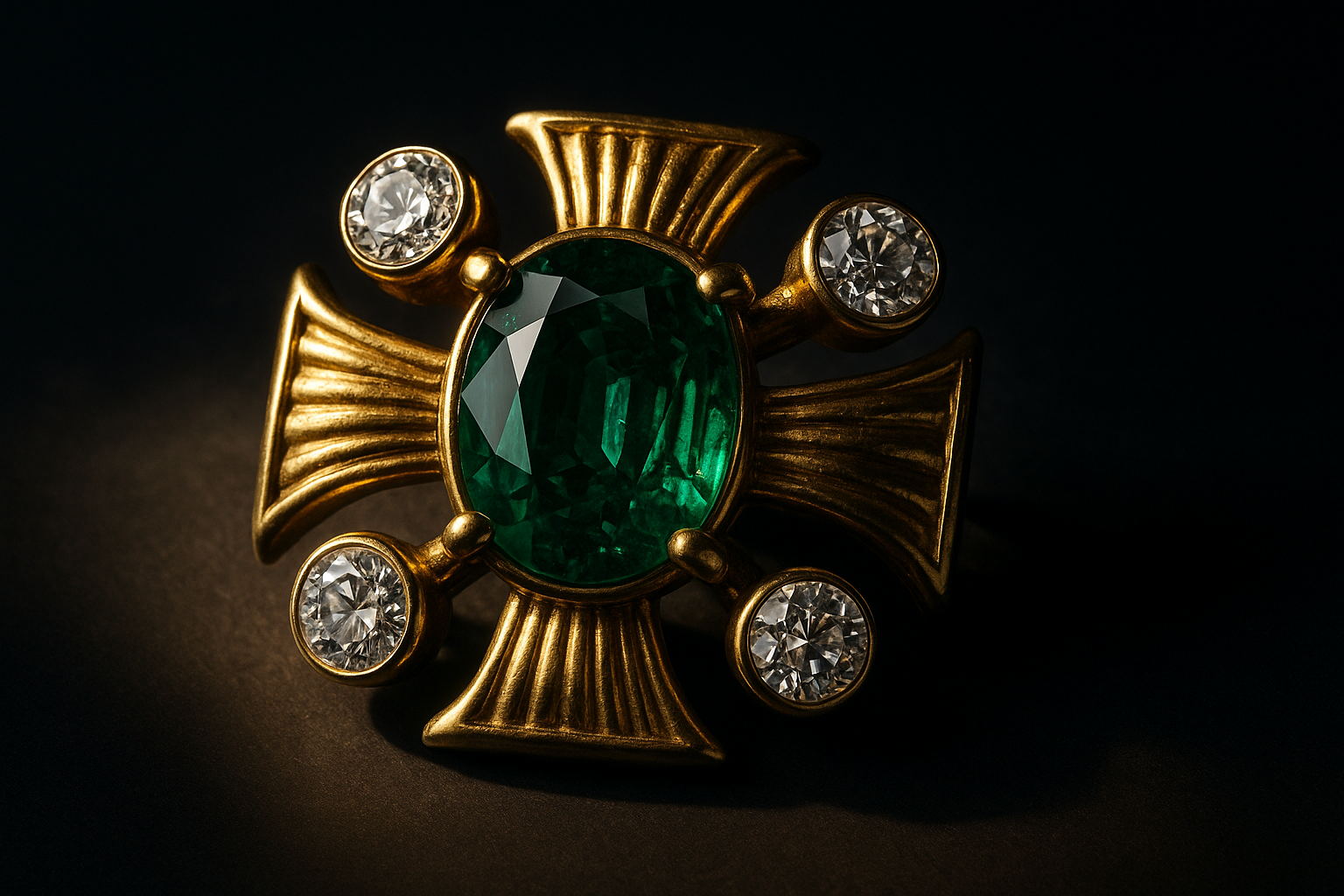
The designs pull from Byzantine mosaics, Renaissance ironwork, Baroque shells, and 18th-century ribbon motifs — but they never feel like costume or historical cosplay. A Verdura Maltese cross cuff in hammered gold with colored stone terminals looks as current today as it did in 1941. That's the trick. Very few jewelers pull it off across eight decades.
Why Doesn't Verdura Sell for Cartier or Van Cleef Prices?
Signatures, mostly. The market is irrational about brand hierarchy.
A Cartier Tutti Frutti bracelet brings $1.3 million. A Verdura piece of equivalent gold weight, stone quality, and design ambition might bring $45,000. The difference isn't the jewelry — it's the name recognition at the auction podium and the Asian market's buying patterns.
Verdura never built the global retail footprint that Cartier and Van Cleef did. No Place Vendôme flagship. No ubiquity in Hong Kong and Tokyo department stores. The result is a collector base that's deep but narrow: mostly American, mostly private, mostly people who've been buying for 25+ years and don't need Christie's to tell them what something is worth.
This creates opportunity. If you know what you're looking at, you can buy museum-quality signed jewelry at entry-level Cartier prices. I've seen a Verdura citrine and amethyst bombe ring — 30 carats of stone, hand-fabricated mount, perfect condition — trade at $9,500. The equivalent Bulgari piece would be triple that, minimum.
What Makes a Piece of Fulco di Verdura Jewelry Identifiable?
The gold tells you first. Verdura goldwork has a specific feel — substantial but not heavy-handed, with a matte finish on many pieces that looks soft but isn't. The construction is entirely hand-fabricated. You won't find casting seams or assembly-line consistency.
Motifs are the next giveaway. The Maltese cross shows up everywhere — cuffs, brooches, earrings, rings. Shells (scallops, conchs, cowries). Wrapped hearts with ribbon-like goldwork. Lion's paw feet on gem-set brooches. Moorish and Byzantine architectural references. If you see a gold bangle that looks like twisted fabric or knotted ribbon executed with zero solder visibility, you're probably looking at Verdura.
The stones matter too — but differently than you'd expect. Verdura didn't compete on carat weight. He used colored stones as punctuation, not paragraphs. A 2-carat tourmaline might anchor a piece because the color was perfect against the gold, not because he needed a big number for the insurance appraisal. Peridot, citrine, amethyst, turquoise, aquamarine show up far more often than sapphires or rubies. That stone selection is deliberate — it keeps the look warm, approachable, and distinctly Mediterranean.
Is Verdura Jewelry a Good Investment Right Now?
Yes, with a caveat: you need to pick the right pieces.
The Maltese cross cuffs are the blue chips. A strong example in yellow gold with hardstone or enamel terminals runs $25,000–$55,000 and has climbed roughly 60% over the past decade. The Byzantine and shell-motif brooches are the next tier — $8,000–$25,000 with steady appreciation but less auction heat. Avoid the post-1973 production unless it's an exceptional design. Ward Landrigan bought the company from Verdura in '73 and the business continued making jewelry, but vintage market premiums attach to the Fulco-era pieces (1939–1973).
The investment case isn't about explosive growth. It's about undervaluation relative to design quality. When a Verdura brooch and a Van Cleef brooch are sitting next to each other in a case and the Verdura has better goldwork, better design, and costs 70% less — that gap doesn't hold forever. The market corrects, just slowly.
One specific: if you find a Verdura piece with a period box and original design sketch, pay the premium. The archive at Verdura (still operating on Fifth Avenue, now run by Nico Landrigan) is meticulous, and provenance documentation adds 20–30% to resale value.
What Should I Know Before Buying Vintage Verdura?
First, condition on enamel pieces. Verdura used guilloché enamel (engine-turned pattern under translucent enamel) extensively, and it chips. A hairline crack that catches light wrong can knock 40% off value. Look at the piece under magnification and angled light.
Second, alterations. A lot of Verdura earrings were converted from clips to posts in the 1980s and 1990s. Some dealers don't disclose this. If the back looks newer than the front, ask. Converted pieces trade at a discount unless the work was done through the Verdura salon itself.
Third, signed pieces. Verdura signatures vary by era and piece type. Early Fulco-era pieces are signed "VERDURA" in block capitals, sometimes with a model number. Post-1973 pieces typically read "VERDURA" with "©" and "14K" or "18K." If you're unsure on a five-figure piece, Verdura's archive on Fifth Avenue can authenticate most designs. Use it. A $200 authentication fee beats a $25,000 mistake.
For colored stone verification — and Verdura used exceptional colored stones — SSEF, Gübelin, and AGL are the labs that matter. GIA is the standard for diamonds but is not the right choice for colored stone origin or treatment determination. I've seen too many Verdura pieces sold with wrong-origin stones because someone used the wrong lab report. Don't make that mistake.
Frequently Asked Questions
What's the price range for vintage Verdura jewelry?
Vintage Verdura runs $4,000 to $250,000+. Simple gold earrings or small shell brooches start around $4,000–$7,000. Strong period brooches with hardstones or enamel run $8,000–$25,000. Maltese cross cuffs are $20,000–$55,000 for good examples; museum-quality pieces with exceptional provenance have hit $80,000–$120,000 at Sotheby's. The very top — a major Fulco-era necklace or suite with original sketches — can push past $200,000. The sweet spot for a serious collector entry point is that $15,000–$30,000 range where you're getting world-class design for half of what a comparable Cartier piece costs.
How can I tell if a Verdura piece is from the Fulco di Verdura era?
Fulco-era pieces (1939–1973) carry the weight differently. The gold is heavier, the finishing is less polished, there's an organic quality to the fabrication that the post-1973 production doesn't quite replicate. Signatures help: early pieces often have just "VERDURA" stamped cleanly with a model number; later pieces add copyright marks and karat stamps. But the real answer is provenance — if the piece comes with an original box, sketch, or client correspondence, you know what you have. Verdura's New York archive can cross-reference most Fulco-era designs against their records. For any piece above $15,000, get the archive check. It's cheap insurance.
Who actually collects Verdura today?
American private collectors dominate, followed by European old-money buyers who remember when Verdura was on Fifth Avenue the first time around. The brand doesn't have the Asian market penetration of Cartier or Van Cleef, which is exactly why prices haven't inflated to match the design quality. You'll find Verdura in museum collections — the Met, the V&A, the Cooper Hewitt — but the private collector base is small, serious, and allergic to hype. These are people buying for their own vaults, not for Instagram. When a great Verdura piece comes to auction, you're usually bidding against maybe three or four people who know exactly what it is and what it's worth. That's rare in this market, and it's an advantage if you've done your homework.
Written by Lawrence Paul
Lawrence Paul is a fine jewelry dealer based in New York's Diamond District with over 20 years of experience buying and selling signed vintage and estate jewelry. He is President of Spectra Fine Jewelry at 44 West 47th Street, Suite GF1, New York, NY 10036.
Continue Reading
Get the Collector's Newsletter
Join collectors who get authentication tips, market insights, and new guide alerts. No spam, just practical knowledge.
Need Help?
Send photos of a piece you're evaluating. We'll give you a straight read—no pressure, no BS.
Contact Spectra Fine Jewelry →Ready to Browse Authenticated Pieces?
Every item at Spectra Fine Jewelry goes through our verification process before it hits the case. No guesswork. No surprises.