Vintage Boucheron: Why the 1960s and 1970s Pieces Are Worth Hunting
Published: June 5, 2026
The short answer: Boucheron's 1960s and 1970s pieces represent the house's most audacious creative period — bold sculptural goldwork, exuberant colored stone combinations, and designs that broke every rule. These pieces trade at a fraction of equivalent-period Cartier or Van Cleef, and the gap won't last. Buy them now while the market is still catching up.
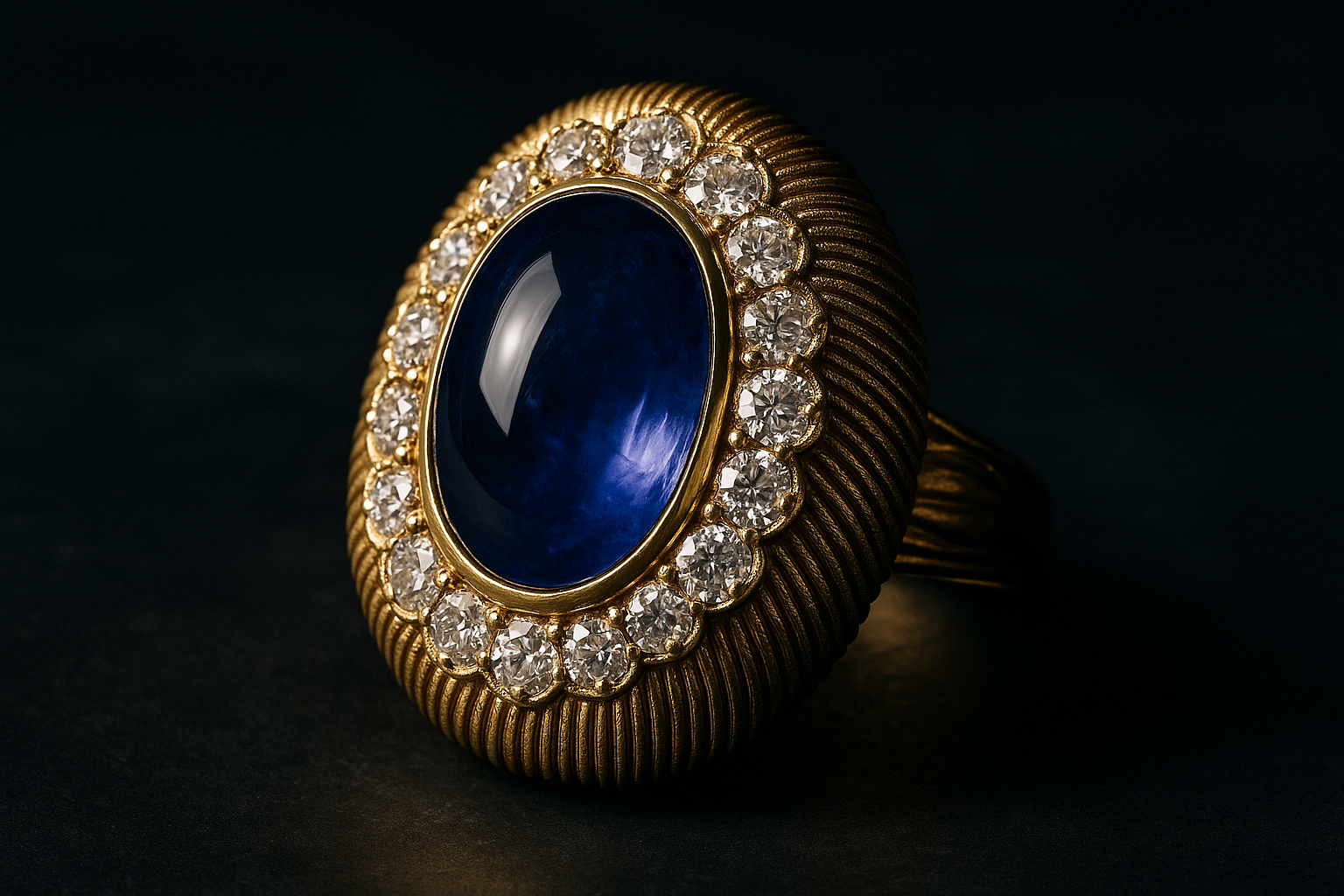
I bought my first vintage Boucheron piece in 2012 — a 1972 textured gold and diamond sautoir that a trade colleague had sitting in his safe for six months with no action. He was relieved to move it. I paid $18,000 and knew within an hour of holding it that I'd stolen it. Three years later, a private client in Hong Kong paid $65,000 for that same necklace. That's when I stopped treating Boucheron as the "other" French house and started hunting their 60s and 70s work seriously.
Here's what the market has been sleeping on.
Why Are Boucheron's 1960s and 1970s Pieces So Different From What Came Before?
Because the house finally let go of the reigns.
Frédéric Boucheron founded the house in 1858 at the Palais-Royal, and for the first hundred years, the brand operated like a high-society couturier for jewelry — technically flawless, deeply elegant, and stylistically conservative. Then the 1960s hit, and the third generation of the Boucheron family did something nobody expected: they hired outsiders. Designers who weren't trained in Place Vendôme tradition. Young sculptors. Goldsmiths who thought in volume, not just surface.
The result was jewelry that looked like nothing else coming out of Paris. Heavy twisted gold collars. Asymmetrical pendant necklaces where the imbalance was the point. Chunky cocktail rings with stone combinations Cartier would have considered vulgar but Boucheron made look inevitable. Coral next to lapis lazuli next to rock crystal. Turquoise carved into improbable shapes and set in 18K with diamond pavé — combinations that on paper sound wrong and in the hand feel electric.
The 1968 "Serpent" collection came directly from this period — the house took the serpent motif Cartier and Bulgari had explored and pushed it toward abstraction, creating pieces more about movement than literal representation. A 1969 Serpent bracelet I handled at auction two years ago hammered at CHF 34,000 against a CHF 18,000–22,000 estimate. Four phone bidders fought for it. The underbidders knew what they were looking at.
What Makes a 1960s/1970s Boucheron Piece Worth More Than Other Vintage Boucheron?
Three things, and none of them are "age."
First: the goldwork. Boucheron's workshops during this period invested heavily in textured gold techniques that few houses could match. They weren't just casting and polishing — they were hammering, chasing, and engraving surfaces to create light-play effects that make the metal look liquid. Pick up a 1970s Boucheron bracelet next to an equivalent-period Van Cleef and the difference is immediately tactile. Boucheron's gold has weight and texture; VCA's feels polite by comparison.
Second: the stone choices. While Place Vendôme competitors stuck to the classics — diamonds, rubies, sapphires, emeralds in predictable combinations — Boucheron was buying coral, turquoise, lapis, malachite, chrysoprase, and carved hardstones that required bench jewelers who actually understood how each material behaved under tools. You can't treat turquoise like lapis. You can't set malachite the way you'd set coral. Boucheron's workshop invested in that expertise, and the result is pieces where the colored stones aren't accents — they're the entire statement.
Third: signed and numbered doesn't mean documented. Most 60s/70s Boucheron pieces carry French assay marks and the house signature, but they predate the era of computerized archives. Boucheron's historical records for this period are incomplete. If you find a piece with full original paperwork or a period receipt, you're looking at a 15-25% premium over an identical unsigned or undocumented piece. I've paid the premium more than once and never regretted it — when you resell, that documentation converts a "nice piece" into a "collector's piece."
Where Do You Actually Find These Pieces Now?
The usual channels, but you have to be faster than the usual buyers.
Auction remains the primary source. Christie's Geneva November sales consistently yield 3-6 significant Boucheron lots from this period, and Sotheby's Paris is arguably better — French estates release Boucheron there with more regularity. The Sotheby's Paris December 2023 sale had a 1974 Boucheron turquoise and diamond "Feuillage" bracelet that hammered at €22,000 against a €12,000 high estimate. Three of us in the room knew exactly what it was. I was not the winner, and I regretted not bidding one more increment.
Bonhams London and Artcurial Paris are the sleeper sources. Less glamorous, fewer international phone bidders, and French provincial estates that don't attract the same competition. I've bought three significant Boucheron pieces through Artcurial in the last five years — each time against one or two other bidders at most.
The dealer network matters too. The 47th Street trade knows I buy Boucheron, and I get calls when estate pieces surface in Florida, Texas, and California — places where the local market doesn't recognize what it has. A 1971 coral and diamond ring walked into a Dallas estate buyer's office last year; they tagged it generically as "vintage French" at $4,200. The dealer who knows me called. I wired funds same day.
What Should You Check Before Buying?
Get the signatures right. Boucheron used multiple signature formats during these decades — the engraved script "Boucheron Paris" with the serial number is the most common, but some earlier 60s pieces carry a simpler block-letter stamp with French eagle-head assay marks. If the signature is laser-etched, walk away. That's a 2000s piece, not a 1960s.
Check the stone condition with magnification. Boucheron's 1970s turquoise and coral pieces have been worn, and both materials are soft. Chips at bezel edges are common and not necessarily dealbreakers — but they affect value, and you need to know about them before you pay. A good bench jeweler can polish out minor turquoise surface wear; a cracked coral cabochon is a replace-or-live-with-it decision.
Verify provenance when possible, but don't expect it. If you're buying from a French estate through Artcurial or a Parisian dealer, ask if the consignor has original boxes, receipts, or insurance appraisals. Most won't. The pieces that do carry a meaningful premium, and they sell faster.
Don't expect a lab report on the colored stones in these pieces. SSEF and Gübelin are the relevant labs for origin determination on sapphires, rubies, and emeralds — GIA is not the standard for colored stone origin work. But on a 1970s Boucheron piece at the $15,000–40,000 level, most sellers won't have invested in a full SSEF report. The house's signature and the period's known sourcing patterns (Ceylon sapphires, Colombian emeralds, Persian turquoise) tell you most of what you need to know. That changes above $50,000 — at that level, get the certificate.
Act Now or Pay More Later
The market is already tightening. Five years ago I could find 1960s/1970s Boucheron sitting unsold for months at prices that look absurd in retrospect. Today, the best pieces sell within weeks — sometimes days — of reaching the open market. Buyers from mainland China and Southeast Asia have discovered this period, and they're buying aggressively at the $20,000–60,000 level where most of the best material sits.
The 60s and 70s Boucheron pieces that combine textured goldwork with unusual colored stone combinations at a human scale — necklaces you can actually wear, rings that don't require a bodyguard — are still undervalued by 30-40% compared to equivalent-period Cartier or Van Cleef. That gap is closing. It won't close evenly, and it won't close forever.
Find a good one. Pay the ask. Don't look back.
Frequently Asked Questions
How can I authenticate a vintage Boucheron piece from the 1960s or 1970s?
Start with the signature. Look for an engraved or stamped "Boucheron Paris" mark with a serial number — usually five or six digits on 1960s pieces, longer on 1970s. You want French eagle-head assay marks on the gold, confirming 18K and French origin. The signature should show tool marks under magnification, not laser precision. Weight matters: Boucheron's goldwork from this period is substantial, not hollow. If it feels light for its size, be suspicious. The French assay marks are the hardest thing to fake convincingly — the detail on genuine 18K eagle heads is crisp under a loupe, while reproductions look soft, as if the metal didn't take the stamp cleanly. If you're unsure, ask a dealer who handles vintage French jewelry regularly. We can spot a bad signature in about ten seconds.
Are Boucheron pieces from the 1970s a better investment than 1960s?
I don't think of it as one decade being categorically better. The 1960s produced more restrained, architectural pieces that appeal to collectors who want wearable sophistication — think the early Serpent bracelets and the textured gold work that defined the transition out of the house's conservative period. The 1970s went bolder everywhere: bigger colored stones, chunkier profiles, more experimentation with coral and turquoise combinations that nobody else was attempting at that scale. The 70s pieces command stronger prices from fashion-forward buyers and clients who want a statement they won't see on anyone else. The 60s pieces sell well to the quiet-money crowd who appreciate the craftsmanship without needing to announce it. Both decades are undervalued. Buy the piece, not the year.
What's the price range for a good 1960s or 1970s Boucheron bracelet?
You can still buy a solid 18K textured gold Boucheron bracelet from this period — signed, with French assay marks, in excellent condition — for $6,000 to $12,000. Add turquoise, coral, lapis, or malachite elements and you're at $12,000 to $25,000. Diamond-set versions with significant carat weight push into $25,000 to $45,000 territory. The exceptional pieces — heavy serpent designs, full pavé diamond collars, unique stone combinations with original boxes — trade between $45,000 and $100,000 at auction. At every price point, you're paying 30-40% less than Cartier or Van Cleef from the same period for a piece that's at least as well made and arguably more distinctive. That math doesn't hold forever.
Written by Lawrence Paul
Lawrence Paul is a fine jewelry dealer based in New York's Diamond District with over 20 years of experience buying and selling signed vintage and estate jewelry. He is President of Spectra Fine Jewelry at 44 West 47th Street, Suite GF1, New York, NY 10036.
Continue Reading
Get the Collector's Newsletter
Join collectors who get authentication tips, market insights, and new guide alerts. No spam, just practical knowledge.
Need Help?
Send photos of a piece you're evaluating. We'll give you a straight read—no pressure, no BS.
Contact Spectra Fine Jewelry →Ready to Browse Authenticated Pieces?
Every item at Spectra Fine Jewelry goes through our verification process before it hits the case. No guesswork. No surprises.