How to Tell Vintage Van Cleef & Arpels Alhambra from Modern: A Dealer's Guide
Published: May 16, 2026
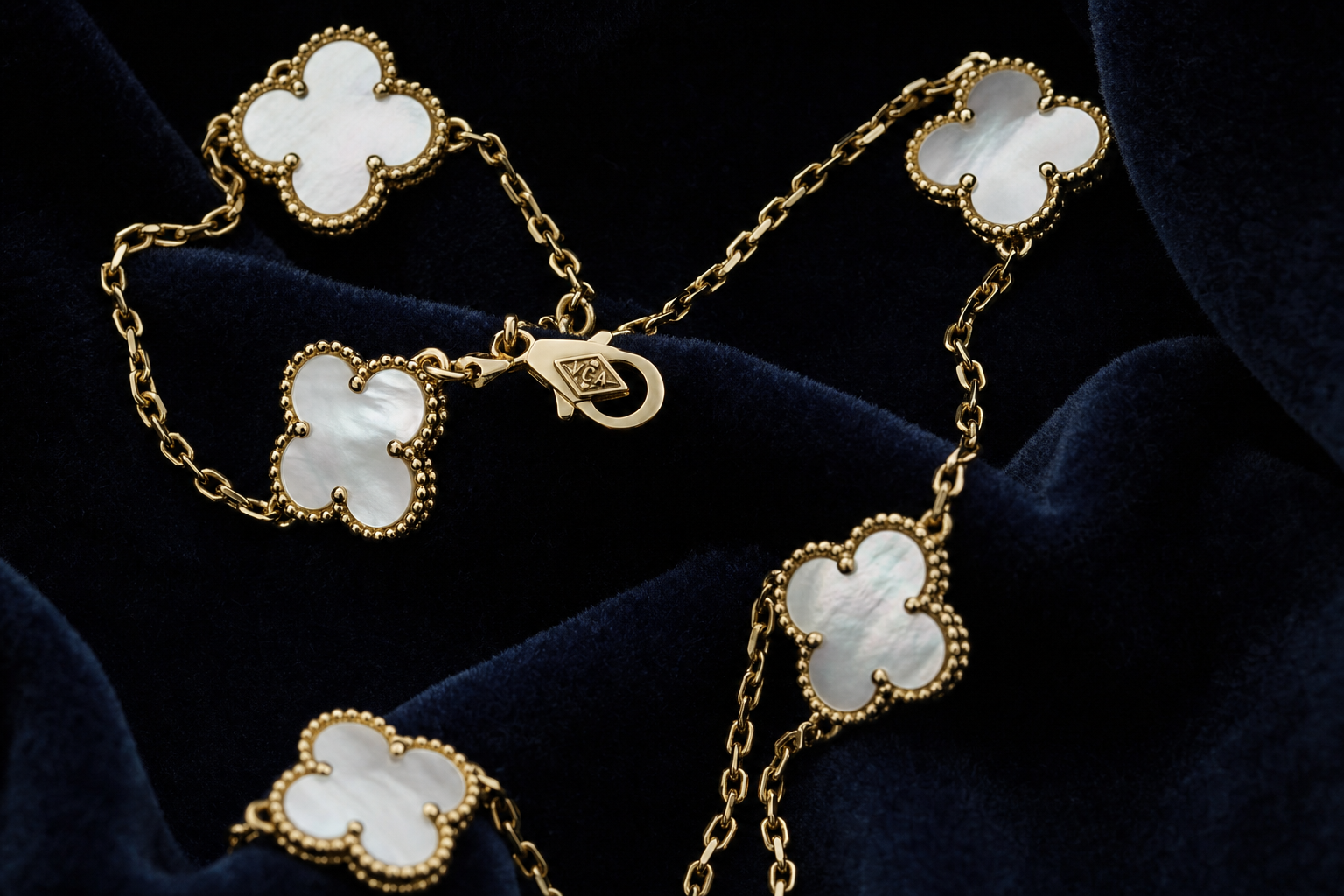
The short answer: Vintage Van Cleef & Arpels Alhambra from the 1968–1990s era shows hand-finished beading, distinct hallmark progressions, and subtle motif asymmetry that modern production lacks. Authentic vintage carries specific French maker's marks, smaller bead counts on early pieces, and patina on the gold that fakers consistently miss.
I've handled vintage Alhambra for 25+ years on 47th Street, and I can tell you this: 80% of what walks through my door labeled "vintage VCA" is either modern, married, or outright fake. The good news? Once you know what to look for, the differences are obvious. Let me walk you through what I check first.
Alhambra launched in 1968. Jacques Arpels designed the four-leaf clover motif as a personal good-luck symbol — he gave them to employees with notes saying "to plant in your garden of luck." That history matters because the earliest pieces (1968 through roughly 1975) are hand-finished by Parisian workshops in a way modern serial production simply can't replicate. A vintage 20-motif long necklace from 1972 trades at a 40–60% premium over modern equivalent. Sometimes more if it's in original Place Vendôme box with papers.
What are the actual physical differences between vintage and modern Alhambra?
The bead count along the motif edge is the fastest tell. Original 1968–1980s Alhambra motifs have 20 beads surrounding the quatrefoil shape. Modern production (post-2010 especially) is more consistent, but examine vintage under 10x loupe and you'll see slight variation — beads that aren't perfectly identical because they were hand-set. That irregularity is the proof of authenticity, not a flaw.
Second: the clasp. Vintage Alhambra used a simpler bridge clasp through the 1970s. The signature "VCA" clasp with the maker's stamp integrated into the hardware came later. A 1970s 20-motif yellow gold long sautoir should have a discreet hook clasp, not the modern signed clasp. If someone shows you "1972 Alhambra" with a modern signed clasp, it's either replaced (married piece) or fake.
Third: spacing and chain. Early Alhambra has motifs spaced at roughly 2.2cm intervals on long necklaces. Modern production tightened this slightly. Lay a vintage piece next to a modern one and the rhythm is visibly different.
Fourth: gold tone. Pre-1990s VCA used a slightly warmer yellow gold alloy. Side by side with a 2020 piece, the vintage reads richer, almost honey-toned. Modern gold is brighter, cooler.
What hallmarks should I find on authentic vintage Alhambra?
This is where most fakes fall apart. Authentic French Van Cleef carries:
- Eagle's head poinçon — French 18k gold hallmark, present on every authentic piece since 1838
- Maker's mark — VCA's registered mark with a four-pointed star and the initials in a lozenge (diamond) shape
- Serial number — engraved on the clasp or back of one motif, typically 6 digits for vintage, longer for modern
- "VCA" or "Van Cleef & Arpels" signature — placement varies by era. 1970s pieces often have signature on clasp only; modern has it on motif backs as well
Pieces made in Van Cleef's New York workshop (yes, they had one) carry slightly different marks. If you see "VCA NY" or American assay marks instead of French eagle's head, you have a U.S.-manufactured piece — still authentic, but a different production line and often priced lower than Paris-made.
The signature font matters. Vintage VCA signatures have specific letterform proportions that fakers consistently get wrong — the "C" in particular tends to be too round in fakes. Compare to a documented vintage piece if you can.
What do counterfeiters get wrong on Alhambra fakes?
After handling hundreds of fakes, here's where they fail:
- Bead uniformity is too perfect — counterfeit beading is laser-cut consistent. Real vintage beading has hand-applied irregularity
- Chain quality — fakes use lighter, hollow chain. Authentic VCA chain has substantial weight, solid construction
- Mother-of-pearl color — vintage VCA used premium MOP with rainbow iridescence. Fakes use cheaper MOP that looks flat, gray, or overly white
- Stone inlay precision — real Alhambra has stones flush with the gold frame, no gaps. Fakes show gaps or proud stones
- Weight — a 20-motif long yellow gold sautoir should weigh 35–40 grams. Significantly lighter = fake or hollow construction
- Hallmarks are missing, sloppy, or in wrong location — French hallmarks are required on every authentic French piece. No exceptions
Why does vintage Alhambra command a premium over modern?
Three reasons. First, scarcity — Van Cleef destroyed records of much vintage production, so authenticated pre-1990s pieces are genuinely rare. Second, the hand-finishing quality of Place Vendôme workshop pieces is simply better than modern serial output. Third, provenance — a 1970s piece with original VCA box, papers, and a documented owner history can double in value at auction.
I sold a 1969 20-motif yellow gold sautoir last year for $42,000 to a Hong Kong client. Modern equivalent retails around $25,000. The vintage premium was real, justified, and the buyer was happy to pay it because the piece had soul that new production doesn't carry.
If you're considering buying vintage Alhambra, get it inspected by a dealer who actually handles VCA regularly. Not a generalist appraiser. There are maybe 30 of us in the world who can authenticate vintage Alhambra confidently.
Frequently Asked Questions
Are all vintage Van Cleef Alhambra pieces stamped "Made in France"?
Not all. Vintage VCA produced pieces in both Paris and New York workshops through the 1970s and 1980s. French pieces carry the eagle's head poinçon and French maker's marks. New York pieces have American assay marks and "VCA NY" stamps. Both are authentic Van Cleef, but the French Place Vendôme production is generally more desirable and commands higher premiums at auction. I've also seen authenticated vintage pieces that lack a "Made in" stamp entirely because the regulations didn't require it for jewelry under certain weights or for export categories. The hallmark combination matters more than any "Made in" text.
Can I get vintage Alhambra authenticated by Van Cleef directly?
Yes, but it's slow and limited. Van Cleef & Arpels' Heritage Service in Paris will authenticate vintage pieces, but they prioritize their own clients and the process can take 6+ months. They will not provide written authentication for resale purposes — only confirm internally for their own restoration services. For trade purposes, you need a senior gemologist familiar with VCA's archive material, or you need to consign through a major auction house (Christie's, Sotheby's, Bonhams) where in-house specialists authenticate before catalog inclusion. That auction authentication is bankable for resale.
Is mother-of-pearl Alhambra worth as much as gold or carnelian versions?
Vintage MOP Alhambra holds its value well, but yellow gold Alhambra (no stone inlay) and vintage malachite or coral Alhambra typically trade higher per motif. Malachite was discontinued in the 1990s and is now a trophy material — a vintage 20-motif malachite long necklace can bring $35,000+ at auction. Carnelian is mid-tier. MOP is the most common stone version, so supply keeps prices reasonable, though vintage MOP with superior iridescence still commands real money. Condition matters enormously with MOP because it chips and dulls; a clean vintage MOP piece is worth significantly more than a worn one.
Written by Lawrence Paul
Lawrence Paul is a fine jewelry dealer based in New York's Diamond District with over 20 years of experience buying and selling signed vintage and estate jewelry. He is President of Spectra Fine Jewelry at 44 West 47th Street, Suite GF1, New York, NY 10036.
Continue Reading
Get the Collector's Newsletter
Join collectors who get authentication tips, market insights, and new guide alerts. No spam, just practical knowledge.
Need Help?
Send photos of a piece you're evaluating. We'll give you a straight read—no pressure, no BS.
Contact Spectra Fine Jewelry →Ready to Browse Authenticated Pieces?
Every item at Spectra Fine Jewelry goes through our verification process before it hits the case. No guesswork. No surprises.