Vintage Van Cleef & Arpels: How the 1950s, 60s, 70s, and 80s Differ
Published: May 16, 2026
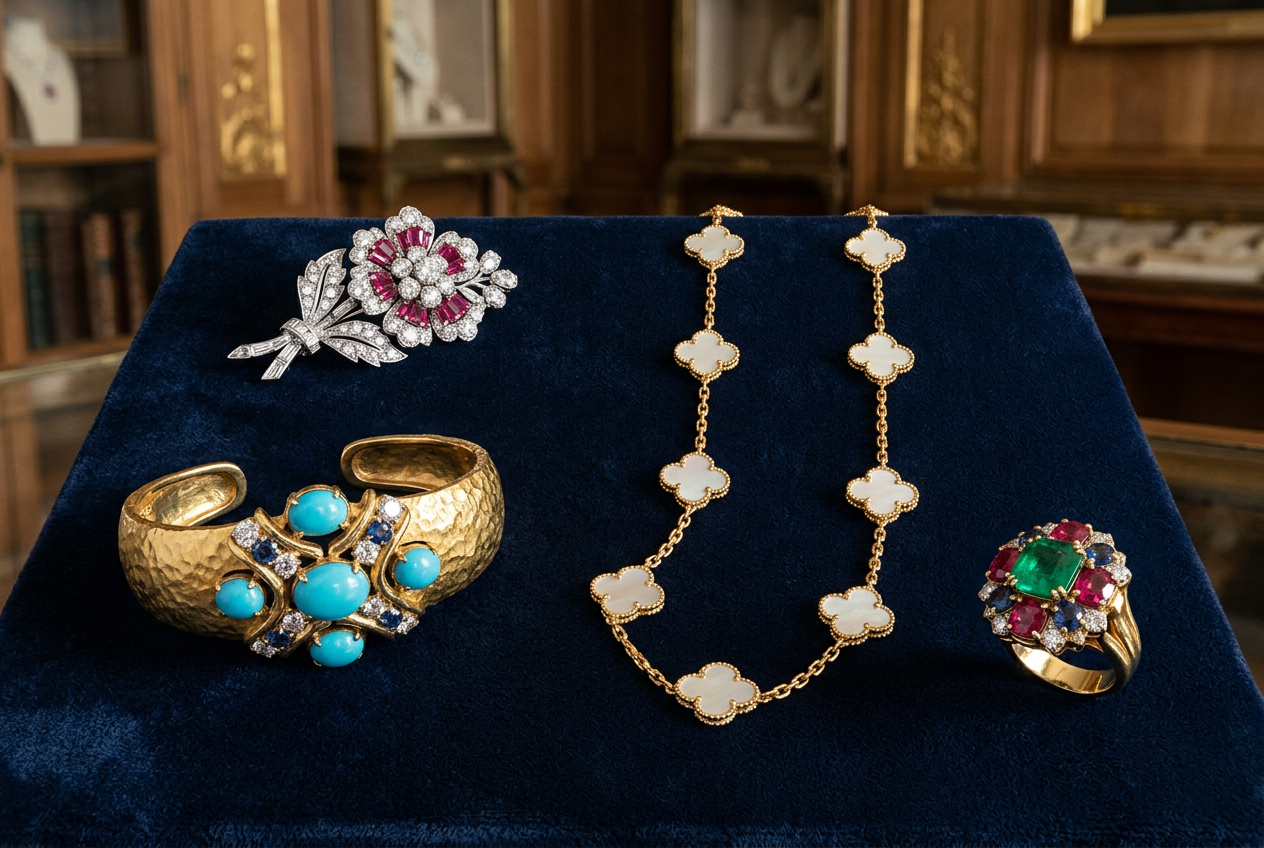
The short answer: Vintage Van Cleef & Arpels pieces from the 1950s–1980s differ dramatically by decade in design language, stone quality, construction, and hallmarks. The 1950s–60s commands the highest premiums — platinum/gold mixed construction, exceptional stone selection, hand-finished Paris workshop quality. Knowing the decade is the first step to knowing what you have.
I've bought and sold vintage VCA across all four decades, and I can tell you the difference the moment a piece lands on my desk. It's not just about age — it's about what each era meant for the house, what they were making, and why certain periods command three times the price of others.
The 1950s VCA is a different object than the 1980s VCA. Not better or worse in absolute terms — different design intentions, different clients, different stone sources. Here's how to read each decade.
What defines 1950s Van Cleef & Arpels?
The 1950s are when VCA was still dressing royalty and the very top tier of European and American society. The client list included genuine aristocracy, and the pieces reflect that. Platinum and yellow gold mixed construction. Stones selected for exceptional quality — you see Burma rubies and Kashmir sapphires in 1950s VCA that would be trophy lots at Christie's today if they were pulled out and sold loose.
Design language: naturalistic motifs. Flowers, leaves, bows, ribbons. The Mystery Set technique — where the gold prongs are completely hidden, making the stones appear to float — was being used at the highest level. If you find a Mystery Set VCA piece from the 1950s, you're looking at one of the most technically demanding objects in 20th century jewelry making.
Hallmarks: French eagle's head poinçon on all gold and platinum pieces. Maker's mark in a lozenge. Serial numbers are typically four or five digits. The "Van Cleef & Arpels Paris" signature appears on piece backs, sometimes abbreviated "VCA." The signature on 1950s pieces is typically finer, more delicate lettering than later decades.
Why this decade commands premium: the stone quality, the construction intensity, and pure scarcity. VCA wasn't producing volume in the 1950s. They were making extraordinary objects for a tiny clientele. Fewer pieces exist. The ones that do are spectacular.
What changed in the 1960s?
The 1960s brought cultural upheaval and VCA adapted. The house moved from pure naturalism toward more graphic, sculptural shapes. Cocktail bracelets became bolder. The color palette shifted — more yellow gold, stronger color contrasts.
The pivotal moment of the decade was 1968: the Alhambra collection launched. Jacques Arpels designed the four-leaf clover motif as a good-luck piece — the first Alhambra pieces were 20-motif long necklaces in yellow gold with mother-of-pearl. This was VCA's entry into what I'd call "accessible luxury" — still expensive, still hand-made, but designed for a broader clientele than the bespoke stone-set pieces of the 1950s.
Early Alhambra (1968–1972) is the most collectible variant. The beading is hand-applied, the motifs show slight asymmetry from individual craftsmanship, and the gold tone is distinctly warmer than modern production. These pieces trade at 40–60% premiums over contemporary Alhambra.
Non-Alhambra 1960s VCA — the larger sculptural pieces, the clip brooches, the bold cuffs — often trades at less than equivalent 1950s work but remains exceptional. The stone quality in 1960s pieces is still far above what you see in the 1980s.
Hallmarks: same eagle's head system, but serial numbers begin transitioning toward six-digit format in the later 1960s. The "VCA Paris" signature becomes more standardized.
What makes 1970s VCA distinctive?
The 1970s are the Alhambra decade. The collection matured, expanded, and became VCA's signature product globally. By the mid-1970s, you see Alhambra in multiple materials — carnelian, malachite, onyx, coral, turquoise — and multiple formats: earrings, bracelets, rings joining the original long necklace.
Malachite Alhambra from the 1970s is now trophy material — VCA discontinued malachite in the 1990s and surviving pieces in excellent condition can reach $35,000+ at auction. Coral is similar — natural undyed coral, now essentially unavailable due to trade restrictions. If you have 1970s Alhambra in malachite or coral with clean stones and good patina, it's worth considerably more than the more common MOP or onyx versions.
Beyond Alhambra, the 1970s produced bold clip brooches, butterfly clips (the Papillon series), and an increase in yellow gold construction as platinum fell out of fashion. The butterfly clips are undervalued right now relative to their design quality and rarity.
Construction: still hand-finished, but you can see the beginning of the transition toward more reproducible production methods. The irregularity of early Alhambra beading begins to even out by the late 1970s.
Hallmarks: six-digit serials standard. The "750" gold content mark (18k) becomes more prominent as European standardization increases.
How do 1980s VCA pieces differ from earlier decades?
The 1980s brought bigger, bolder, showier. Reagan-era America, Japanese luxury boom, Gulf state wealth. VCA responded with larger colored stone pieces, more elaborate constructions, and what I'd call "volume luxury" — pieces designed to make an impression across a room.
The stone quality in 1980s VCA is more variable than earlier decades. You still find exceptional pieces — the house hadn't stopped caring about quality. But you also find pieces where the emphasis was clearly on scale and visual impact over the refinement of stone selection. The rubies and sapphires in 1980s cocktail pieces are often heated commercial material rather than the unheated Burma/Kashmir goods that populated the 1950s inventory.
Alhambra in the 1980s is fully standardized production. Still hand-finished to a degree, but the irregularity of the early pieces is gone. These are excellent pieces — they hold their value, they're beautifully made — but they don't carry the premium of 1960s–70s Alhambra.
Why the 1980s trades lower than earlier decades: volume. VCA made more pieces in the 1980s than in any previous decade. Supply is higher, the stone quality is less consistent, and the design language — while bold — doesn't have the originality of the 1950s–60s work.
Hallmarks: longer serial numbers, "750" marking standard, "Van Cleef & Arpels" full name appears more consistently on piece backs alongside the VCA lozenge mark.
Frequently Asked Questions
What vintage Van Cleef & Arpels is most valuable?
On a per-piece basis, the highest values attach to Mystery Set pieces from the 1950s–60s with exceptional stones — Burma rubies, Kashmir sapphires, natural pearls in the original mounts. These can reach six and seven figures at Christie's or Sotheby's when the provenance is documented. Within more accessible ranges, early Alhambra (1968–1972) in yellow gold with original hook clasp commands the strongest premiums relative to modern equivalents — typically 40–60% over current retail. Discontinued materials (1970s malachite, 1970s–80s coral) in excellent condition are the best value plays right now because they're underpriced relative to their rarity. A clean malachite long necklace from 1974 is worth more than a modern MOP equivalent and it's not close.
How do I authenticate vintage Van Cleef from a specific decade?
The serial number format is the fastest rough guide — four/five digits typically means pre-1970, six digits means 1960s–70s transition, longer formats push toward 1980s. But serial numbers alone don't authenticate. For decade-specific authentication, you need to read the construction: clasp type (hook clasp = 1970s Alhambra, signed modern clasp = later), bead irregularity (more variation = earlier), chain weight (heavier = earlier), gold tone (warmer = pre-1990), and signature font. For pieces worth authenticating at significant cost, Christie's and Sotheby's vintage jewelry specialists are the right call — they handle hundreds of VCA pieces annually and their institutional knowledge is unmatched. I also authenticate pieces directly for dealers and clients who've been referred to me.
Is 1970s VCA considered vintage?
Yes, in any reasonable definition of the term. The industry generally considers jewelry 30+ years old to be vintage, which means anything pre-1990s qualifies. The auction houses treat 1970s VCA as vintage material and price it accordingly. More importantly, 1970s VCA has production characteristics that distinguish it from contemporary VCA — the hand-finishing quality, the hallmark system, the construction methods, and for Alhambra specifically, the motif spacing and bead irregularity that modern production doesn't replicate. Whether the label matters less than whether the piece has the attributes that justify a premium over contemporary production. A 1972 Alhambra sautoir does. A 1988 cocktail ring might or might not, depending on the piece.
Written by Lawrence Paul
Lawrence Paul is a fine jewelry dealer based in New York's Diamond District with over 20 years of experience buying and selling signed vintage and estate jewelry. He is President of Spectra Fine Jewelry at 44 West 47th Street, Suite GF1, New York, NY 10036.
Continue Reading
Get the Collector's Newsletter
Join collectors who get authentication tips, market insights, and new guide alerts. No spam, just practical knowledge.
Need Help?
Send photos of a piece you're evaluating. We'll give you a straight read—no pressure, no BS.
Contact Spectra Fine Jewelry →Ready to Browse Authenticated Pieces?
Every item at Spectra Fine Jewelry goes through our verification process before it hits the case. No guesswork. No surprises.