What a 32-Carat Kashmir Sapphire Is Really Worth — Reading a Real 2026 Auction Lot
Published: July 13, 2026
The short answer: A genuine unheated 32-carat Kashmir sapphire with strong cornflower-blue color and an SSEF or Gübelin origin report is worth $4.5 million to $7.5 million at auction in 2026. At the top end, that's roughly $140,000–$235,000 per carat. The number swings wildly based on one thing: color saturation. Size alone means nothing.
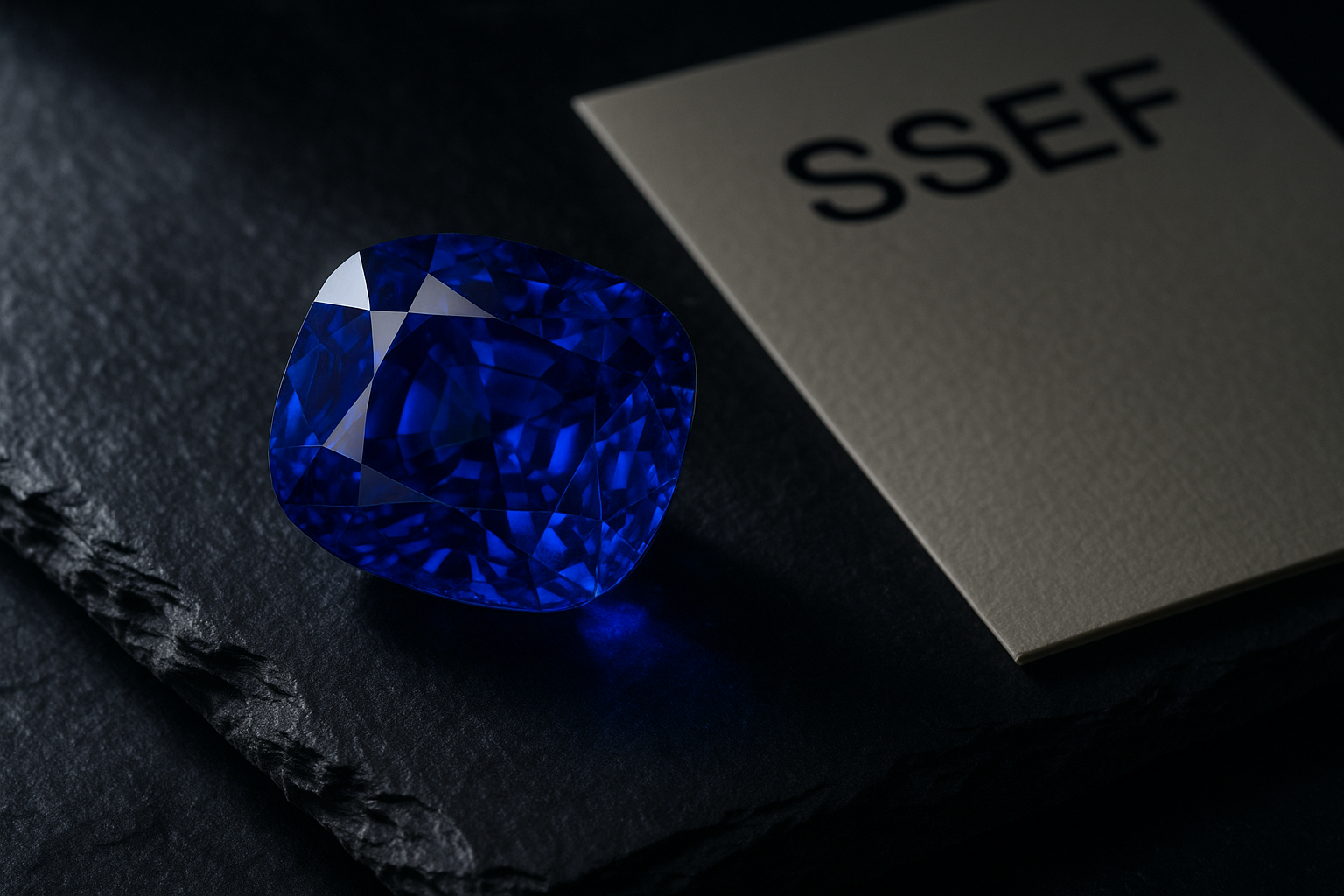
I've handled exactly one Kashmir sapphire over 30 carats in 17 years of buying. It wasn't mine — I was the underbidder. Lost it by CHF 80,000 in Geneva. Still think about that stone.
Here's the reality: a 32-carat Kashmir sapphire at auction in 2026 is a genuine event. The Kashmir mines — tucked 14,000 feet up in the Himalayas in a remote corner nobody can pronounce — produced sapphires from roughly 1882 to 1927. Less than 50 years. Then the deposit was exhausted. Every single fine Kashmir sapphire on the market today was already cut before any of us were born. There is no new supply. That's not marketing copy. That's geology.
So when a 32-carat stone hits the block, the trade notices. I notice. And the number on the hammer isn't random — it's the product of a handful of very specific factors that most auction previews won't spell out for you.
Let me walk through what actually determines the number.
How Do Auction Houses Price a 32-Carat Kashmir Sapphire?
They don't price it. They estimate it — and the estimate is a negotiation, not a valuation.
Christie's and Sotheby's set estimates based on what they need to land the consignment. The seller wants a high estimate (looks good in the catalog, sets a psychological floor). The auction house wants a low estimate (drives bidding, generates headlines when the lot "blows past" expectations). The published range you see is the compromise.
A 32-carat Kashmir sapphire in 2026 would likely carry an estimate of $3 million to $5 million. That's intentionally conservative. The actual hammer almost always lands above estimate on stones this rare — sometimes dramatically above.
Look at the comps. In May 2025, Christie's Hong Kong sold The Regent Kashmir — a 35.09-carat antique cushion-shaped Kashmir, unheated, with a Gübelin report — for HK$74.7 million. That's roughly $9.5 million, or $271,000 per carat. It set the world record price per carat for any sapphire at auction. Three carats heavier than our hypothetical 32-carat stone, but the per-carat math is the anchor the market uses.
Then in November 2025, the same room sold The Royal Blue necklace — 16 Kashmir sapphires totaling 104.61 carats — for HK$125.5 million ($16.19 million). Smaller individual stones, but the aggregate weight and the jewel's composition pushed the total past The Regent Kashmir's number. Different value driver: jewel significance vs. single-stone rarity.
In between, a 16.58-carat Kashmir cabochon sapphire ring — unheated, SSEF-certified — sold at Christie's New York in October 2025 for $1,016,000. That's roughly $61,300 per carat. Why the huge spread from $271K to $61K? Because cabochons trade at a discount to faceted stones, and color saturation on that particular stone didn't hit the top tier. Two Kashmir sapphires, both unheated, both with lab reports — separated by $210,000 per carat. The difference was entirely in the look of the stone.
Does Carat Weight Actually Drive Kashmir Sapphire Value?
Not the way you think.
A 32-carat Kashmir sapphire isn't worth twice what a 16-carat one is worth. The price-per-carat curve doesn't scale linearly — it stair-steps at rarity thresholds. Once you cross about 10 carats in fine unheated Kashmir, you're in thin air. Cross 20 carats, you're in a category with maybe a dozen known stones. Cross 30 — you're in single-digit territory.
The Regent Kashmir at 35.09 carats is the largest single Kashmir sapphire ever sold at auction. A 32-carat stone would be among the five or six largest Kashmir sapphires ever to appear in a public sale. That scarcity premium adds 40-60% on top of what the color grade alone would suggest.
But here's the trap: a mediocre 32-carat Kashmir sells for less than an exceptional 10-carat Kashmir. Every time. I've watched dealers buy stones based on the carat weight line on the cert and ignore what their eyes were telling them. Those stones sit in inventory for years.
The hierarchy, in order of what actually moves the price needle:
- Color saturation and tone — cornflower blue with that signature velvety softness that Kashmir material is famous for. Not too dark (inkies die on the auction block). Not too light (looks like Ceylon, kills the premium).
- No heat — a Kashmir sapphire with even minor heating is worth 40-60% less. The market demands untouched. SSEF and Gübelin reports that read "no indications of heating" are non-negotiable at this level.
- Origin report quality — SSEF and Gübelin are the authoritative labs for colored stone origin. GIA is the diamond standard, full stop. For sapphire origin and treatment determination, you want the Swiss labs. A stone this size without an SSEF or Gübelin origin report creates doubt that costs real money.
- Provenance — named collections (Rockefeller, etc.) add a floor. A stone from The Regent Kashmir's collection history trades differently than one that appeared from a vault in Geneva with no backstory.
- Cut quality and shape — cushion cuts dominate the Kashmir record books. Elongated shapes and deep bellies hurt per-carat value.
- Carat weight — matters, but only after items 1-5 check out.
What Would a 32-Carat Kashmir Sapphire Actually Sell For in 2026?
Based on the comps:
Strong scenario (top-tier cornflower blue, unheated, SSEF/Gübelin, clean proportions): $7 million to $7.5 million. That's roughly $220,000–$235,000 per carat. Right around where The Regent Kashmir traded, adjusted slightly down for the 3-carat weight difference but up for the 2026 market. Demand for top Kashmir hasn't softened — if anything, the Regent Kashmir result pulled more stones out of vaults and proved the depth of the buyer pool.
Good scenario (fine color, unheated, minor proportion issues or slightly less saturated): $4.5 million to $5.5 million. Roughly $140,000–$170,000 per carat. This is where most 30+ carat Kashmir stones actually land. Still a seven-figure number per carat. Still a multi-generational asset.
Weak scenario (the stone looks better on paper than in the case): $2.5 million to $3.5 million. A 32-carat Kashmir at $78,000–$110,000 per carat means the color isn't there. The market is ruthlessly efficient at punishing stones that disappoint in person. I've seen it happen in real time — the room goes quiet, the auctioneer works harder, and the hammer falls at or below the low estimate. The cert says Kashmir. The eyes say pass.
If you're bidding on something in this category, buy the plane ticket. Look at the stone. The cert tells you what it is. Your eyes tell you what it's worth.
Frequently Asked Questions
Why are Kashmir sapphires so much more expensive than sapphires from other origins?
The Kashmir deposit, discovered after a landslide in the early 1880s in the Padar region of the Himalayas, produced sapphires for roughly 45 years before the mines were exhausted. Total production from the entire history of the Kashmir mines is estimated at less than 200,000 carats of rough — and a large percentage of that was commercial or lower-grade material. Fine-quality faceted Kashmir sapphires over 5 carats are extraordinarily rare. Add the distinctive velvety cornflower-blue color, caused by microscopic rutile silk that scatters light in a way no other sapphire origin replicates, and you have a combination of objective beauty and absolute scarcity that no other colored stone origin matches. Burmese rubies have Mogok. Colombian emeralds have Muzo. But those mines still produce. Kashmir doesn't. When you buy a fine Kashmir sapphire, you're buying from a fixed pool that shrinks every time a major stone goes into a museum, a sovereign wealth fund, or a private collection that won't sell for two generations.
What lab report should a Kashmir sapphire have?
For colored stones — sapphires, rubies, emeralds, tourmalines — the authoritative labs are SSEF (Swiss Gemmological Institute), Gübelin Gem Lab, and AGL (American Gemological Laboratories). These three are the standard for origin determination and treatment detection on high-value colored gemstones. GIA is the gold standard for diamonds but is not the recommended lab for colored stone origin or treatment analysis — the Swiss labs have deeper reference collections and more specialized protocols for geographic origin determination on sapphires specifically. At the 32-carat level, I'd expect to see both an SSEF and a Gübelin report in the lot documentation. Two reports from different Swiss labs is not unusual at this value tier — it's standard practice. A GIA report alone on a seven-figure Kashmir sapphire would raise questions.
Can Kashmir sapphires be heated or treated and still hold value?
Any treatment on a Kashmir sapphire — even traditional heat — destroys 40-60% of its value compared to an unheated equivalent of similar color. The entire premium for Kashmir material rests on rarity, and rarity only matters if the stone is untouched. The market treats "no indications of heating" on an SSEF or Gübelin report as a binary gate: heated Kashmir is still Kashmir, but it trades in a completely different price universe. At the 32-carat level, a heated stone might sell for $1.2–1.8 million — still real money, but a fraction of what the unheated version commands. Most serious collectors and dealers won't even bid on a heated Kashmir over 10 carats. The buyer pool simply evaporates.
Written by Lawrence Paul
Lawrence Paul is a fine jewelry dealer based in New York's Diamond District with over 20 years of experience buying and selling signed vintage and estate jewelry. He is President of Spectra Fine Jewelry at 44 West 47th Street, Suite GF1, New York, NY 10036.
Continue Reading
Get the Collector's Newsletter
Join collectors who get authentication tips, market insights, and new guide alerts. No spam, just practical knowledge.
Need Help?
Send photos of a piece you're evaluating. We'll give you a straight read—no pressure, no BS.
Contact Spectra Fine Jewelry →Ready to Browse Authenticated Pieces?
Every item at Spectra Fine Jewelry goes through our verification process before it hits the case. No guesswork. No surprises.