What AGL Certified Actually Means (And When It Matters)
Published: May 16, 2026
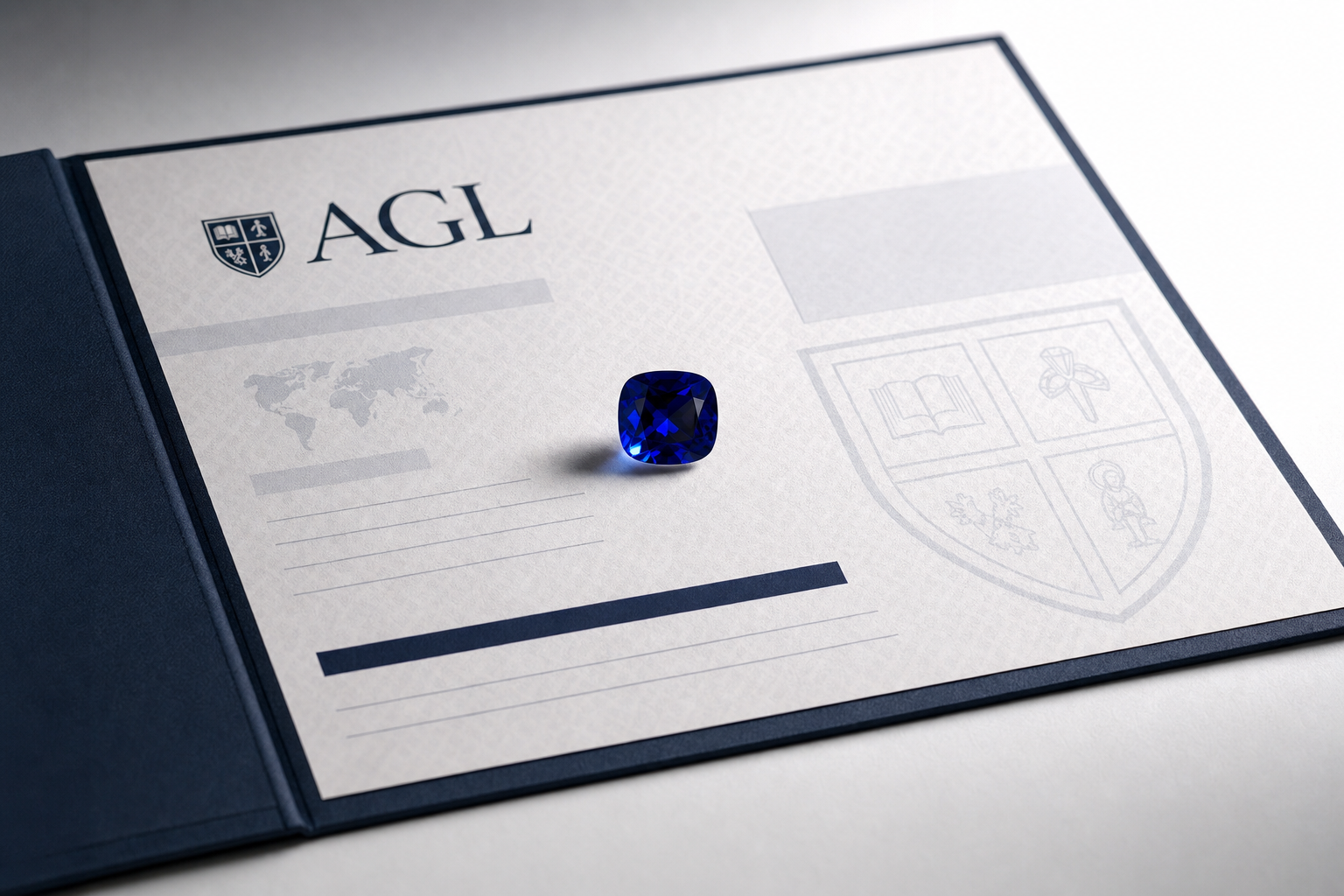
The short answer: AGL (American Gemological Laboratories) is the leading U.S. colored stone certification lab. Their reports determine geographic origin using trace element analysis, assess heat treatment and clarity enhancement, and — for qualifying stones — assign color grades like "Pigeon Blood" or "Royal Blue." For colored stones above $5,000, AGL paper is often the difference between a sale and a pass.
I get asked this at least twice a week: "It has an AGL cert — is that good?" The answer is yes, with context. AGL is one of three labs I trust for colored stone origin and treatment work. Here's what their report actually tells you and when I insist on it.
What does AGL actually test?
AGL (founded in New York, 1977) runs the full suite of gemological analysis:
- Species and variety identification — confirming the stone is what the seller claims (natural ruby vs. synthetic, natural sapphire vs. glass imitation)
- Geographic origin determination — using laser ablation ICP-MS trace element mapping against their reference database. This is the critical test for origin premiums.
- Heat treatment assessment — detecting spectroscopic evidence of thermal enhancement. "No heat" vs. "heated" is often a 60–80% price difference on corundum.
- Clarity enhancement — fracture filling with oil, resin, or glass. For emeralds, rated on a scale (None → Insignificant → Minor → Moderate → Significant). For rubies, glass-filling detection is non-negotiable.
- Color grade — on their Prestige reports for qualifying stones, AGL assigns trade color grades: Pigeon Blood Red (ruby), Royal Blue (sapphire), Vivid Green (emerald). These are not arbitrary — they require specific hue, saturation, and tone criteria.
What's the difference between AGL report tiers?
AGL offers several report levels:
- Colored Stone Identification Report — basic species/variety ID, treatment status. No origin call. Useful for lower-value stones.
- Colored Stone Report — adds geographic origin determination. This is the standard report for mid-market colored stones.
- Prestige Gem Report — full analysis plus color grade designation for exceptional stones. This is what I want on anything above $30,000. The Prestige designation signals to buyers that the stone met AGL's quality threshold for detailed evaluation.
When someone shows me "an AGL cert," the first thing I check is which tier. A basic ID report with no origin call on a stone being sold as "Kashmir" or "Burma" is a red flag.
AGL vs. GIA for colored stones — what's the difference?
GIA is the best diamond lab in the world. For colored stones, they do solid work on treatment detection, and their origin determination has improved substantially over the last decade. But AGL has been focused exclusively on colored stones since 1977 and has one of the deepest reference databases for the origins that matter most — Mogok ruby, Kashmir sapphire, Colombian emerald, Paraiba tourmaline.
When a stone's origin call will change the price by $50,000, I want the lab with 45 years of specialized focus on that question. That's AGL or the Swiss labs (SSEF, Gübelin). GIA is acceptable on mid-market stones where origin is less critical to pricing.
When should I insist on AGL?
- Any colored stone above $10,000 where origin drives the price
- Any ruby where fracture-filling status is in question
- Any emerald where you need the treatment enhancement scale (None through Significant)
- Any sapphire or ruby where you want a trade color grade call (Royal Blue, Pigeon Blood)
- Any Paraiba tourmaline where you need copper-bearing confirmation and origin
For diamonds: GIA, always. AGL does diamond work but it's not their specialty and the trade doesn't value their diamond reports the same way.
Frequently Asked Questions
Does an AGL report guarantee a stone is untreated?
No — it reports what the lab detected. "No indications of heating" means their analysis found no spectroscopic evidence of heat treatment. It doesn't mean the stone was never heated; it means they can't detect it. Heating technology has advanced and some modern treatments leave minimal traces. AGL is using the best available methodology, but they're reporting on evidence, not making an absolute guarantee. That said, "no indications of heating" from AGL on a high-value stone is the best assurance available and is accepted as definitive by the trade. If you want more certainty, submit to both AGL and SSEF — if both say no heat, you're as confident as the current state of science allows.
How long is an AGL report valid?
Technically indefinitely, but practically, a report older than 10 years warrants fresh testing for high-value transactions. Lab methodology improves, reference databases expand, and what was a borderline origin call in 2012 might be a clear determination in 2025. I've seen Kashmir calls change on re-submission, and I've seen stones gain Burma origin calls that older reports missed. For any transaction above $50,000, I want a report issued in the last 5–7 years. The re-testing cost ($500–1,200 for a full Prestige report) is trivial against the transaction value and removes a negotiation variable.
Can I submit a stone to AGL myself, or does it have to go through a dealer?
You can submit directly. AGL accepts submissions from private clients and dealers alike. Their New York office handles all submissions. You'll need to fill out a submission form, pay the lab fee upfront (varies by report tier and stone value — typically $300–1,200 for colored stone work), and ship insured. Turnaround is typically 3–6 weeks for standard service, faster for rush. The report comes back with the stone. One caution: if you're submitting a stone you bought as "Kashmir, unheated, AGL certified" and the existing report is more than a few years old, re-testing before you sell rather than after is how you avoid surprises.
Written by Lawrence Paul
Lawrence Paul is a fine jewelry dealer based in New York's Diamond District with over 20 years of experience buying and selling signed vintage and estate jewelry. He is President of Spectra Fine Jewelry at 44 West 47th Street, Suite GF1, New York, NY 10036.
Continue Reading
Get the Collector's Newsletter
Join collectors who get authentication tips, market insights, and new guide alerts. No spam, just practical knowledge.
Need Help?
Send photos of a piece you're evaluating. We'll give you a straight read—no pressure, no BS.
Contact Spectra Fine Jewelry →Ready to Browse Authenticated Pieces?
Every item at Spectra Fine Jewelry goes through our verification process before it hits the case. No guesswork. No surprises.