What Happened to Argyle Pink Diamond Prices After the Mine Closed
Published: May 18, 2026
The short answer: Argyle pink diamond prices have doubled to tripled since the mine closed in November 2020, with top tender stones up 400%+. The supply tap is off permanently. Every stone that trades now was already above ground. There is no "next Argyle." Prices have one direction to go.
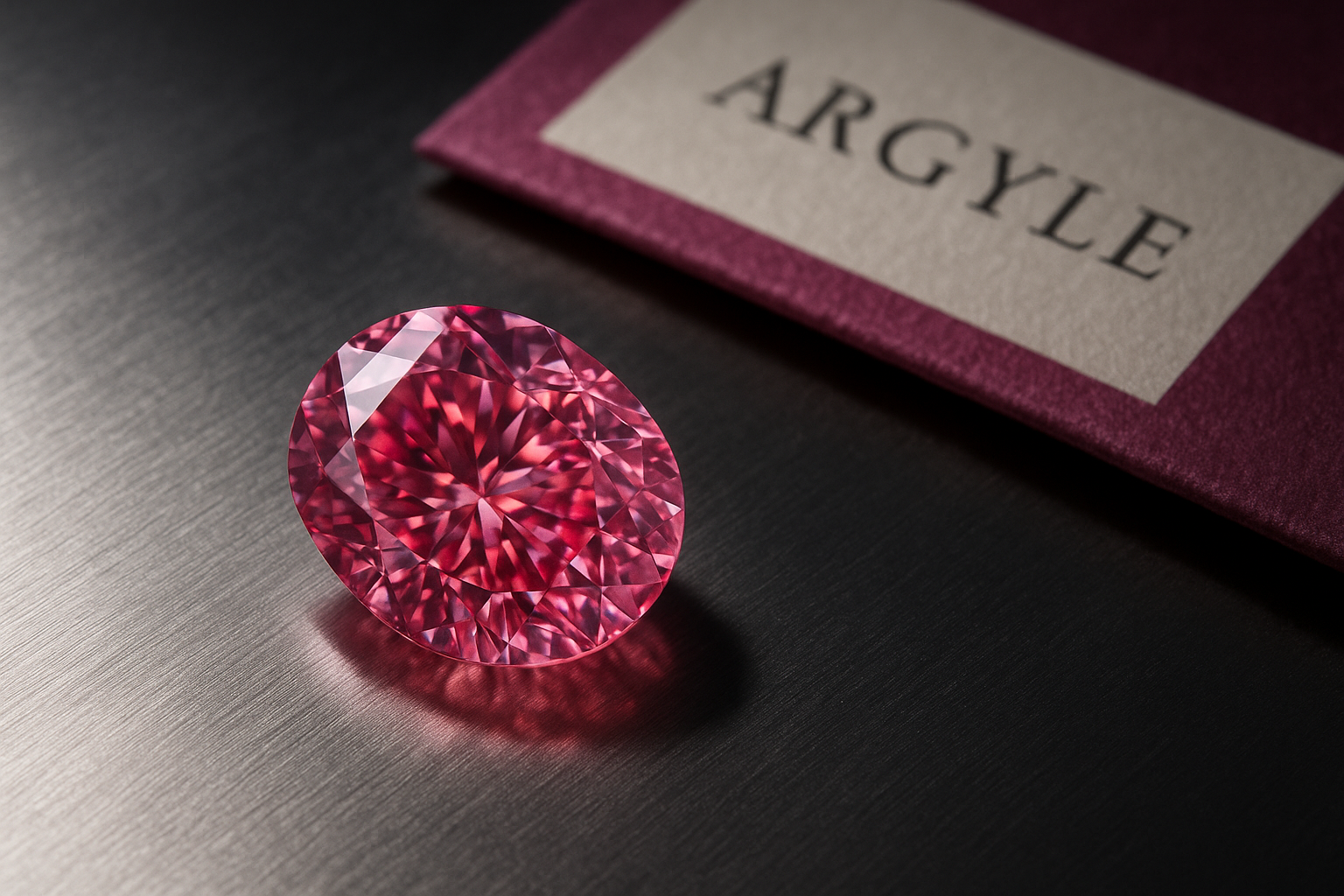
I held my first Argyle pink in 2011 — a 0.62-carat oval, fancy intense purplish pink, paid $38,000 per carat. My colleagues thought I was insane. "It's a treated fancy color," one guy told me. "Buy a GIA-certified fancy yellow and sleep better."
That stone would cost me $180,000 a carat today. Maybe more. Nobody's laughing now.
The Argyle mine in Western Australia produced 90% of the world's pink diamonds. It operated for 37 years under Rio Tinto and closed on November 3, 2020. During its entire life, every pink diamond the mine produced — every single one — would have fit in a single champagne flute. That's the scale we're talking about. Out of 865 million carats of rough, fewer than 1% qualified as pink. The truly exceptional stones, the ones Rio Tinto held back for the annual Argyle Pink Diamonds Tender, numbered maybe 50 to 65 per year.
The mine is gone. The ore body is exhausted. There is no stockpile.
How Much Have Prices Actually Gone Up?
The numbers are real. I track this market weekly — it's my business and my obsession.
Tender stones — the top 1% of the top 1% — have seen the most dramatic moves. A 1.21-carat fancy red radiant that sold at the 2017 Tender for roughly $1.8 million per carat? Comparable stones traded privately in 2025 at north of $5 million per carat. That's not hype. I've had three different dealers in Hong Kong confirm similar numbers.
The broader market tells the same story with slightly less extreme multiples:
- 0.50–0.99 carat fancy pink (SI1–SI2): $25,000–40,000/carat pre-2020 → $90,000–160,000/carat today
- 1.00–1.99 carat fancy intense pink (VS): $60,000–120,000/carat pre-2020 → $220,000–380,000/carat today
- 2.00+ carat fancy vivid pink (VS+): $250,000–500,000/carat pre-2020 → $800,000–1,500,000+/carat today
- Fancy red, purple-pink, blue-pink (any size, any clarity): Pure auction-grade pricing. No dealer will quote you a "market" price because there is no market — every trade is a negotiation between two people who both know exactly what they're holding.
I sold a 0.81-carat fancy intense pink oval, VS2, GIA-certified, in December 2023 at $142,000/carat. In January 2020, that same category of stone would have cleared between $55,000 and $75,000. That's a tripling in less than four years.
Why Did Prices Accelerate After November 2020?
Three forces collided at once. Any one of them would have moved the needle. All three together created a supply panic that hasn't stopped.
First, the supply tap turned off. The mine produced roughly 90% of global pink diamond supply. Not 50%. Not 70%. Ninety percent. When it closed, the industry lost its only meaningful source of new pink rough overnight. The other mines that occasionally yield pink — Diavik in Canada, Lulo in Angola — produce quantities so small they're statistically irrelevant.
Second, the secondary market tightened instantly. The day the announcement hit, every serious dealer and collector I know stopped selling. Why would you liquidate an asset that just became permanently scarce? I pulled three Argyle stones off my website within 48 hours of the closure. So did everyone else. The supply of available stones on the open market collapsed before prices could even adjust.
Third, a new class of buyer entered. Pink diamonds had always been a jewelry person's purchase. Post-2020, the investment crowd arrived. People who'd never bought a colored diamond in their life suddenly wanted one — not because they loved the stone, but because they understood supply destruction when they saw it. When financial advisors start asking you about Argyle pink price per carat trends, the game has changed.
Are Argyle Pinks Still a Buy at These Levels?
I get asked this twice a week. My answer hasn't changed since 2014 when I started seriously accumulating: the window for "cheap" Argyle pinks closed five years ago. The window for "fair value" Argyle pinks is closing right now.
Here's the math that matters. Rio Tinto held 38 annual Tenders. Total Tender production over 38 years was roughly 2,000 to 2,500 stones. That's the entire universe of top-tier Argyle pink diamonds that will ever exist. Compare that to Kashmir sapphires — another legendary source that ran dry — where no new material has emerged in over 80 years and prices have compounded at roughly 12–15% annually for three generations. In some size/quality brackets, Kashmir sapphires are up 3,000%+ since the 1970s.
Argyle pinks have been appreciating for five years. Kashmir sapphires have been appreciating for 80 years. The trajectory tells you everything you need to know about the timeline here.
What to look for now:
-
Buy the cert, not just the color. GIA is the only lab that matters for Argyle diamonds. A GIA report with an Argyle inscription number adds a 15–25% premium over an equivalent pink that can't be source-verified. Do not buy an "Argyle" pink that lacks the laser inscription. Dealers who sell uninscribed stones as Argyle are either careless or dishonest — neither is acceptable at these prices.
-
Clarity matters less than you think. I've sold an SI2 Argyle pink for more per carat than a VS1 from another source. The color — especially saturation and the presence of a secondary hue like purple or blue — drives 80% of the value. A fancy intense pink with SI2 clarity will outperform a fancy pink with VVS1 every time.
-
Tender lots vs. non-Tender lots. The Tender provenance premium is real and widening. Tender stones come with numbered certificates, custom packaging, and Rio Tinto's own documentation. The spread between a Tender-certified fancy intense pink and a non-Tender equivalent has grown from roughly 30% to 70%+ in some categories. If you can buy a Tender lot at under a 50% premium to a comparable non-Tender stone, you're getting a deal.
-
Size thresholds are everything. The jump from 0.99 to 1.01 carats isn't a 2% price increase — it's often 40–60%. The one-carat psychological barrier is real in this market. Same at two carats, same at three. If you're buying for appreciation, get above a threshold. If you're buying for beauty at a better price, stay just under.
The bottom line: there are roughly 2,000 Tender-quality Argyle pink diamonds in existence. That's it. That's the supply. Forever.
Frequently Asked Questions
Is it too late to invest in Argyle pink diamonds?
If you're asking whether prices will double from here in 18 months — probably not. The fastest appreciation window was 2021–2024. But if you're asking whether Argyle pinks will outperform virtually every other hard asset over a 10–15 year horizon, I'd bet yes. I'm still buying when the right stones surface. The key is discipline on entry price. Overpaying a motivated seller in 2026 is the same mistake as overpaying in 2019 — bad entry erases good thesis. Buy GIA-certified stones with Argyle inscription above the one-carat threshold, pay market not aspirational pricing, and hold. The supply curve doesn't bend from here.
What's the difference between Argyle pink and non-Argyle pink diamonds?
Argyle pinks have a distinct color signature — a specific purplish-pink saturation that's different from the brownish-pink or orangey-pink you typically see from other sources. More importantly, Argyle produced the overwhelming majority of fancy vivid and fancy intense pink diamonds on earth. A non-Argyle high-saturation pink is genuinely rare. That said, a beautiful pink is a beautiful pink regardless of origin. The Argyle name commands a premium because the mine's reputation is backed by 38 years of consistent, documented, auction-grade output. GIA-certified Argyle stones with laser inscriptions command the strongest premiums. Without the inscription, you're buying seller claims.
How do I verify an Argyle pink diamond is authentic?
Three checks, in order. One: the GIA report must state natural color origin — no treatments, no HPHT, no irradiation. Argyle ran its own grading but GIA is the standard post-sale. Two: the diamond must carry the Argyle laser inscription on the girdle, visible under 10x magnification. The inscription typically includes the Argyle logo and a unique ID number. Three: for Tender stones, Rio Tinto issued numbered certificates and custom packaging that should accompany the diamond. If all three align, you have a verifiable Argyle pink. If any one is missing, the premium should reflect that — or you should walk.
Written by Lawrence Paul
Lawrence Paul is a fine jewelry dealer based in New York's Diamond District with over 20 years of experience buying and selling signed vintage and estate jewelry. He is President of Spectra Fine Jewelry at 44 West 47th Street, Suite GF1, New York, NY 10036.
Continue Reading
Get the Collector's Newsletter
Join collectors who get authentication tips, market insights, and new guide alerts. No spam, just practical knowledge.
Need Help?
Send photos of a piece you're evaluating. We'll give you a straight read—no pressure, no BS.
Contact Spectra Fine Jewelry →Ready to Browse Authenticated Pieces?
Every item at Spectra Fine Jewelry goes through our verification process before it hits the case. No guesswork. No surprises.