What Platinum Jewelry Hallmarks Tell You About Age and Authenticity
Published: June 11, 2026
The short answer: Platinum hallmarks are the single most reliable way to date a piece and confirm authenticity. The mark itself — its shape, the number, the presence or absence of maker stamps — tells you more in three seconds than a loupe session ever will.
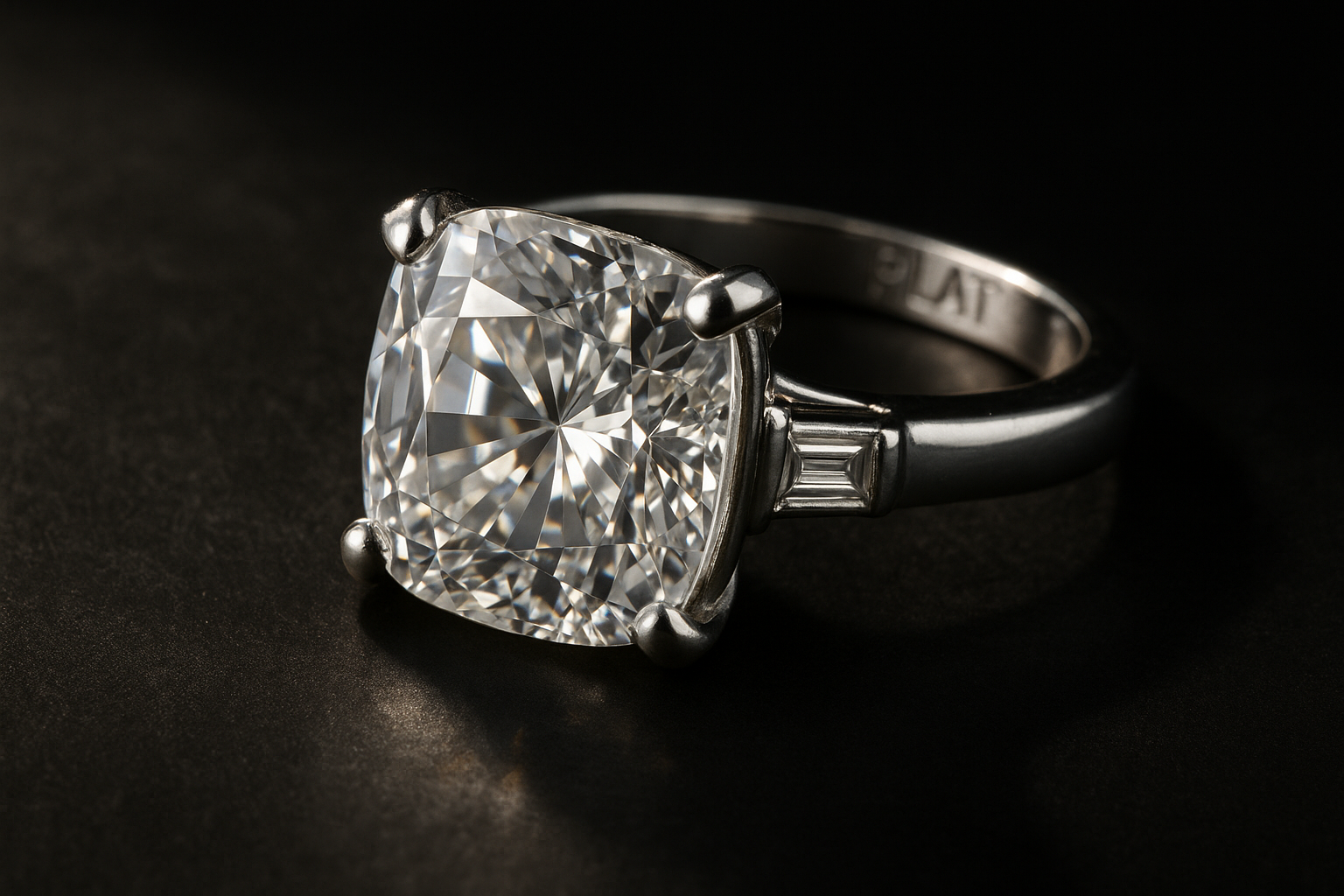
I bought a Cartier bracelet at auction two years ago that had every dealer in the room hesitating. The design was right, the weight felt correct, the stones checked out. Nobody bid. I did. Why? Because the hallmark was a pre-1912 French eagle's head on platinum — a mark most dealers under 50 have never seen outside a reference book. That bracelet was 1910, and it was undervalued by about sixty percent because nobody else could read the stamp.
That's not a flex. That's what hallmarks do. They're the fingerprint. And for platinum, the fingerprint tells a richer story than almost any other metal.
Why Does Platinum Even Need Hallmarks?
Because platinum is deceptive.
It's dense. It feels heavy in the hand the way gold does, which means a lead-filled fake can pass the "heft test" if you're not careful. It doesn't tarnish, so surface appearance tells you nothing about age. And unlike silver — which has a thousand years of hallmarking tradition across Europe — platinum hallmarking didn't really get standardized until the early 20th century. That gap creates confusion. Confusion creates deals. It also creates fraud.
A correct hallmark eliminates the guesswork. Not "probably platinum." Not "tests like platinum." Actual, verifiable, legally-stamped platinum content.
What Do the Numbers Actually Mean?
The three marks you'll see most often on fine jewelry are 950, 900, and 850 — and they are not interchangeable.
950 platinum means 95% pure platinum, typically alloyed with 5% ruthenium or iridium. This is the standard for American and Japanese fine jewelry. Every serious piece I've sold from Cartier, Tiffany, Harry Winston, or any major American house carries 950. If you see "PT950" or "Plat 950" inside a ring shank, you're looking at the real standard. Not better. Not worse. The standard.
900 platinum — 90% pure — was common in early 20th century European production, particularly British and German pieces. I've handled Edwardian brooches stamped 900 that predate the 950 convention entirely. These aren't inferior. They're just older, and the alloy was often formulated differently to allow for the kind of fine hand-engraving you don't see anymore.
850 platinum is the wildcard. This mark shows up on mid-century Italian and some Swiss pieces. It's less pure, but it's still legally platinum in most jurisdictions. The lower platinum content was sometimes chosen deliberately — 850 alloys can be harder, take a sharper polish, and hold milgrain detail better than 950. Not a red flag. Just a different engineering decision.
Then there's Iridium — "IRID" or "10% IRID" stamps appear on American pieces roughly 1900–1940. Before ruthenium became the standard alloying metal, iridium was the go-to. Finding an "IRID" mark on a piece that looks 1920s Art Deco is as close to a birth certificate as you're going to get.
How Can a Hallmark Tell You When a Piece Was Made?
I date platinum jewelry by hallmark five times a week. Here's what I actually look at:
Pre-1900. Forget it. Platinum jewelry essentially doesn't exist before the late 19th century because nobody could reach the melting point (1,768°C) with the torches available. If someone tries to sell you "Victorian platinum," they're either lying or they don't know what they have. Either way, walk.
1900–1920. Look for "IRID" or "PLAT" with serif lettering struck by hand. The stamp will be slightly uneven — deeper on one side — because it was done with a hammer and punch, not a machine. Belle Époque and Edwardian pieces from this period often carry French eagle's head assay marks if they passed through Paris. Maker's marks are small, sometimes hard to read, and usually accompanied by a town mark (a symbol, not a word).
1920–1940. Art Deco glory years. "900" and "IRID" still common. More consistent stamping as mechanical presses replaced hand punching. American pieces start carrying maker marks alongside purity marks. Cartier New York pieces from this era will often have the Cartier signature, a serial number, and "PLATINUM" spelled out in full — not abbreviated.
1940–1970. The "950" standard locks in. Hand-engraved serial numbers fade in favor of machine-stamped alphanumeric codes. Less regional variation. More boring, frankly, but more reliable.
1970–present. Laser engraving, hallmarking conventions like the CCM (Common Control Mark) — a balance scale with a number inside — appear on European pieces sold across borders. Modern laser marks are perfectly uniform, usually slightly gray rather than bright-cut. If you see a "PT950" mark that looks like it was typed rather than struck, you're looking at something made in the last thirty years.
What's the Difference Between American, British, and French Platinum Marks?
If you buy internationally — and I do, every auction season — you need to know the regional languages.
American marks are the simplest: "PLAT," "PT950," "IRID," or "10% IRID." No national assay office required; makers self-certify. This means you need to trust the maker, which is why American platinum from no-name manufacturers requires a second look and usually an XRF scan.
British marks are the most rigorous. Before 1975, British platinum was hallmarked at one of four assay offices (London, Birmingham, Sheffield, Edinburgh) and will carry: a purity mark (950 or 900), an assay office symbol (leopard for London, anchor for Birmingham, crown for Sheffield, castle for Edinburgh), and a date letter. British platinum hallmarks from 1975 onward add the orb-and-cross symbol specific to platinum. If a piece is stamped "London 1923" and you can't find the leopard's head date letter, you don't have a London 1923 piece. You have a story.
French marks are the ones I love finding. The eagle's head (tête d'aigle) on platinum means French assay, pre-1912 for the small eagle, post-1912 for the larger version. The dog's head (tête de chien) is the platinum mark used from 1912 onward — a detail that has paid for more than one of my buying trips to Paris.
Hard reality: if the hallmark is wrong, the piece is wrong. A loupe costs thirty dollars. Not having one costs thousands. Learn to read the stamps, or buy from someone who already did.
Frequently Asked Questions
How can I tell if a platinum hallmark is fake?
A fake hallmark usually gets caught on the details. Real hand-struck marks from pre-1940 have slight depth variation and often a faint halo around the impression where the metal displaced. Laser-faked marks are too uniform, too gray, too perfect. Under 10x magnification, a genuine struck mark shows sharp edges with metal compression lines radiating outward — like a tiny crater. A cast-in mark (common on reproductions) has rounded edges and no compression. It looks poured rather than punched. The easiest field test: genuine platinum feels dead in the hand. No ring. No resonance. Drop it on a counter and it thuds, unlike gold or silver which ping.
Does all platinum jewelry have a hallmark?
No. And that's the problem. American law requires a quality mark on platinum if a fineness is claimed, but I see unmarked platinum regularly — custom pieces, estate jewelry from makers who didn't stamp, and some Asian-market production. Pre-1920 pieces from smaller workshops often carry only a maker's mark with no purity stamp. The absence of a hallmark doesn't mean it's not platinum. It means you need to test it. XRF is the gold standard for non-destructive testing. Acid tests work but are less reliable for platinum than for gold. If a seller swears a piece is platinum and there's no stamp, the burden of proof is on them.
What's the difference between platinum and white gold hallmarks?
White gold will carry a karat stamp — 14K, 18K, 750, or 585 — sometimes with "WG" appended. Platinum will never carry a karat number. It will say 950, 900, 850, PLAT, PT, or IRID. The confusion usually comes from rhodium-plated white gold, which looks identical to platinum at a glance. Here's the tell: white gold's rhodium plating wears off at the edges over time, revealing a slightly yellowish metal underneath. Platinum never yellows. Ever. If you see warmth bleeding through at the prongs or shank edges, you're holding white gold regardless of what the stamp says.
Written by Lawrence Paul
Lawrence Paul is a fine jewelry dealer based in New York's Diamond District with over 20 years of experience buying and selling signed vintage and estate jewelry. He is President of Spectra Fine Jewelry at 44 West 47th Street, Suite GF1, New York, NY 10036.
Continue Reading
Get the Collector's Newsletter
Join collectors who get authentication tips, market insights, and new guide alerts. No spam, just practical knowledge.
Need Help?
Send photos of a piece you're evaluating. We'll give you a straight read—no pressure, no BS.
Contact Spectra Fine Jewelry →Ready to Browse Authenticated Pieces?
Every item at Spectra Fine Jewelry goes through our verification process before it hits the case. No guesswork. No surprises.