Why Art Deco Jewelry Is Still the Best Value in Signed Estate
Published: June 13, 2026
The short answer: Art Deco signed jewelry from Cartier, Van Cleef & Arpels, and Boucheron trades at 30–50% less per gram of design weight than equivalent mid-century pieces — despite superior materials, hand-fabrication, and stones that would cost triple to source today. The market hasn't caught up yet.
I watched a Cartier Art Deco diamond bracelet sell at Christie's Geneva last November for CHF 38,000. Platinum mount, 14 carats of European cuts, all original. Three lots later, a 1970s Bulgari tubogas — machine-made, no stones to speak of — hit CHF 42,000. The room didn't blink. I did.
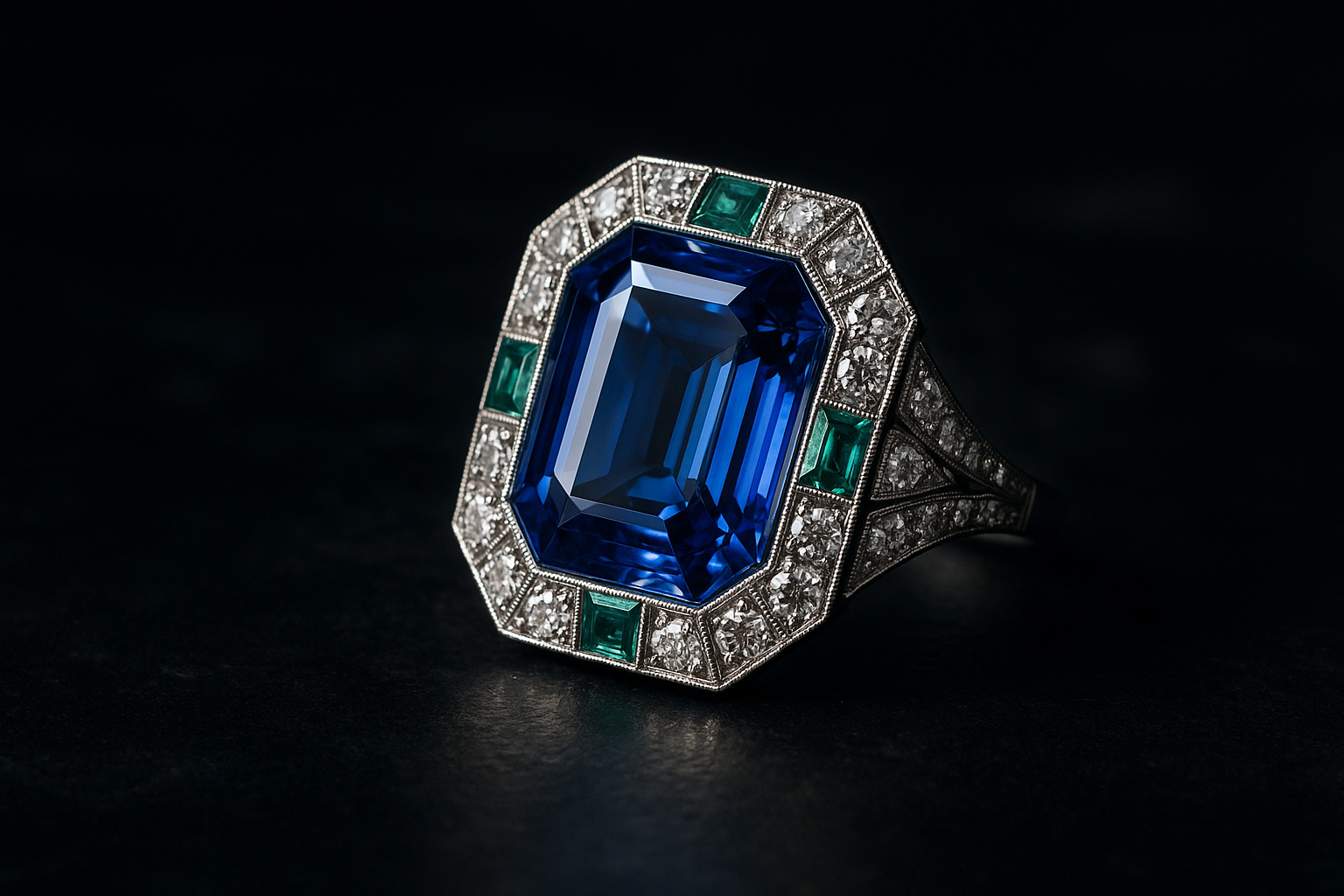
That gap is the whole story. Art Deco jewelry runs 1920 through roughly 1939, and the signed pieces from that window represent something the market consistently misprices: geometric perfection built entirely by hand, set with old-cut diamonds and untreated colored stones that were simply the best material available at the time. No synthetics. No diffusion-treated sapphires. No laser-drilled clarity enhancements. What you see is what was pulled from the ground — and what a bench jeweler spent 80 hours fabricating from platinum sheet.
That same quality today, made new, would run you four to five times the auction price. The math isn't close.
What Makes Art Deco Jewelry Different from Art Nouveau?
Art Nouveau (1890–1910) was nature gone wild — orchids, dragonflies, women's faces emerging from vines, enamel work that looked like stained glass. It was romantic, soft, and almost entirely French. René Lalique owned that era.
Art Deco killed the curve. After World War I, everything changed. Women cut their hair, hemlines went up, and jewelry went geometric. Straight lines. Chevrons. Stepped baguettes. Platinum everywhere because it let you build structures that gold couldn't hold. The color palette shifted from pastels to hard contrast: rock crystal and onyx against diamond, coral against jade, black enamel framing calibrated sapphires.
This matters for value because Art Nouveau is a museum market now. Genuine Lalique or Fouquet pieces hit six and seven figures regularly — they're rare, fragile, and chased by institutions. Art Deco, by contrast, was produced in real volume. Cartier, Van Cleef, Boucheron, Mauboussin, and Tiffany all had active workshops turning out serious quantities of high-quality jewels. Supply exists. That's why prices haven't run away — yet.
If you're buying Art Nouveau, you're competing with the Musée des Arts Décoratifs. If you're buying Art Deco, you're competing with other dealers who still need to make margin. That's your edge.
Which Signatures Actually Matter in Art Deco?
Cartier London and Cartier Paris are the top of the pyramid. New York is strong but doesn't carry the same premium. A Cartier London Art Deco clip brooch from 1935 with original box will routinely double the estimate at auction. I've seen it too many times to call it luck.
Van Cleef & Arpels is next — especially anything with the mystery setting (serti mystérieux), which they patented in 1933. But be careful: most "mystery set" pieces you'll encounter at the mid-tier auction level are 1950s or later. True Art Deco period mystery set Van Cleef is rare and priced accordingly.
Then comes Boucheron, Mauboussin, and Tiffany & Co. After that, the French houses that serious buyers know but the general market sometimes overlooks: Lacloche Frères, Marchak, Janesich, Verger Frères (who actually manufactured for many of the big names).
One thing I've learned the hard way: a signed piece with a replaced clasp or a resized shank loses 20–30% of its value overnight. Collectors want untouched. If you're buying at auction, check the condition report for those three words: "later added," "replacement," or "repair." Walk if you see them on a piece you're paying full retail for.
Where Are the Best Art Deco Deals Right Now?
The action is in the middle tier of the auction market — not the Magnificent Jewels sales at Christie's Geneva and Sotheby's Hong Kong where global collectors push prices past reason, but the specialist jewelry auctions at houses like Bonhams, Doyle, and the regional European rooms.
I'll give you a concrete example. At a Bonhams London jewelry sale in April 2025, a Boucheron Art Deco ruby and diamond brooch — unheated Burmese rubies, SSEF-certified, approximately 3 carats total — sold for £8,200. Comparable material in a new Van Cleef piece would have been £45,000 minimum. The rubies alone, loose at wholesale, would have been £6,000. You were essentially paying £2,200 for the platinum, the diamonds, the Boucheron signature, and a century of history.
Here's what I tell clients who want to build an Art Deco collection:
- Buy French or British signatures — Cartier London, Cartier Paris, Van Cleef, Boucheron, Lacloche. American and German pieces trade at a discount that compounds over time.
- Prioritize platinum over white gold — Art Deco platinum pieces were fabricated, not cast. The workmanship difference is visible under a loupe and it matters for resale.
- Check colored stone certs — Any sapphire, ruby, or emerald in an Art Deco piece should have an SSEF, Gübelin, or AGL report. GIA is fine for diamonds but does not carry the same authority on colored stone origin and treatment determination. Don't let anyone tell you otherwise.
- Bracelets over brooches right now — Brooches are undervalued across the board but harder to resell. Bracelets, especially line bracelets and geometric strap styles, wear easily and hold stronger bidder interest.
- Condition is everything — Original clasp, original pin stem, no replaced stones, no re-enameling. The premium for untouched condition is worth every dollar when you go to sell.
Why Hasn't the Market Already Corrected This?
Because signed Art Deco jewelry falls into a gap between three buyer groups and none of them own it completely. Vintage collectors gravitate toward signed mid-century — the 1950s–1970s Bulgari, the 1970s Cartier, the recognizable motifs that perform well on Instagram. Contemporary buyers want new, branded, box-fresh. Estate jewelry generalists often lack the specific knowledge to price Art Deco correctly and default to melt value plus a modest premium.
Nobody is aggressively bidding these pieces up. That's the inefficiency.
I've watched this for 17 years. The pieces that used to feel expensive in 2010 now look like bargains — and the trend line is only moving one direction. Quality Art Deco is getting absorbed into permanent collections and isn't coming back out. Supply shrinks every season. When enough buyers figure out that a Cartier London geometric bracelet from 1928 contains hand-cut diamonds and platinum work no modern workshop will touch for under six figures, the pricing gap closes fast.
You want value? Buy before the next generation of collectors gets the memo.
Frequently Asked Questions
Is Art Deco jewelry a good investment compared to contemporary signed jewelry?
I don't call jewelry an investment — I call it a purchase you shouldn't lose money on. Art Deco signed pieces hold their value better than contemporary production jewelry because the input costs are irreplaceable. A new Van Cleef Alhambra pendant is made with machine-calibrated stones and standardized production methods. A 1925 Cartier brooch required a master jeweler working by hand with material nobody can source at scale anymore. When both cost roughly the same at auction, which one do you think has more downside protection? I'll take the Deco piece every time — but only if it's signed, period-correct, and untouched.
How do I authenticate an Art Deco piece without a signature?
You don't — or at least, you shouldn't pay full price for it. Unsigned Art Deco can be genuine and beautiful, but the value drops 40–60% versus a signed equivalent. Without a signature, you're buying on faith and the judgment of the dealer or auction specialist. With a signature, you have a baseline: Cartier and Van Cleef archives exist, scholars have documented production periods and style transitions, and the market recognizes the name when you resell. If you love an unsigned piece enough to keep it forever, buy it. But if you're thinking about value, signature is the first filter.
What's the difference between Art Deco and Art Deco Revival jewelry?
Art Deco Revival refers to pieces made after the period ended — typically 1970s onward — that mimic the geometric style. The difference matters enormously for value. A 1980s "Art Deco style" diamond bracelet is a reproduction, regardless of quality. It lacks the hand-fabrication, the period gemstones, and the historical significance of a 1920s original. Dealers sometimes blur this line intentionally. Look at the clasp mechanism, the metal composition (post-1940 pieces often use white gold instead of platinum), and the diamond cutting style. Old European cuts and transitional cuts belong to the period. Modern round brilliants don't. If the piece has perfectly matched, machine-calibrated stones in a geometric setting, you're looking at Revival — and you should pay Revival prices, not Deco prices.
Written by Lawrence Paul
Lawrence Paul is a fine jewelry dealer based in New York's Diamond District with over 20 years of experience buying and selling signed vintage and estate jewelry. He is President of Spectra Fine Jewelry at 44 West 47th Street, Suite GF1, New York, NY 10036.
Continue Reading
Get the Collector's Newsletter
Join collectors who get authentication tips, market insights, and new guide alerts. No spam, just practical knowledge.
Need Help?
Send photos of a piece you're evaluating. We'll give you a straight read—no pressure, no BS.
Contact Spectra Fine Jewelry →Ready to Browse Authenticated Pieces?
Every item at Spectra Fine Jewelry goes through our verification process before it hits the case. No guesswork. No surprises.