Why Burmese Rubies Command a Premium (And Which Certs Prove Origin)
Published: June 5, 2026
The short answer: Burmese rubies — particularly those from the Mogok Valley — command 3–10x premiums over equivalent Mozambique material because of their unique fluorescence-driven glow, trace chromium chemistry that can't be replicated, and a 1,500-year mining history that produced less top-grade rough than the world extracted in diamonds last year.
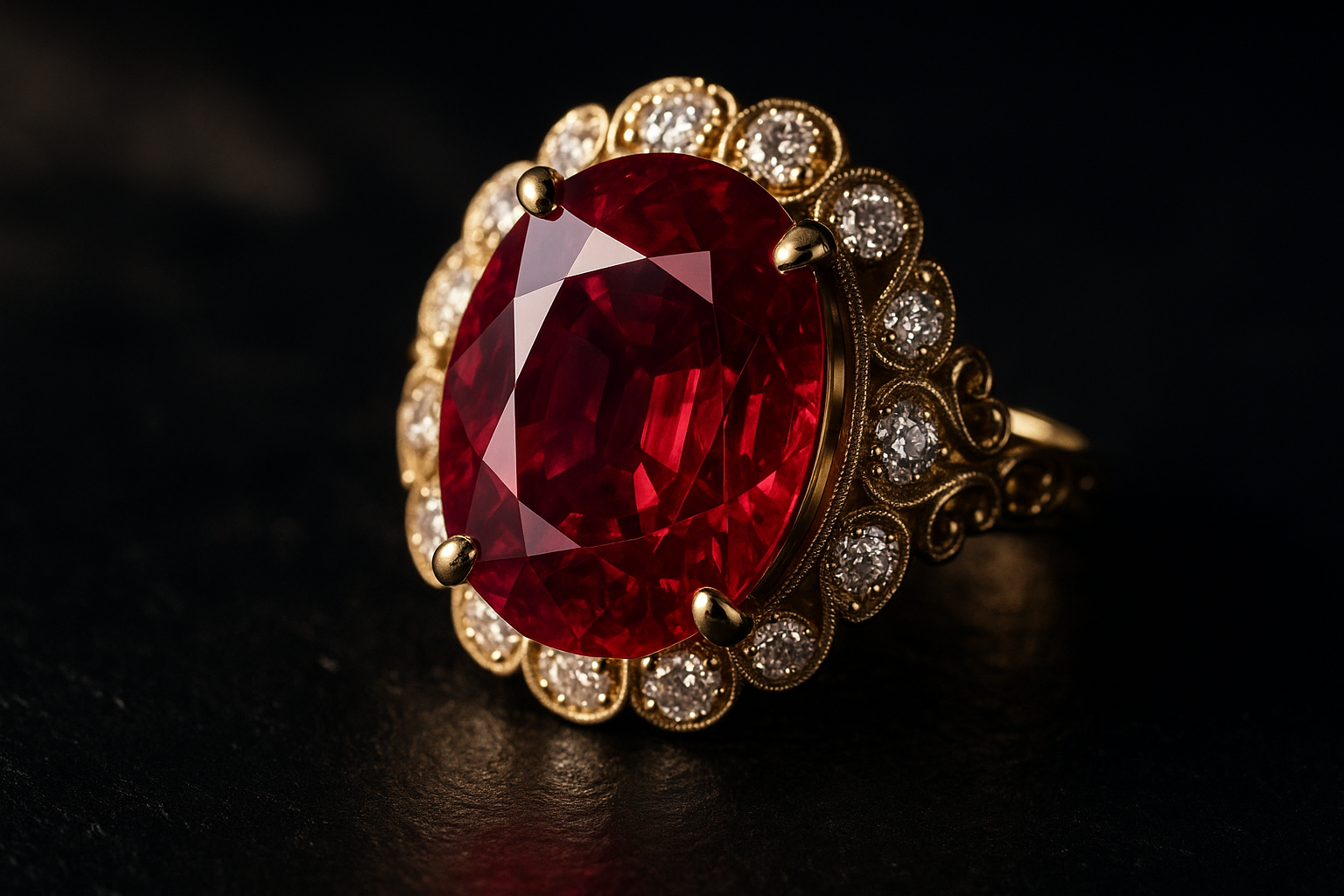
I remember watching a 5.05-carat unheated Burmese ruby sell at Christie's Geneva in November 2023. The room went dead silent when bidding crossed $1.8 million. No one was looking at their phones anymore. That's what a top Mogok ruby does — it makes professionals forget they're working.
The final hammer: $2.3 million. That's roughly $455,000 per carat for a stone the size of your fingernail.
I pay these premiums myself. Not because I want to. Because clients who've held a true Burmese ruby next to a high-quality African stone don't ask about the difference — they see it. The question is whether the cert backs up what their eyes are telling them.
What Actually Makes a Burmese Ruby Different?
The glow. Everything else is secondary.
Burmese rubies contain a specific trace chromium-to-iron ratio that creates fluorescence under UV light and, more importantly, under natural daylight. The stone absorbs blue and green wavelengths, reflects red, and the chromium kicks back additional red fluorescence. The result isn't just "red" — it's a red that seems lit from within.
Mozambique rubies can have excellent color saturation. I've bought beautiful ones. But they carry higher iron content, which suppresses fluorescence. Put a top Mozambique ruby next to a top Burmese ruby under the same light, and the Mozambique stone looks flat by comparison. Not bad — just earthbound.
The Mogok Valley in Myanmar (Burma) has produced rubies for roughly 1,500 years. The geologic conditions there — marble-hosted deposits with extremely low iron — created something geochemistry hasn't repeated anywhere else on the same scale. Winza in Tanzania and a few isolated pockets in Vietnam come closest, but the consistent volume of low-iron, high-fluorescence rough from Mogok remains unique.
There's also simple scarcity. The Mogok mines haven't produced meaningful quantities of fine rough in over a decade. What's in circulation today was mostly mined 20–50 years ago and has been recut, resold, and moved between dealers and collectors. Every year there's less of it.
How Much More Does a Burmese Ruby Cost vs. Other Origins?
3–10x, depending on size and quality tier.
For commercial-grade material — under 2 carats, moderately included, decent but not exceptional color — the premium might be 2–3x over a comparable Mozambique ruby.
Once you cross 3 carats with strong fluorescence, no heat treatment, and clean enough to be set in a ring without visible fractures, the math changes fast. I've seen 4-carat unheated Burmese rubies trade at $80,000–$120,000 per carat while an equivalent 4-carat Mozambique stone brought $12,000–$18,000 per carat. That's not a premium — it's a different asset class.
Auction data bears this out. A 15.04-carat unheated Burmese ruby sold at Sotheby's Hong Kong in October 2023 for $18.3 million, or roughly $1.2 million per carat. The largest fine Mozambique ruby ever auctioned — a 55.22-carat stone at Sotheby's in June 2023 — brought $34.8 million but only $630,000 per carat despite being nearly 4x the weight.
The relationship isn't linear. Size amplifies the premium because large unheated Burmese rubies above 5 carats are genuinely rare events. I can count on one hand the number I've seen cross my desk that I'd call grade-A material in the last five years.
Which Lab Reports Actually Prove Burmese Origin?
This is where I see buyers get burned.
For origin determination on rubies, GIA is not the authority. They're the standard for diamonds — end of discussion. For colored stone origin and treatment analysis, the relevant labs are SSEF (Swiss), Gübelin (Swiss), and AGL (American).
Here's why this matters: a ruby sold with only a GIA origin report saying "Burma" carries less weight than one with an SSEF or Gübelin report saying the same thing. The Swiss labs analyze trace element chemistry (chromium, iron, vanadium, gallium ratios), inclusion spectroscopy, and growth structure patterns at a level GIA's colored stone division doesn't match.
I've personally seen stones where GIA called Burma and SSEF called Mozambique on the same ruby. The seller was disappointed. The buyer who asked for the right lab saved six figures.
If you're spending serious money on a Burmese ruby, here's what you want:
- SSEF or Gübelin origin report confirming Burma (Myanmar), preferably specifying Mogok if the inclusion scene allows it
- "No indications of heating" on the report — unheated stones carry the full premium; heated Burmese rubies still trade at a premium but it shrinks considerably
- AGL Prestige Report as your American option — AGL's colored stone work is respected internationally and their treatment analysis is thorough
- A second opinion on any stone crossing $100,000 — I send my significant colored stones to SSEF even if they already have an AGL report. Two labs agreeing is better than one being wrong
Avoid stones sold as "Burmese" with only an in-house jeweler's verbal guarantee or a lab report from an unrecognized outfit. If the seller won't let you send it to SSEF, walk.
Are Heated Burmese Rubies Still Worth the Premium?
Yes — but less than half.
An unheated 2-carat Burmese ruby might bring $35,000–$50,000 per carat. The same stone with classic heat treatment (no flux, no fracture filling — just heat) might bring $12,000–$18,000 per carat. Still above a comparable Mozambique stone, but the gap narrows substantially.
Heat treatment is the industry standard for ruby — roughly 95% of all rubies on the market have been heated to improve clarity and color. A heated Burmese ruby is still a Burmese ruby. The glow is still there. But collectors and investors pay for rarity, and "no heat" on a Burmese stone is the rarest combination in colored gemstones short of an untreated Kashmir sapphire.
If your budget tops out at $30,000 and you want a Burmese ruby above 2 carats, you're buying heated. That's not a compromise — it's market reality. Just make sure the cert confirms heat treatment explicitly, because if the lab can't determine whether the stone was heated, the market treats it as though it was.
Frequently Asked Questions
How can I tell if a ruby is really from Burma without a lab report?
You can't — not definitively. Experienced dealers look for specific inclusion patterns (short rutile needles in "silk" formations, distinctive growth zoning) and the characteristic fluorescence response under long-wave UV. But inclusions can overlap with Vietnamese and Tajik material, and fluorescence alone isn't proof. Anyone who claims they can reliably origin-grade a ruby by eye is either lying or has been doing this 40 years and still gets it wrong sometimes. Spend the $500–$1,200 on an SSEF or Gübelin origin report. It's the cheapest insurance you'll ever buy on a five-figure stone.
Why are Burmese rubies more expensive than Thai or African rubies with the same color grade?
Because color grade on a lab report only tells part of the story. A Mozambique ruby can score "vivid red" on a report and still lack the fluorescence that makes Burmese material glow in daylight. The premium isn't just about color saturation — it's about the chromium fluorescence, the 1,500-year provenance, and the reality that Mogok hasn't produced significant fine rough in over a decade. You're buying photophysics and scarcity, not just a color description. That said, if you're buying a ruby to wear and enjoy — not as an investment — a fine Mozambique or Madagascar stone at one-third the price is often the smarter buy.
Is "pigeon's blood" a grading term that matters?
Only if an SSEF or Gübelin report uses it. "Pigeon's blood" has no universal definition — it's a trade term traditionally reserved for the finest Burmese rubies with a specific red hue balanced between slightly bluish-red and pure red, with strong fluorescence. SSEF and Gübelin have formal criteria (color saturation, tone, evenness, fluorescence intensity), and they apply it sparingly. When a Swiss lab appends "pigeon's blood" to a report, it adds 20–40% to the per-carat price. When a dealer says it without lab backing, it adds nothing to anything except their sales pitch.
Written by Lawrence Paul
Lawrence Paul is a fine jewelry dealer based in New York's Diamond District with over 20 years of experience buying and selling signed vintage and estate jewelry. He is President of Spectra Fine Jewelry at 44 West 47th Street, Suite GF1, New York, NY 10036.
Continue Reading
Get the Collector's Newsletter
Join collectors who get authentication tips, market insights, and new guide alerts. No spam, just practical knowledge.
Need Help?
Send photos of a piece you're evaluating. We'll give you a straight read—no pressure, no BS.
Contact Spectra Fine Jewelry →Ready to Browse Authenticated Pieces?
Every item at Spectra Fine Jewelry goes through our verification process before it hits the case. No guesswork. No surprises.