Why Burmese Rubies Command a Premium (And Which Certs Prove It)
Published: May 16, 2026
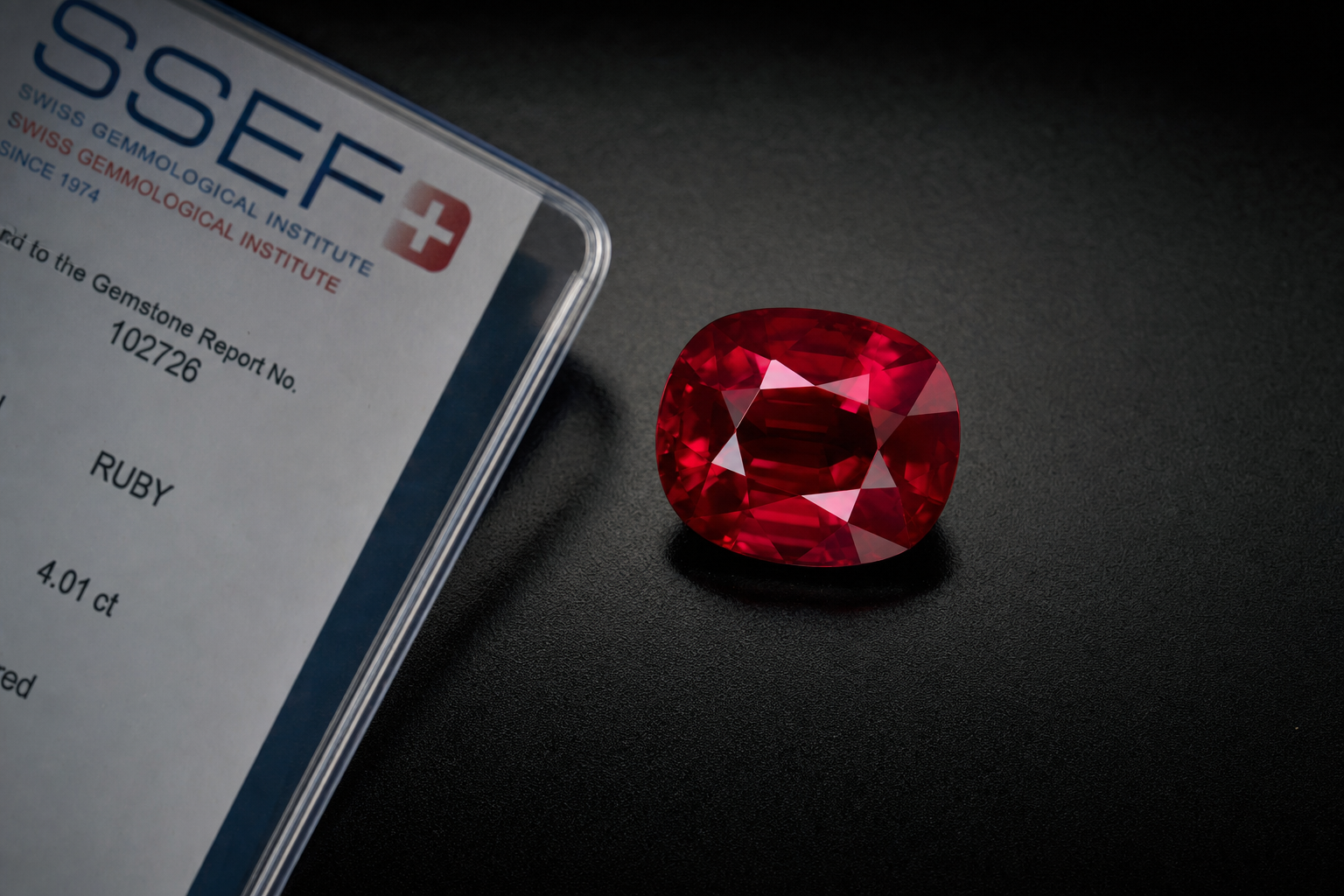
The short answer: Burmese rubies from the Mogok Valley command 3–10x the price of comparable rubies from other origins because of their unique chromium-driven fluorescence, "pigeon blood" color standard, and centuries of provenance. An unheated Burmese ruby above 3 carats with AGL or SSEF certification is one of the rarest objects in the gem trade.
I sold a 2.8-carat unheated Mogok ruby in 2022 for $185,000. Clean, no fracture filling, AGL Prestige Gem Report calling Burma origin and no heat. The buyer was a collector in Singapore who'd been looking for that stone for four years. He paid immediately. Didn't negotiate.
Three months later, a Thai dealer offered me a 3.1-carat Mozambique ruby, beautiful stone, similar color grade, heavily heated, for $28,000 total. Both are "rubies." The Burmese stone at $66,000 per carat and the Mozambique at $9,000 per carat. Same species. Completely different objects.
Here's why.
What makes Mogok rubies different from every other origin?
The Mogok Valley in Myanmar — historically called Burma — is a marble-hosted deposit where ruby crystals grew under specific pressure and temperature conditions that have never been replicated anywhere else. The chromium content is high. The iron content is unusually low. That combination matters because iron suppresses fluorescence, and chromium drives it. Mogok rubies glow under UV light and under natural daylight with an intensity that other origins can't match.
"Pigeon blood" is the trade's highest color designation for ruby. It refers to a specific hue — pure red with slight blue undertone and strong red fluorescence that makes the stone appear to glow. It's not a strict spectroscopic standard; it's a trade judgment. AGL, SSEF, and Gübelin all use the term on reports when a stone qualifies. Not every Burmese ruby is pigeon blood. But essentially all pigeon blood rubies are Burmese.
The other Burmese origin that matters is Mong Hsu — a different Myanmar deposit that came online in the 1990s. Mong Hsu rubies are typically darker, more purplish, and require heavy heat treatment to improve color. They're legitimate Burmese rubies but they don't carry the Mogok premium. If you see "Burma" on a report without a sub-district call, ask the seller directly: Mogok or Mong Hsu? It's a $50,000 question on a 3-carat stone.
How does heating affect Burmese ruby value?
Ruby heating is even more impactful on value than sapphire heating.
Virtually all Mong Hsu rubies are heated — it's how they become marketable. Many Mogok rubies are also heated to dissolve silk and improve color saturation. Heating is accepted and disclosed. But unheated Mogok ruby is a different class of stone entirely.
An unheated 3ct Mogok pigeon blood ruby with AGL certification has sold at Christie's Geneva for over $300,000 per carat. The same stone with heat treatment evidence: $40,000–$80,000 per carat. Unheated status at Mogok origin at significant size is the rarest combination in the colored stone market — rarer than Kashmir sapphire, rarer than Argyle pink.
Beyond heat, there's fracture filling. Some rubies have surface-reaching fractures filled with glass or lead glass to improve apparent clarity. This is a catastrophic treatment. A glass-filled ruby is not a fine ruby — it's an industrial product. AGL and SSEF will note fracture filling explicitly. Never buy a ruby above $5,000 without a report that addresses fracture-filling status.
What does the cert language actually say for Burmese ruby?
AGL's Prestige Gem Report (their top-tier colored stone report) for a qualifying Burmese ruby will typically state:
- Geographic Origin: Burma (Myanmar)
- Enhancement: None detected (for unheated) or Heat: Indications of heating present
- Clarity Enhancement: None (critical — absence of fracture filling)
- Color Grade: Pigeon Blood Red (if qualifying)
The "Prestige" designation on AGL means the stone met their threshold for exceptional quality. Not every Burmese ruby gets this — it's reserved for stones that AGL considers significant. It's a meaningful designation in the U.S. market.
SSEF reports use similar language: "Burma (Myanmar)" for origin, "no indications of heating" for unheated status. They've been publishing ruby research since the 1970s and their Mogok call is the most trusted in the trade.
For any Burmese ruby above $30,000, I want either AGL Prestige or SSEF. GIA does ruby origin work and their heating determination is reliable, but for the highest-value Burmese stones, I want the lab with the deepest Mogok reference database.
What's the realistic market for Burmese ruby right now?
Current price ranges (2025–2026, AGL or SSEF certified):
- Mogok, unheated, 1–3ct, good color: $30,000–$80,000/ct
- Mogok, unheated, 3ct+, pigeon blood: $80,000–$300,000+/ct
- Mogok, heated, 1–3ct, strong color: $8,000–$25,000/ct
- Mong Hsu, heated, 1–3ct: $2,000–$8,000/ct
- Mozambique, heated, 1–3ct, strong color: $5,000–$15,000/ct
- Thailand/other, heated: $1,000–$5,000/ct
A 3ct+ unheated Mogok with pigeon blood call is not a liquid market — these stones trade by appointment between serious collectors and dealers, not at retail. If someone is offering you one on a public platform at retail price, ask very hard questions about the certification.
Frequently Asked Questions
Is Mozambique ruby a legitimate alternative to Burmese?
Yes. Mozambique emerged as a major ruby source around 2009 with material from the Montepuez deposit, and top-quality Mozambique rubies are serious gems. They tend to have higher iron content than Mogok, which produces a slightly darker, less fluorescent red. The very best Mozambique can be called pigeon blood by AGL and SSEF, though it's rarer than at Mogok. Prices run 30–50% of comparable Mogok material. For a buyer who wants a beautiful, certified ruby without Mogok prices, Mozambique is the right answer. I buy Mozambique regularly. It's a real gem market, not a consolation prize — just a different origin at a different price point.
Why does ruby certification cost more than sapphire certification?
It doesn't necessarily, but the full AGL Prestige report — which includes the pigeon blood color assessment and detailed fracture-filling analysis — is priced at the top of AGL's fee schedule. The extra cost reflects the additional analysis required for fracture-filling detection, which involves examination under fiber optic illumination, UV fluorescence, and sometimes spectroscopic testing of any filling material. For a $100,000 ruby, an $800–1,200 lab fee is irrelevant. For a $3,000 ruby, it's 30% of the stone's value — at that price point, I'd use a lower-tier report that at minimum confirms treatment status and origin.
Can a Burmese ruby's value change after I buy it?
Yes, in both directions. U.S. sanctions on Myanmar have periodically affected the market for Burmese ruby — there were periods when importing new Burmese material was restricted, which increased the value of stones already in the U.S. market. That dynamic could change with political shifts. The more common risk is re-testing: if you have an older report and submit to a current lab, origin calls occasionally change as reference databases improve. I've seen stones lose their Burma call and gain Sri Lanka, or gain their Burma call that an older report missed. For any significant holding, re-test every 7–10 years. Lab methodology improves and your report should reflect it.
Written by Lawrence Paul
Lawrence Paul is a fine jewelry dealer based in New York's Diamond District with over 20 years of experience buying and selling signed vintage and estate jewelry. He is President of Spectra Fine Jewelry at 44 West 47th Street, Suite GF1, New York, NY 10036.
Continue Reading
Get the Collector's Newsletter
Join collectors who get authentication tips, market insights, and new guide alerts. No spam, just practical knowledge.
Need Help?
Send photos of a piece you're evaluating. We'll give you a straight read—no pressure, no BS.
Contact Spectra Fine Jewelry →Ready to Browse Authenticated Pieces?
Every item at Spectra Fine Jewelry goes through our verification process before it hits the case. No guesswork. No surprises.