Why Cat's Eye Chrysoberyl Deserves More Attention Than It Gets
Published: June 22, 2026
The short answer: Cat's eye chrysoberyl delivers one of gemology's most hypnotic optical effects — a razor-sharp "milk and honey" line that glides across the dome — at a fraction of what equivalent-quality sapphire or alexandrite commands. The finest Sri Lankan stones under 5 carats trade between $2,000 and $8,000 per carat. Try finding any other phenomenal gem with that combination of rarity and relative affordability.
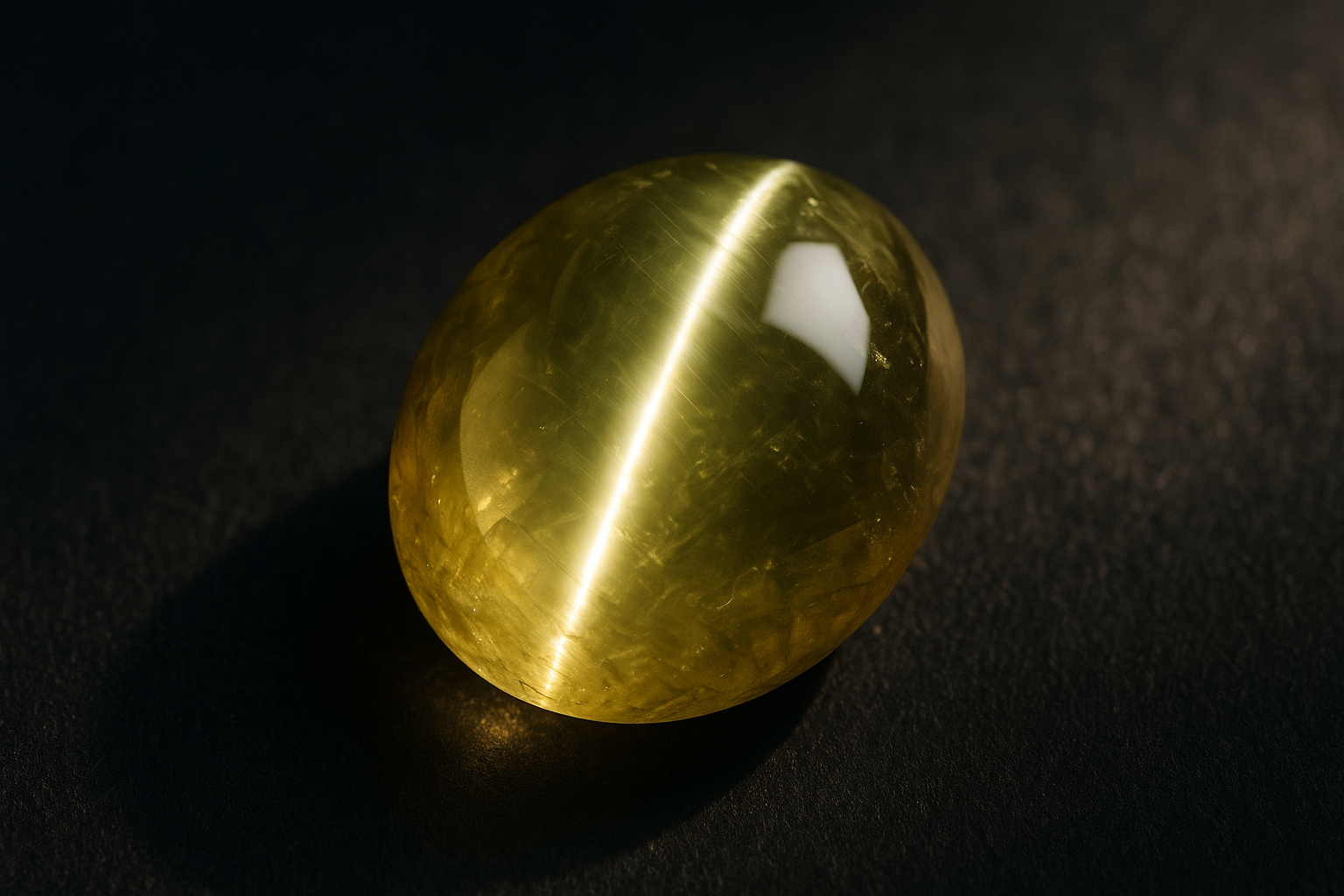
I bought my first serious cat's eye chrysoberyl in 2011 — a 4.82-carat Sri Lankan stone with a needle-sharp eye that opened perfectly under a single light source. Paid $3,200 per carat from a dealer on 47th Street who'd been sitting on it for two years because "nobody asks for these." That stone sold within three weeks of hitting my showcase. The client still owns it.
That's the cat's eye chrysoberyl market in a sentence: ignored by the masses, quietly prized by the people who actually know what they're looking at. I've handled hundreds of phenomenal stones since 2009, and I can count on one hand the number of optical effects that rival a top-grade cymophane's chatoyancy. The stone has a branding problem, not a quality problem.
What Makes a Cat's Eye Chrysoberyl Actually Good?
The term "cymophane" gets thrown around by gemologists — it's the mineralogical name for chatoyant chrysoberyl, derived from Greek words meaning "wave" and "appearance." The trade just calls it cat's eye.
Here's what separates the sleepers from the serious stones:
The eye has to be single, sharp, and centered. You want one bright line running straight across the dome — not two, not fuzzy, not off-center. When you rotate the stone under a penlight, that line should open and close like, well, a cat's eye. The best stones show the "milk and honey" effect: one side of the dome glows lighter than the other, creating a split-tone appearance that makes the eye pop in three dimensions.
Body color matters more than most people admit. Stones with a honey-gold to apple-green body and strong transparency command the highest prices. The pale yellowish-green stuff that shows up in mall jewelry cases? That's commercial grade. Fine material from Sri Lanka — still the premier source — shows a saturated golden-green that holds its own even when the eye isn't fully open.
Transparency is the hidden multiplier. A translucent-to-transparent body behind a sharp eye can triple the per-carat price versus a heavily included, opaque stone of the same weight. The chatoyancy comes from thousands of parallel rutile needles — you need enough to create the eye but not so many that the stone goes dead.
Cut quality is non-negotiable. Cat's eye is always cut as a cabochon — the dome needs exactly the right height and curvature to focus the light into that single line. Too flat and the eye spreads into a band. Too high and it fragments. I've rejected stones where the cutter got lazy with the base — an uneven pavilion rotates the eye off-center, and once that's cut, there's no fixing it.
How Much Does Cat's Eye Chrysoberyl Actually Cost?
Cat's eye chrysoberyl value splits into three tiers in the real market, not the retail fantasy version:
Commercial grade (1-3 carats, weak eye, pale body): $200-$600/carat. Mall jewelry counter territory. Fine for a curiosity piece, not for a collection.
Fine quality (2-8 carats, sharp eye, good color, good transparency): $2,000-$8,000/carat. This is where I buy. At this level you're getting a genuine collector's stone — the kind that stops people mid-sentence when you put it under a light.
Exceptional (8-20+ carats, museum-grade eye, top color, high transparency): $10,000-$25,000/carat and up. These almost never hit the open market. When a 15-carat Brazilian or Sri Lankan stone with a perfect eye surfaces at auction, the serious collectors circle.
Compare this to alexandrite cat's eye — which combines chatoyancy with color change — and the price gap gets ridiculous. A natural alexandrite cat's eye under 2 carats with a visible color shift and decent eye can run $15,000-$50,000 per carat. Larger stones with strong change and a sharp eye? Six figures per carat without blinking.
That gap makes cat's eye chrysoberyl one of the best value propositions in colored gems. You're getting a genuine phenomenal effect from a durable stone (8.5 on the Mohs scale — harder than topaz, tougher than emerald) for roughly one-tenth the price of equivalent-quality alexandrite cat's eye. The market hasn't caught up to the rarity because the general public doesn't understand the material.
Is Alexandrite Cat's Eye the Same Stone?
No. This is where the confusion costs people money.
Both are chrysoberyl — same mineral species, BeAl₂O₄. But alexandrite cat's eye is the chrome-bearing variety that changes color (green in daylight, red under incandescent) and shows chatoyancy. Standard cat's eye chrysoberyl (cymophane) doesn't change color. It's an iron/titanium-colored stone with a phenomenal optical effect.
I've seen dealers mislabel standard cat's eye as "alexandrite cat's eye" hoping the buyer won't know the difference. A SSEF or Gübelin report will settle it instantly — the lab identifies the variety based on trace element chemistry, not visual appearance. Chrome = alexandrite. Iron/titanium = regular chrysoberyl.
For colored stone origin and treatment determination on chrysoberyl: SSEF, Gübelin, and AGL are the labs you want. GIA is the standard for diamonds — for colored stones, the Swiss labs and AGL carry more weight on origin calls.
Natural cat's eye chrysoberyl has essentially no treatments to worry about. Unlike ruby (heat, glass-filling), sapphire (heat, diffusion), or emerald (oil, resin), chrysoberyl is typically sold as nature made it. Synthetics exist — mostly lab-grown corundum imitations — and they're easy to spot under magnification because the eye pattern looks too perfect, almost mechanical.
Where Does the Best Material Come From?
Sri Lanka produces the finest cat's eye chrysoberyl, period. The Ratnapura district has been turning out top-grade cymophane for centuries, and the combination of golden-green body color with sharp chatoyancy from Ceylon material is the benchmark against which everything else is measured.
Brazil has produced significant quantities — Minas Gerais and Espírito Santo in particular — and the Brazilian material tends toward more yellowish-green tones. Some exceptional stones have come out of India (Orissa) and Tanzania, but these are inconsistent producers.
The supply side is thin. Unlike sapphire or ruby where new discoveries occasionally flood the market, cat's eye chrysoberyl production is steady but low-volume. The big auction houses — Christie's and Sotheby's — might feature one or two significant cat's eye stones per year across all their jewelry sales combined. When they do, the serious buyers show up.
I've watched this market for 17 years. The stones that sell fastest at the best prices are always the 3-8 carat range with honey-gold body, sharp centered eye, and strong transparency. That's the sweet spot. Below 2 carats, the eye rarely develops with proper intensity. Above 15 carats, you're competing for a tiny pool of stones that almost never trade publicly.
Cat's eye chrysoberyl is the gem equivalent of a sleeper car — unassuming until you turn it on, then impossible to ignore. The market undervalues it because most buyers don't know what they're missing. That won't last forever. The supply isn't growing, the material is genuinely rare, and the optical effect is one of nature's best tricks. Buy a good one now — or pay double later when everyone else figures it out.
Frequently Asked Questions
Is cat's eye chrysoberyl valuable compared to other phenomenal gems?
It's significantly undervalued. A fine 5-carat cat's eye chrysoberyl with a sharp eye trades around $4,000-$6,000 per carat. A star sapphire of equivalent quality and visual impact would run $8,000-$15,000 per carat. Alexandrite cat's eye — even the mediocre stuff — starts at $15,000 per carat. The chrysoberyl is harder (8.5 Mohs), rarer in top grades, and visually more dramatic than most star stones. The price gap exists because cat's eye chrysoberyl doesn't have the marketing machine behind it that sapphire and alexandrite do. For a collector who values the optical effect over the name recognition, it's one of the best buys in the colored stone market right now.
How do I verify a cat's eye chrysoberyl is natural and not synthetic?
Send it to SSEF or Gübelin. Those are the relevant labs for colored stone origin and species determination — GIA is the diamond standard, not the authority for chrysoberyl. A lab report will confirm the stone is natural chrysoberyl (not synthetic corundum, which is the most common imitation), identify any treatments (rare in this material), and provide origin if the inclusion scene is diagnostic. Under a loupe, synthetic imitations typically show an eye that's too perfectly uniform — natural chatoyancy has subtle variation in the silk band that lab-grown material can't replicate convincingly. If the price seems too good to be true and the eye looks like it was drawn with a ruler, walk away.
What's the difference between cymophane and alexandrite cat's eye?
Cymophane is the gemological term for cat's eye chrysoberyl — it shows chatoyancy (the moving eye effect) but no color change. Alexandrite cat's eye is the same mineral species (chrysoberyl, BeAl₂O₄) but contains chromium, which produces a color shift from green in daylight to red/purplish-red under incandescent light — on top of the chatoyancy. The distinction matters enormously for value: a 2-carat alexandrite cat's eye with good color change and a visible eye can cost $30,000-$100,000+. The same weight cat's eye chrysoberyl with perfect chatoyancy might run $4,000-$12,000. Both are rare. Both are phenomenal. But they're different stones with different chemistry, different visual properties, and wildly different price tags. Know which one you're buying.
Written by Lawrence Paul
Lawrence Paul is a fine jewelry dealer based in New York's Diamond District with over 20 years of experience buying and selling signed vintage and estate jewelry. He is President of Spectra Fine Jewelry at 44 West 47th Street, Suite GF1, New York, NY 10036.
Continue Reading
Get the Collector's Newsletter
Join collectors who get authentication tips, market insights, and new guide alerts. No spam, just practical knowledge.
Need Help?
Send photos of a piece you're evaluating. We'll give you a straight read—no pressure, no BS.
Contact Spectra Fine Jewelry →Ready to Browse Authenticated Pieces?
Every item at Spectra Fine Jewelry goes through our verification process before it hits the case. No guesswork. No surprises.