Why Unheated Kashmir Sapphires Cost 3-5x More (And How to Spot the Fakes)
Published: May 17, 2026
The short answer: Kashmir sapphires carry a 3-5x premium over comparable unheated Ceylon or Burmese stones because the mine was exhausted by the 1930s — total production lasted roughly 50 years. That velvet-soft cornflower blue, caused by microscopic silk inclusions scattering light, cannot be replicated by any modern source. Supply is permanently fixed.
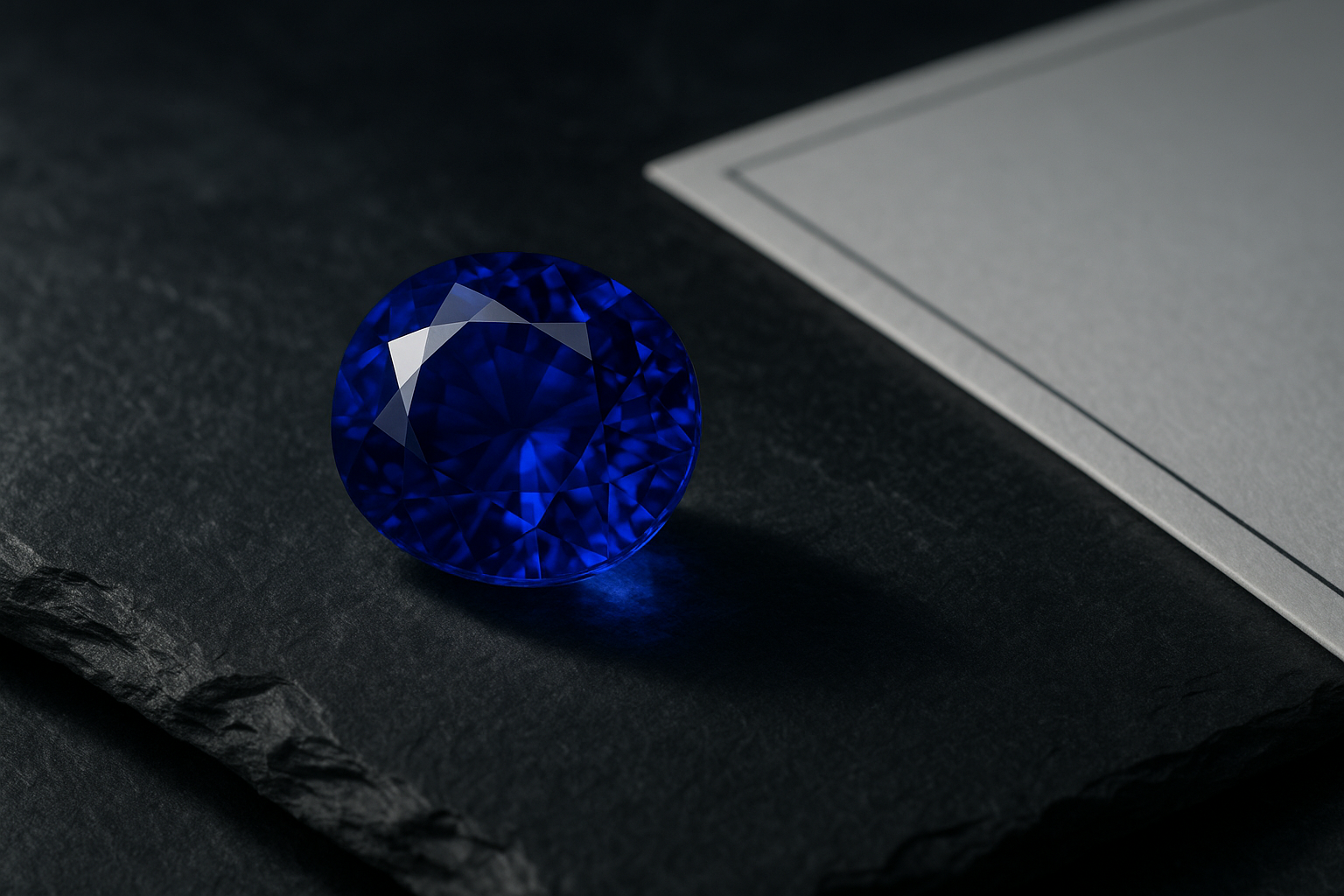
I've held three true Kashmir sapphires in the past five years. That's not modesty — that's the market. If someone tells you they see them weekly, walk.
The Kashmir deposit sits at 14,000 feet in the Zanskar range. Discovered in 1881 after a landslide exposed the pocket, mined intermittently until the 1930s, completely dead since. Every Kashmir sapphire in circulation today was pulled from the ground before World War II. Total production across the entire life of the mine: maybe 3,000 to 4,000 carats of significant material. Compare that to Ceylon, which has produced millions of carats over centuries. The math isn't complicated.
A 5-carat unheated Kashmir with proper provenance will trade at $100,000 to $200,000 per carat at the top end. A comparable 5-carat unheated Ceylon or Burmese sapphire might fetch $25,000 to $50,000 per carat. Same weight, same lack of treatment, roughly similar color to the untrained eye — and a 3-4x gap minimum. The best stones hit 5x. I've seen a 10-carat Kashmir cross the block at Sotheby's Hong Kong in 2015 for over $240,000 per carat. That's not hype. That's what happens when demand never shrinks but supply zeroes out.
What Makes a Kashmir Sapphire Look Different?
That velvety cornflower blue. Everyone reaches for the word "velvety" and for once the cliché is earned. Kashmir sapphires have a sleepy, almost drowsy blue — not the electric glow of a top Ceylon, not the inky royal of a Burma stone. The color sits somewhere between cornflower and a deep soft blue with a faint purplish undertone. But the texture is the tell.
Microscopic rutile silk — ultrafine needle inclusions dispersed evenly through the crystal — scatters light inside the stone. That's what creates the velvet. It softens the color without dulling it. A Kashmir that's completely clean? Suspicious. The finest Kashmir stones carry a gentle haze, like seeing blue through morning fog. You don't want a glassy Kashmir. You want that silk.
Under magnification at 10-60x, the silk in a Kashmir sapphire tends to be finer and more evenly distributed than in Burmese or Ceylon stones. It forms wispy bands rather than distinct needles. The turbidity zones — subtle milky bands — are another classic indicator. If you're buying unheated Kashmir, you're looking at a stone through an SSEF or Gübelin report, and those reports will flag the microscopic characteristics in the origin determination section. AGL is also solid for origin work on Kashmir. GIA? For diamonds, they're the standard. For colored stone origin and treatment on sapphires? I want SSEF, Gübelin, or AGL. Every time.
Why Does "Unheated" Matter So Much Here?
Heating a sapphire dissolves rutile silk. It clears up the stone, improves clarity, sometimes intensifies the blue. But a heated Kashmir loses the very thing that makes it a Kashmir — that velvet texture from the silk. You're paying for provenance, rarity, and optical character in one package. Heat treatment destroys one leg of that tripod.
More practically: the market for unheated Kashmir is a different animal entirely. I talk to dealers who won't touch a heated Kashmir at any price. They're after the untouched, natural state — exactly what came out of that landslide in 1881. An unheated Kashmir with an SSEF or Gübelin origin report is the closest thing in the sapphire world to a guaranteed blue-chip asset. There's maybe 500 to 800 carats of genuinely fine unheated Kashmir material still circulating. Prices move one direction over time.
Heated Kashmir can still be beautiful, can still be valuable — $30,000 to $75,000 per carat for fine stones — but it occupies a different tier. The buyers paying $150,000+ per carat want untouched and will pay whatever it takes.
How Do People Fake Kashmir Origin?
This is where it gets ugly. Kashmir origin commands such an extreme premium that the incentive to pass off a Ceylon or Madagascar stone is enormous.
Method one: start with a Ceylon sapphire that already has a sleepy, slightly silky blue body color. Send it to a second-tier lab known to be loose on origin calls. I've seen reports from labs in Thailand and Sri Lanka that push "Kashmir" on stones that SSEF or Gübelin would laugh out of the room. If the report isn't from SSEF, Gübelin, or AGL, the origin call is negotiable.
Method two: synthetic overgrowth. A natural sapphire seed with a thin flame-fusion overgrowth layer can mimic that haze under a quick loupe inspection. A good gemologist catches it, but plenty of buyers skip the microscope.
Method three: heat a Burmese or Ceylon sapphire just enough to partially dissolve the silk, creating turbidity zones that look passably Kashmiri. Low heat, 800-1100°C, in a reducing atmosphere. SSEF and Gübelin are getting better at catching low-temperature heating, but the fraudsters keep adjusting.
Method four: the mixed-parcel hustle. A parcel of 20 small ceylon sapphires, one or two real Kashmir stones mixed in, all sold as "Kashmir origin." The lab report covers one stone. The rest ride its coattails.
The fix is simple and not cheap: SSEF, Gübelin, or AGL premium origin reports. Expect to pay $800 to $2,000 per stone depending on carat weight and report complexity. On a stone costing $50,000 to $500,000, that's noise. Skip the report, and you're guessing.
What Should You Actually Look For When Buying?
-
Lab report first, stone second. SSEF, Gübelin, or AGL. If the seller can't produce one from these labs, price the stone as if it's Ceylon. You're buying an unknown.
-
Check for that specific velvet. Hold the stone under a daylight-equivalent light source. Move it. A Kashmir has a sleepy glow that shifts gently — not a glassy, hard brilliance. If it pops like a Ceylon, it probably is one.
-
Look at the carat weight coldly. Kashmir sapphires over 10 carats in unheated condition are genuinely rare single-digit-count material. A 20-carat "Kashmir" without impeccable provenance and a top-tier lab report? I'd bet against it every time.
-
Verify provenance beyond the certificate. The best Kashmir stones have auction histories — Christie's Geneva, Sotheby's Hong Kong, Phillips. A stone that's been in a prominent collection or an estate with verifiable history commands premium, but more importantly, it's traceable. Mystery Kashmir is an oxymoron.
-
Understand the silk-clarity tradeoff. Eye-clean Kashmir with no silk? Probably heated, possibly not Kashmir at all. Inclusions that are fine, evenly dispersed, and create that soft haze are exactly what you're paying for.
-
Price check against comparable public sales. Christie's sold a 21.72-carat unheated Kashmir for $4.2 million in 2021 — roughly $193,000 per carat. A 5.15-carat unheated Kashmir sapphire ring fetched $900,000 at Sotheby's in 2022. These are benchmarks. If someone offers you an unheated 8-carat Kashmir for $80,000 total, you're not getting a deal. You're getting robbed.
The premium exists because the mine is empty, the stones are finite, and the optical fingerprint is irreplaceable. Heat one and you erase the signature. Buy one without the right lab report and you're betting five or six figures on someone else's honesty. In 17 years of buying, I've learned exactly one thing about Kashmir sapphires: if the deal feels easy, the stone isn't what they say it is.
Frequently Asked Questions
What's the price difference between heated and unheated Kashmir sapphires?
The gap is severe. Unheated Kashmir sapphires over 3 carats with top color and an SSEF or Gübelin origin report trade at $100,000 to $200,000 per carat. Heated Kashmir of similar weight and color drops to $30,000 to $75,000 per carat. The market sees a heated Kashmir as optically compromised — the velvet is diminished or gone — and a significant portion of top buyers simply won't consider heated material regardless of price. For investment-grade stones, unheated is the only category that matters.
Can a GIA report confirm if my sapphire is from Kashmir?
GIA is the gold standard for diamonds. For sapphire origin and treatment determination, I'd go to SSEF in Lucerne, Gübelin also in Lucerne, or AGL in New York. These three labs have the deepest reference collections of Kashmir material and the most rigorous protocols for distinguishing Kashmir from Ceylon, Madagascar, and Burmese origin. GIA can identify sapphires and flag treatments, but when tens or hundreds of thousands of dollars ride on a Kashmir origin call, the Swiss labs are where the serious trade goes.
Are there any active Kashmir sapphire mines today?
No. Zero. The original deposit in the Paddar region at 14,000 feet was exhausted by the 1930s. Occasional government-led exploration projects have kicked up nothing commercially meaningful. Every few years someone floats a rumor about a new find, and every few years it turns out to be nothing. The supply of Kashmir sapphire is permanently frozen. What's in circulation — in vaults, in collections, in estate parcels — is all there is. That fixed supply is the entire reason the premium keeps widening.
Written by Lawrence Paul
Lawrence Paul is a fine jewelry dealer based in New York's Diamond District with over 20 years of experience buying and selling signed vintage and estate jewelry. He is President of Spectra Fine Jewelry at 44 West 47th Street, Suite GF1, New York, NY 10036.
Continue Reading
Get the Collector's Newsletter
Join collectors who get authentication tips, market insights, and new guide alerts. No spam, just practical knowledge.
Need Help?
Send photos of a piece you're evaluating. We'll give you a straight read—no pressure, no BS.
Contact Spectra Fine Jewelry →Ready to Browse Authenticated Pieces?
Every item at Spectra Fine Jewelry goes through our verification process before it hits the case. No guesswork. No surprises.