Why Unheated Kashmir Sapphires Cost 3-5x More (And How to Spot the Fakes)
Published: May 16, 2026
The short answer: Unheated Kashmir sapphires cost up to 5x more than comparable Ceylon stones because the original Padar valley deposit was exhausted by 1887, permanently fixing the global supply. Their unique microscopic rutile inclusions create a velvety blue glow that holds its color under any light — something no other sapphire origin reliably does.
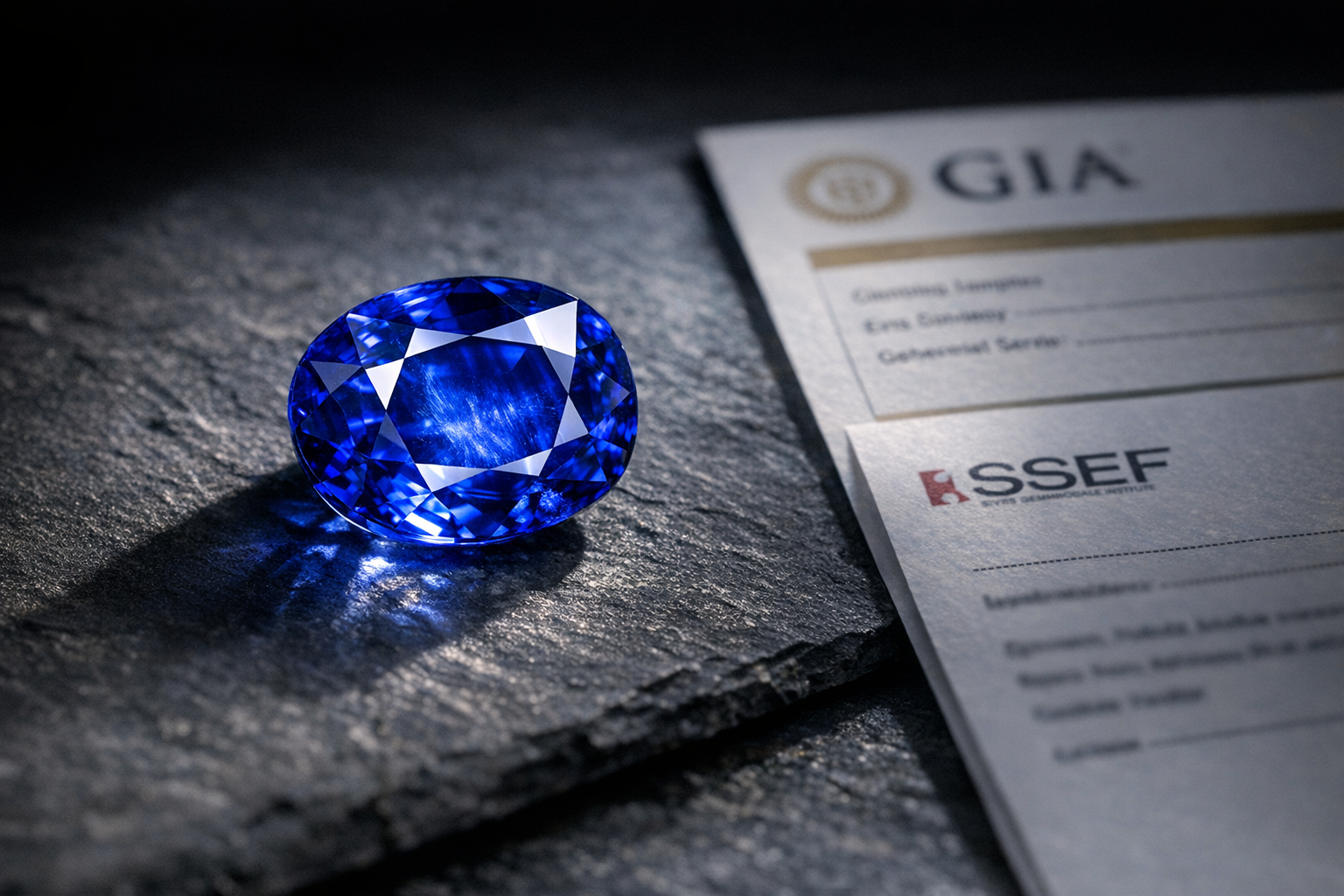 A genuine unheated Kashmir sapphire — the velvety blue holds across every light source
I've handled maybe thirty true Kashmir sapphires in thirty-five years. Thirty. That's the entire reality of this market — not the hundreds of stones you'll see labeled "Kashmir-type" or "Kashmir-like" on auction previews and dealer trays. Real ones. Stones with SSEF or Gübelin paper calling them Kashmir, unheated, no clarity treatment.
The premium isn't marketing. The Kashmir deposit in the Padar valley was mined out by roughly 1887. There's been sporadic activity since — a few stones trickling out in the 1930s, occasional finds attributed to old colluvial workings — but anything reaching the market today was either pulled out of the ground 140 years ago or pried out of an Edwardian brooch your grandmother's friend inherited. That's the supply. It doesn't grow.
So when a 5-carat unheated Kashmir crosses $200,000 per carat at Christie's Geneva and a comparable Ceylon stone of the same color sells for $40,000 to $60,000 per carat, you're not paying for prettier blue. You're paying for the fact that no more are coming.
What Is "Kashmir Blue" in Sapphires?
Every dealer says velvety. Most have never seen the stone they're describing. The actual optical phenomenon is a soft scattering effect from microscopic exsolved rutile and ilmenite needles — too fine to see as silk under a loupe, but dense enough to diffuse light through the body of the stone. The result is a blue that holds its color in candlelight, in office fluorescents, in daylight, in jewelry-store halogens. It doesn't flash. It doesn't go inky. It glows.
Ceylon at its best — and I mean the top 2% of Ceylon, the cornflower stones from Ratnapura — can come close in daylight. Put it under tungsten and it shifts. Goes greyer, sometimes purplish. The Kashmir doesn't shift. That's the tell, and it's the part labs are actually evaluating when they assign origin.
Why Does "Unheated" Matter for Kashmir Sapphires?
Market data indicates approximately 95% of all blue sapphires are heat-treated at 1,600–1,800°C. Standard practice since the 1970s — you take a milky or overly dark Ceylon, run it through a kiln for a day or two, and the silk dissolves into the corundum lattice. Color saturates, clarity opens up. Stone is more saleable. Nothing wrong with it as long as it's disclosed.
But heat destroys the very silk that gives Kashmir its character. A heated Kashmir isn't a Kashmir anymore — it's a corundum that was once from Kashmir. The trade values it accordingly. AGL and SSEF will note "no indications of heat" or "H" with enhancement codes; that single line on the report is worth roughly 60–70% of the stone's price.
I sold a 4.18-carat unheated Kashmir in 2023 for $187,000 per carat. The same stone, if it had been heated, would have brought maybe $35,000 per carat. Same crystal. One word on a piece of paper.
How Are Kashmir Sapphires Faked?
There are three categories of fraud I see regularly:
- Heated stones sold as unheated. The most common. I won't transact a Kashmir without current SSEF, AGL, or Gübelin paper — not GIA, which is fine for diamonds but is the third or fourth choice for colored stone origin. Older reports get tampered with. I've seen Photoshopped scans, reports issued for a different stone, reports where the carat weight was altered. Always verify directly with the lab using the report number.
- Ceylon or Madagascar stones misattributed as Kashmir. Origin determination is probabilistic, not absolute. A top-color Ceylon with the right trace element fingerprint can be miscalled by less rigorous labs. SSEF and Gübelin run laser ablation ICP-MS and compare against reference databases going back decades. Smaller labs guess. If your stone has paper from a lab you haven't heard of, treat the origin call as a suggestion.
- Synthetics in old mountings. Flame-fusion synthetic sapphires have been around since 1902. I've seen "estate Kashmir" rings from supposedly reputable estate sources where the center stone was a Verneuil synthetic the previous owner had set in 1955 to replace a stone she'd sold off. The mounting was period. The stone wasn't. Test every center stone, regardless of provenance story.
What to Actually Do Before Buying a Kashmir Sapphire
If you're buying a Kashmir north of $50,000, you do three things before wiring money:
- Get the stone unmounted and re-tested at SSEF or Gübelin on your dime. A current report costs around $800. Sellers who refuse this are telling you something.
- Look at the stone in three light sources yourself — daylight, incandescent, LED. The color should hold. If it shifts noticeably, you don't have what you're paying for, regardless of the paper.
- Check comparables at the last three Christie's and Sotheby's Magnificent Jewels sales. Per-carat prices for certified unheated Kashmir in the 3-7 carat range have been running $150,000 to $250,000 since 2022. If someone's offering you a "Kashmir" at $40,000 per carat, the question isn't whether you're getting a deal. The question is what you're actually buying.
The real ones aren't cheap. They've never been cheap. And there's no version of this market where they get cheaper.
Frequently Asked Questions
How much does a 1-carat unheated Kashmir sapphire cost? A certified unheated Kashmir sapphire in the 1-carat range with SSEF or Gübelin origin paper typically starts at $80,000–$120,000 per carat depending on color saturation and clarity. Stones with exceptional "no heat" certification and top cornflower blue color regularly exceed $150,000 per carat at Christie's and Sotheby's Geneva sales.
How can you tell if a Kashmir sapphire is real? The only reliable way is a current laboratory report from SSEF, Gübelin, or AGL — the three labs that use laser ablation ICP-MS to compare trace element fingerprints against Kashmir reference databases. Visually, genuine Kashmir holds its velvety blue color under tungsten and incandescent light without shifting gray or purple. Any stone worth more than $50,000 should be re-tested at your expense before purchase.
Do Kashmir sapphires change color in artificial light? No — and that stability is one of the defining characteristics. Top Kashmir holds its blue across daylight, LED, halogen, and incandescent. Ceylon sapphires, even high-quality cornflower examples, typically shift toward gray or purple under warm artificial light. If a stone labeled Kashmir shifts noticeably under tungsten, treat the origin attribution with skepticism.
Written by Lawrence Paul
Lawrence Paul is a fine jewelry dealer based in New York's Diamond District with over 20 years of experience buying and selling signed vintage and estate jewelry. He is President of Spectra Fine Jewelry at 44 West 47th Street, Suite GF1, New York, NY 10036.
Continue Reading
Get the Collector's Newsletter
Join collectors who get authentication tips, market insights, and new guide alerts. No spam, just practical knowledge.
Need Help?
Send photos of a piece you're evaluating. We'll give you a straight read—no pressure, no BS.
Contact Spectra Fine Jewelry →Ready to Browse Authenticated Pieces?
Every item at Spectra Fine Jewelry goes through our verification process before it hits the case. No guesswork. No surprises.