Hermès Jewelry Authentication Guide
Beyond Birkins: what collectors need to know about the leather house's jewelry.
Hermès Jewelry Authentication Guide
When the Saddle Maker Turned Jeweler
Hermès jewelry occupies a peculiar space in the luxury market. This is a house that made its name in leather and silk, where bags command six-figure prices and scarves are heirlooms. Their jewelry often gets overlooked by serious collectors—which means there are both opportunities and pitfalls in this space.
Here's what you actually need to know about authenticating Hermès jewelry.
Hermès History: The Leather House Goes Gold
1837: Thierry Hermès opens a harness workshop in Paris, serving European nobility.
Early 1900s: Expands into leather goods as horse-drawn transportation declines.
1938: First silk scarf—another future icon.
1951: Robert Dumas designs the Anchor Chain link (Chaîne d'Ancre), inspired by ship anchor chains. This becomes their jewelry DNA.
1960s-70s: Jewelry line expands, often incorporating equestrian motifs.
Today: Jewelry is a growing but still secondary category. The house's leather reputation overshadows everything.
Why Hermès Jewelry Is Different
Unlike Cartier or Van Cleef, Hermès didn't start as a jeweler. They bring a leather-goods sensibility to everything:
Hardware-influenced design: Their jewelry often looks like refined versions of belt buckles and bag clasps. This isn't coincidence.
Enamel expertise: The bangle work—especially the cloisonné enamel—is where Hermès really shines.
Brand motifs dominate: H logos, chains, equestrian themes. The design language is consistent across all categories.
Price positioning: Often more accessible than comparable pieces from pure jewelry houses.
This heritage affects authentication. You're not looking for the same tells as you would with traditional jewelers.
Iconic Hermès Jewelry Collections
Chaîne d'Ancre (Anchor Chain)
Origin: Designed by Robert Dumas, 1938—yes, the same as the scarves Design: Interlocking oval links resembling anchor chain
What to look for:
- Link proportions consistent throughout
- High-polish finish on each link
- Substantial weight (solid gold versions are heavy)
- Clean solder work where links connect
- "HERMÈS" stamp on clasp or link
The Chaîne d'Ancre test: The links should move smoothly but with precision—not floppy, not stiff.
Price range (secondary market):
- Silver bracelet: $400-$1,200
- Gold bracelet (18k): $4,000-$15,000
- Necklace: Higher depending on length
Collier de Chien (Dog Collar)
Origin: Based on actual dog collars from Hermès's equestrian heritage Design: Wide band with pyramid studs (médor) and buckle closure
What to look for:
- Leather quality (if leather version)
- Stud placement precisely symmetrical
- Hardware weight and quality
- Buckle mechanism functions smoothly
- Proper stamps on hardware
Materials:
- Leather with gold/silver hardware
- Full gold versions (rare, expensive)
- Swift, Box, or Barenia leather varieties
Price range:
- Leather with hardware: $800-$2,500
- All-gold versions: $8,000-$40,000+
Kelly Motifs
Named after: Grace Kelly (same as the bag) Design: Lock/closure motif translated to jewelry
Key authentication points:
- Lock mechanism on pendants should click
- Cadenas (padlock) shape precise
- "H" opening is proportionally correct
- Weight appropriate for size
Variations:
- Kelly Clochette (bell pendant)
- Kelly pendant
- Kelly bracelet
Clic H / Clic Clac
Design: The H-shaped hinged bracelet, often with enamel
What to look for:
- Hinge mechanism smooth
- Enamel flawless (no bubbles, chips, color inconsistency)
- H-clasp proportions correct
- "HERMÈS PARIS" stamp inside
- Enamel color matching known Hermès palettes
Red flag: Enamel colors that don't exist in Hermès's catalog are immediate suspects.
Price range:
- Narrow enamel: $500-$800
- Wide enamel: $600-$900
- PM sizes higher
- Rose gold hardware versions: Premium
Enamel Bangles (Printed/Cloisonné)
Heritage: True Hermès enamel craftsmanship
Cloisonné quality:
- Wire work creates raised design
- Enamel sits within wire boundaries
- Colors vibrant, consistent
- No gaps or fill issues
Printed enamel:
- Design applied, then fired
- Should be under glaze (not sitting on top)
- No wearing or flaking
Width designations:
- 70mm (extra wide)
- 65mm (wide)
- 62mm (medium)
- 60mm (narrow)
Where to Find Hermès Marks
Bangles:
- Interior surface, usually near opening
- "HERMÈS" or "HERMÈS PARIS"
- Sometimes "MADE IN FRANCE"
Chains/Bracelets:
- Clasp area
- Ring attached near clasp
- Sometimes on a link
Hardware pieces (Collier de Chien, etc.):
- On the buckle
- On major hardware components
- Stamped into metal
Pendants:
- Back of pendant
- Bail
- Inside hollow pieces
The Hermès Stamp
Standard formats:
- "HERMÈS" — simple
- "HERMÈS PARIS" — with location
- "HERMÈS PARIS MADE IN FRANCE" — full
Metal marks:
- 750 (18k gold)
- 925 (sterling)
- "GF" or "PL" (gold-filled or plaqué)
Quality matters: Hermès engravings are clean and precise. Fuzzy, uneven, or poorly placed stamps are red flags.
French Hallmarks on Hermès
Pieces made in France may carry:
Eagle head — 18k gold Owl — Import mark Crab — Small gold items Shell — Silver
Not all Hermès jewelry has French hallmarks—depends on where made and for which market. But their presence supports authenticity.
Hermès Enamel: What to Examine
Enamel pieces are Hermès's jewelry crown jewel. Authentication focuses here:
Surface quality:
- Should be glass-smooth
- No surface bubbles
- No chips or cracks
- Even gloss
Color authenticity:
- Hermès uses specific enamel colors
- Compare to known authentic examples
- Unusual colors warrant skepticism
Edge treatment:
- Clean transition metal to enamel
- No exposed base metal
- Professional finishing
Wear patterns (vintage):
- Natural wear on edges
- Not painted-on distressing
Red Flags for Hermès Jewelry
Enamel problems:
- Bubbles or pits in enamel surface
- Colors not in Hermès palette
- Painted rather than fired enamel
- Chips revealing base material
Hardware issues:
- Lightweight feel
- Poor plating (wearing through)
- Mechanisms don't work smoothly
- Hardware shape slightly off
Stamp problems:
- Fuzzy or uneven engraving
- Wrong format
- Missing where expected
- Added later (different patina)
Design inaccuracies:
- Chaîne d'Ancre links wrong proportion
- H-shape on Clic bracelets off
- Colors that Hermès doesn't make
The Hermès vs. "Hermès-Style" Problem
Many pieces imitate Hermès motifs without claiming to be Hermès:
Unsigned H-bracelets: If it doesn't say Hermès, it isn't. No matter how similar.
Chain styles: Anchor chain design isn't exclusive to Hermès. Only signed pieces are Hermès.
Look-alikes: There's a massive market in Hermès-style bangles and chains. Legal, just not Hermès.
The distinction matters: A "$50 Hermès bracelet" on eBay isn't Hermès. Period.
Common Authentication Mistakes
Mistake 1: Assuming leather goods expertise translates
Authentication for Hermès bags ≠ jewelry authentication. Different materials, different fakes, different tells.
Mistake 2: Trusting the box
Orange boxes are everywhere. Authenticate the piece, not the packaging.
Mistake 3: Ignoring enamel quality
Real Hermès enamel is exceptional. Obvious flaws are disqualifying.
Mistake 4: Expecting jewelry house hallmarks
Hermès isn't Cartier. Their marking conventions differ.
Hermès Pricing Reality
Secondary market (authenticated):
| Piece | Typical Range |
|---|---|
| Enamel bangle (narrow) | $400-$700 |
| Enamel bangle (wide) | $500-$900 |
| Clic H bracelet | $500-$900 |
| Chaîne d'Ancre bracelet (silver) | $400-$1,200 |
| Chaîne d'Ancre bracelet (gold) | $4,000-$15,000 |
| Collier de Chien (leather) | $600-$1,500 |
| Kelly pendant | $1,500-$4,000 |
| High jewelry | $10,000-$500,000+ |
Reality check: Hermès jewelry rarely appreciates like their bags. Don't buy expecting investment returns.
Hermès vs. Traditional Jewelry Houses
What's different:
- Hermès pieces often reference functional objects (buckles, chains)
- Less emphasis on precious stones
- Enamel is a major focus
- Price points often lower than comparable designer jewelry
- Brand recognition from leather goods, not jewelry
What's similar:
- High craftsmanship standards
- Consistent brand signatures
- French hallmarks on appropriate pieces
- Strong secondary market for authenticated pieces
What Collectors Should Know
The opportunity: Hermès jewelry is sometimes undervalued because collectors focus on bags. Good pieces can be found.
The risk: Fakes are common, especially for accessible items like enamel bangles.
The strategy:
- Focus on execution quality, not just the H-stamp
- Enamel condition is paramount
- Hardware pieces benefit from leather expertise—examine the leather too
- Verify against known authentic examples
Frequently Asked Questions
Will Hermès authenticate jewelry? Sometimes, at boutiques. Policies vary by location and piece type. They may verify for repair purposes.
Are Hermès jewelry fakes common? Yes, especially enamel bangles and Clic H bracelets. These are highly counterfeited.
Is vintage Hermès jewelry valuable? Some pieces, especially rare enamel patterns or early Chaîne d'Ancre, command premiums. But generally less appreciation than bags.
Can I send photos for authentication? Photos can identify obvious fakes but can't verify enamel quality, weight, or mechanism function.
What about Hermès watches? Different category. Watch authentication requires horological expertise in addition to brand knowledge.
Examples from Our Collection
These authenticated Hermès pieces from Spectra Fine Jewelry showcase the French house's distinctive designs—from rare fine jewelry to their famous enamel work:
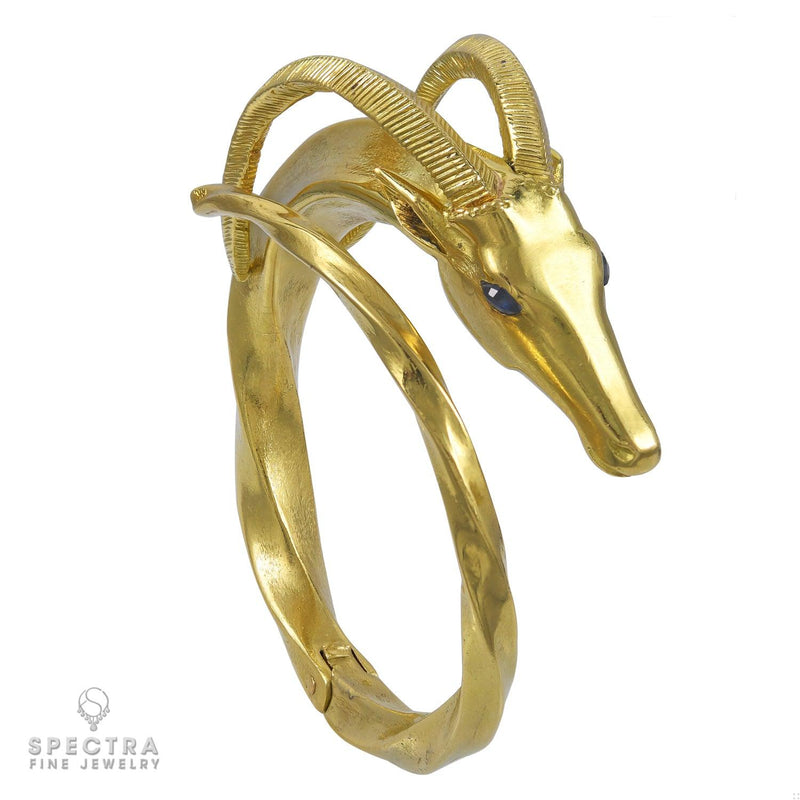 Hermès Vintage 18K Gold Capricorn Bangle with Sapphire Eyes. A rare zodiac-themed piece from Hermès' fine jewelry collection. Note the sculptural capricorn head, cabochon sapphire eyes, substantial 18K gold construction, and proper HERMÈS PARIS signature with French hallmarks. Vintage Hermès jewelry like this is increasingly sought by collectors.
 Hermès Chaîne d'Ancre (Anchor Chain) Bracelet in 18K Yellow Gold. The design that launched Hermès jewelry in 1938. Authentication points: substantial link weight, smooth interlocking action, high-polish finish on each oval link, clean solder work at connections, and proper "HERMÈS" stamp with French hallmarks on clasp. The links should move fluidly—neither floppy nor stiff.
 Hermès Clic H Bracelet in Palladium Hardware with Orange Enamel. The iconic hinged H-bracelet—one of Hermès' most popular (and most counterfeited) designs. What authenticates it: glass-smooth enamel surface with no bubbles or pits, correct H-clasp proportions, smooth hinge mechanism, "HERMÈS PARIS MADE IN FRANCE" stamp inside, and enamel color matching known Hermès palettes.
Images courtesy of Spectra Fine Jewelry. Hermès inventory varies—contact for current availability.
Looking for Authenticated Hermès?
We carry verified Hermès jewelry pieces when available. Our inventory changes regularly.
Have a Question About Your Piece? →
Related Reading
Independent educational resource. Not affiliated with Hermès.
Frequently Asked Questions About Hermès Jewelry
More on Hermès
Get the Collector's Newsletter
Join collectors who get authentication tips, market insights, and new guide alerts. No spam, just practical knowledge.
Need Help?
Send photos of a piece you're evaluating. We'll give you a straight read—no pressure, no BS.
Contact Spectra Fine Jewelry →Ready to Browse Authenticated Pieces?
Every item at Spectra Fine Jewelry goes through our verification process before it hits the case. No guesswork. No surprises.